
Extensive AMS analysis of Q1 2026 fireball surge raises questions about the near-Earth meteoroid environment
Large fireballs became significantly more frequent in early 2026, according to a new American Meteor Society analysis of fireball reports dating back to 2011. While total Q1 event counts remained close to recent years, the number of events seen by 50 or more witnesses more than doubled, pointing to a shift in the character of incoming meteoroids rather than a broad rise in activity.
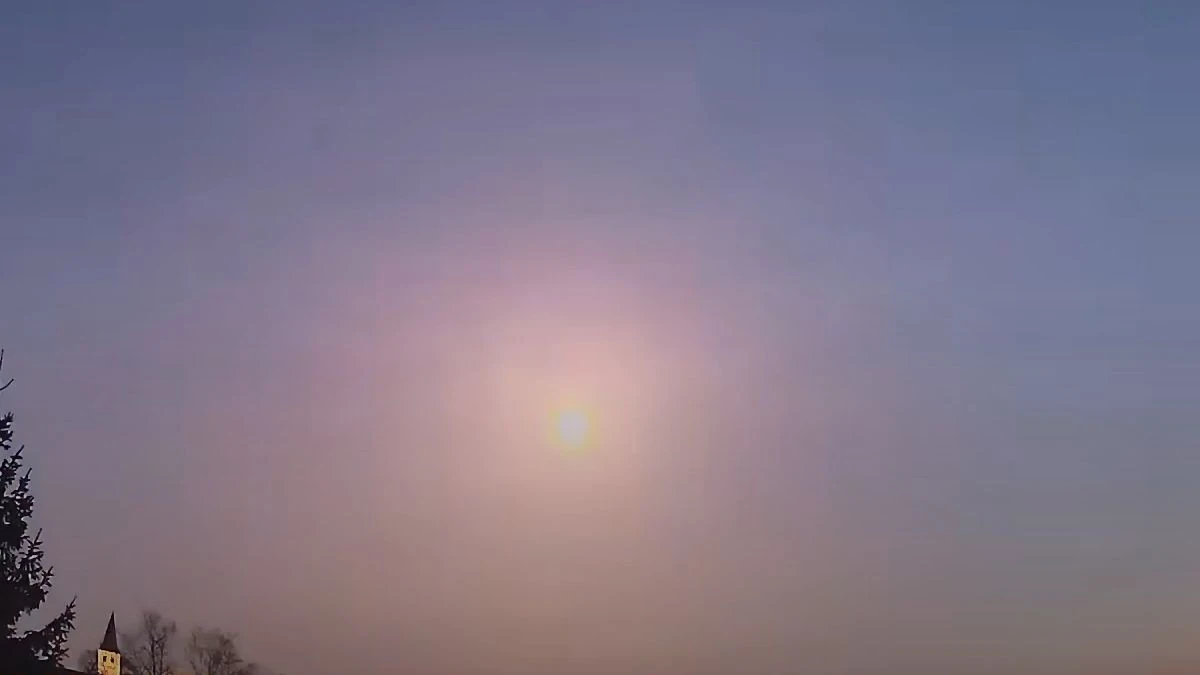
All-sky camera capture of the fireball observed over western Germany at 17:55 UTC on March 8, 2026, which produced meteorites recovered near Koblenz. Credit: AllSky7/Bernd Klemt
A measurable increase in large fireball events was recorded during the first quarter of 2026, and the strongest evidence for that shift comes from a new analysis by the American Meteor Society (AMS), which reviewed its fireball database back to 2011 and focused on Q1 patterns during the mature reporting era of 2021–2026.
Their main finding is not that Earth was struck by dramatically more meteoroids overall, but that a larger share of the objects entering the atmosphere were big enough, slow enough, or energetic enough to produce unusually bright and widely observed fireballs.
Total Q1 fireball counts in 2026 were elevated but not radically out of line with recent years. The database shows 2 046 events through March 24, compared to 2 037 in 2022 and 1 947 in 2021.
On its own, that increase is not strong enough to support claims of a major jump in overall incoming material. The more important signal appears only when events are separated by witness-count thresholds, which AMS uses as a practical indicator of event prominence and, indirectly, of the physical scale of the incoming objects.
At the 25+ report level, Q1 2026 produced 61 events, compared with a 2021–2025 average of roughly 43. At the 50+ report level, the count rose to 38, compared with an average near 18, while at the 100+ level, 2026 reached 14 events — double the recent average of about 7.
In other words, the anomaly strengthens as the witness threshold rises, making it the most important point in the entire analysis. If the change was mainly due to more people filing reports, the increase would be expected to appear more evenly across the distribution.
Instead, the strongest signal is concentrated at the top end, where the brightest and most widely seen events are found, and the month of March is when that pattern became most pronounced.
According to the AMS analysis, the lower layer of activity remained broadly stable. Events drawing 10–24 reports did not show a major surge, but what changed was the upper part of the distribution.
A larger share of March events crossed into the 50+, 100+, and even 200+ witness ranges, showing that events that might in another year have remained moderate in visibility instead became major public sightings.
March 2026 produced five events exceeding 200 reports, more than all previous Marches combined since 2011. The average witness count per event climbed to 142.7, nearly three times the previous March high of 49.4 in 2021.
Even after removing the most extreme outlier, the March 8 European event with 3 229 reports, the remaining March events still averaged roughly 67 reports each, which remained well above the historical norm. This is better described as an upward shift in the distribution than a simple broadening of activity.
The analysis becomes stronger when physical characteristics are considered alongside witness counts. 30 of the 38 events with 50 or more reports in Q1 2026 were associated with sonic booms, a rate of 79%. That is historically high, but the more important feature is the combination of both a high percentage and a high absolute count.
Previous years had sometimes shown elevated sonic-boom percentages, but with fewer large events overall. In 2026, both metrics rose together.
Thirty large fireballs producing delayed sound in a single quarter amounts to about one every three days. That is difficult to explain through visibility or publicity alone, because sonic booms require objects to penetrate deeply enough into the atmosphere to generate pressure waves detectable at the ground.
When it comes to the duration data point, it goes in the same direction. AMS reported 1 693 individual witness reports describing fireballs lasting 4 seconds or longer during Q1 2026, more than 2.5 times the previous high of 651 recorded in 2021.
Long-duration fireballs generally reflect slower atmospheric entries, longer luminous paths, or both. Combined with the sonic-boom data, this suggests that the quarter did not merely produce more reports, but more physically substantial atmospheric entries.
Several events in March are perfect examples of the scale of what the analysis identified statistically. On March 8, a daytime bolide over western Europe generated 3 229 reports across multiple countries and produced delayed sound reports from 174 witnesses. Recovered specimens were suspected of being diogenites, a rare achondritic meteorite type linked to differentiated asteroids in the Vesta family.
On March 17, a daytime event over Ohio and Pennsylvania involved an object estimated at about 2 m (6.5 feet) in diameter and about 7 tons in mass, with an energy release of roughly 250 tons of TNT. Meteorites recovered from that event were identified as eucrites.
On March 21, a meteoroid of about 1 ton broke apart over the Houston metropolitan area, producing an airburst of about 26 tons of TNT, sonic booms, and at least one meteorite fragment that penetrated the roof of a home in Ponderosa Forest. On March 23, two separate California events generated 306 and 122 reports. On March 24, another bright fireball over the Midwest and Ontario drew 111 reports.
When we take a look at those events together, they gave March 2026 an unusually dense sequence of major fireballs rather than one isolated outlier.
The analysis was then extended beyond event counts and witness totals to radiant structure, which is where the story became more scientifically interesting.
When fireballs come from a common source population, their radiants, the apparent points in the sky from which they arrive, tend to cluster. AMS computed radiants for trajectory-resolved events and compared Q1 2026 with the 2021–2025 baseline.
The strongest enhancement appeared in the Anthelion source, the sporadic radiant region located roughly opposite the Sun. During Q1, this is a well-known source of bright fireballs, but AMS found that activity there was unusually strong in 2026. Twelve events fell within the tighter Anthelion zone defined in the analysis, compared with only 1 to 6 in prior years.
In the broader Anthelion region, 2026 logged 26 events, above the 12–20 range seen from 2021 to 2025.
This finding matters because Anthelion meteoroids are generally associated with asteroidal material on Earth-like orbits. Since they move in roughly the same direction as Earth, the relative encounter speed is lower than for many other sporadic sources. Lower entry speeds favor longer luminous durations, broader visibility footprints, more frequent sonic booms, and greater meteorite survival.
That combination fits the character of many of the major Q1 2026 events. In that sense, the radiant analysis does not just show where the fireballs came from — it also provides a physically plausible framework for why so many of them were widely seen and, in some cases, survived to the ground.
A second cluster appears in high-declination radiants above +70°, which AMS describes as an unusual enhancement requiring further study. Eleven such events were identified in 2026, compared with a previous maximum of 5 in 2021.
This group includes some of the quarter’s most notable events, including the Ohio eucrite fall and one of the California fireballs. High-declination radiants correspond to meteoroids on steeply inclined orbits relative to the ecliptic, so an increase in that population is harder to fold into the usual seasonal fireball discussion. The society treats this as one of the more intriguing unresolved features of the quarter.
One of the strongest parts of the analysis is the effort to separate what can already be excluded from what remains uncertain. AMS, as a mature reporting platform, weakens the idea that the signal is simply a late-stage growth effect of the database. A new meteor shower is also not supported, because the radiant structure remains tied to known sporadic sources rather than to a new compact radiant.
Interestingly, the familiar late-winter or early-spring increase in bright fireballs, often described as the February fireball effect and usually framed in the range of about 10% to 30%, is also not enough on its own to explain the Q1 2026 pattern.
The signal in 2026 is stronger, most pronounced in March rather than February, and concentrated disproportionately in the largest events.
AMS explicitly notes that one modern factor cannot yet be quantified: AI-assisted reporting. A witness who sees a bright meteor today may ask an AI assistant where to report it and be directed to the AMS reporting system. In principle, that could increase witness counts per event without increasing the actual number of fireballs.
The society treats that as a plausible partial factor, and it is a reasonable caveat, especially because the anomaly is strongest in report-count metrics. At the same time, their analysis argues that AI-assisted reporting cannot explain the full pattern, because it does not account for the simultaneous increase in sonic booms, long-duration sightings, and confirmed meteorite falls.
The analysis does not present Q1 2026 as evidence of an impact threat. The meteoroids involved remain part of the normal near-Earth environment, ranging from small fragments to meter-scale bodies, and the associated hazards remain localized.
The quarter did, however, show an increased frequency of events capable of producing audible booms, widespread public sightings, meteorite recovery, and, in one case, a direct strike on a residential structure. That does not amount to a system-level hazard, but it does represent a meaningful change in the character of observed fireball activity.
The most important unanswered question is whether Q1 2026 reflects an actual short-term change in the near-Earth meteoroid environment or whether it represents an unusually strong statistical fluctuation amplified by modern reporting dynamics.
AMS does not claim to have resolved that question. Instead, it argues that the current evidence supports a real enhancement at the large-object end of the sporadic fireball distribution, with radiant structure consistent with stronger-than-usual activity from known source regions.
AMS also notes that the witness-derived radiants used in the analysis carry uncertainties of about 10–20°, and that instrumental confirmation from all-sky camera networks would significantly improve the precision of orbital interpretation.
The data support the conclusion that something changed in Q1 2026, at least in the upper end of the observed fireball population, but it doesn’t yet support a definitive explanation for why it changed.
References:
1 Has Something Changed in the Near-Earth Meteoroid Environment? – AMS – March 25, 2026

I'm a dedicated researcher, journalist, and editor at The Watchers. With over 20 years of experience in the media industry, I specialize in hard science news, focusing on extreme weather, seismic and volcanic activity, space weather, and astronomy, including near-Earth objects and planetary defense strategies. You can reach me at teo /at/ watchers.news.

I would love for more follow up to this as the year progresses and more fireballs are recorded!
Dear Teo, you write in this article that 1 fragment penetrated a house in Houston but the meteorite in Europe, 8th of March 2026, did penetrate a house in Germany.
From Google: Impact in Germany: Fragments of the meteorites struck buildings in the Koblenz-Güls area (Rhineland-Palatinate), with reports of a piece breaking through a roof and leaving a hole about the size of a football.
Greetings,
Ab Martins,
The Netherlands.