
Crocodilian fossil from the Sphinx’s rock formation reveals a different evolutionary history
A crocodilian fossil collected in Egypt nearly a century ago has been assigned to a new genus after researchers found that it was not closely related to the living false gharial, as its original classification had implied. The reclassification identifies a separate branch of long-snouted crocodilians that inhabited the ancient Mediterranean about 45 million years ago, adding evidence of a more diverse prehistoric ecosystem.
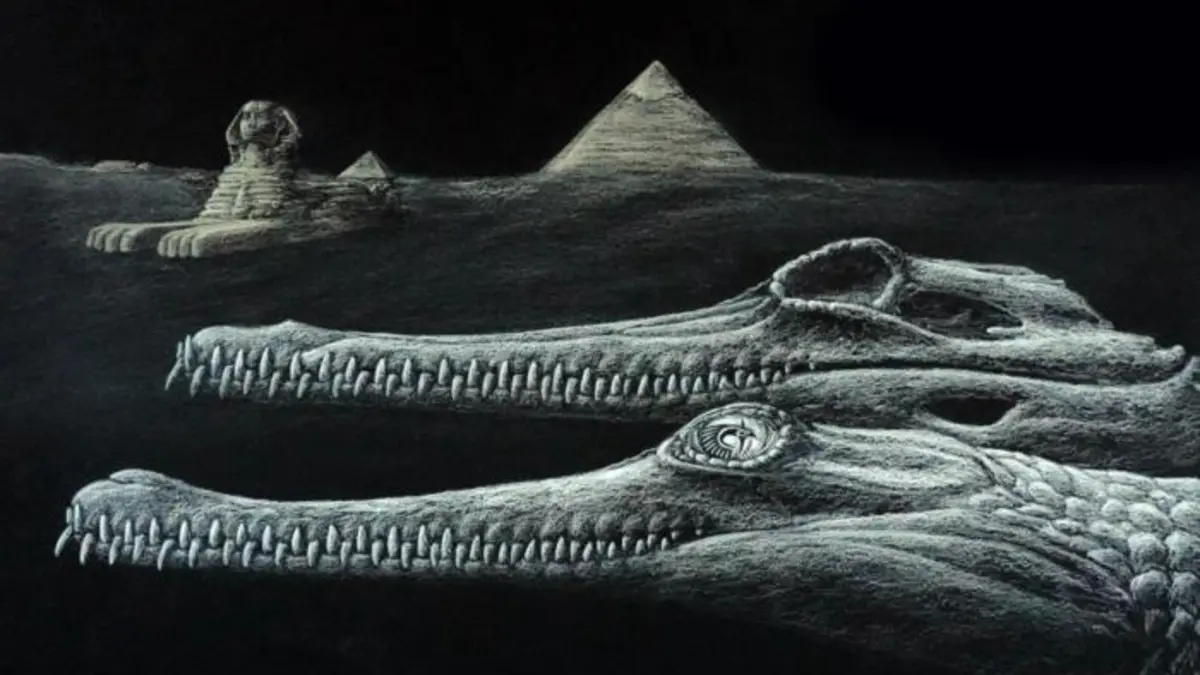
Reconstruction of the extinct Herugavialis cairensis with the Great Sphinx and pyramids depicted in the background. Credit: Karim Zanaty
The fossil was recovered from Gebel Mokattam, east of Cairo, during the 1920s and described by Lorenz Müller in 1927 as Tomistoma cairense. Müller placed it in Tomistoma, the genus that includes the living false gharial, because of similarities in its skull. Later studies questioned that classification, but the fossil’s exact evolutionary position remained uncertain.
A study published in Royal Society Open Science on October 7, establishes the new genus Herugavialis, giving the previously described species the name Herugavialis cairensis.
The finding changes how scientists interpret crocodilian diversity in ancient Egypt. Rather than belonging to the same close evolutionary group as the living false gharial, the fossil represents a separate, relatively early branch of gavials (a group of long-snouted crocodilians).
The research also provides a clearer basis for examining how Mediterranean crocodilian diversity changed alongside major shifts in climate and sea level.
Burke et al. (2026) reached this conclusion after re-examining the relatively complete fossil skull and several additional specimens. The researchers compared their external and internal anatomy with that of other extinct and living crocodilians, identifying differences that supported placing the Egyptian species in its own genus.

The fossil came from the Mokattam Formation, a marine limestone deposit dating to the Middle Eocene. The Great Sphinx of Giza was carved from the same geological formation, although the crocodilian remains were collected at Gebel Mokattam rather than from the monument itself.
The geological connection influenced the new genus name. Heru refers to the Egyptian god also known as Horus, whom the researchers describe as being associated with, and possibly an inspiration for, the Great Sphinx.
The fossil skull is also missing the front of its snout, a coincidence with the Sphinx’s missing nose. The ending -gavialis refers to the animal’s relationship with gavials.
One of the clearest anatomical differences concerns the eyes. Herugavialis has strongly raised bony margins around its eye sockets, a condition described as “telescoped” orbits. In physical terms, the bones forming the upper edges of the eye openings rise above the surrounding skull surface. Their shape helps distinguish the animal from other known gavialoids.
The researchers also identified differences in bones at the back and roof of the skull, along with a distinctive feature inside the braincase. Computed tomography (CT) allowed them to examine the skull without cutting into the fossil, producing digital reconstructions of internal cavities that once contained the brain and associated tissues.
The reconstructed brain cavity, known as an encephalic endocast, contains a blunt projection that was not observed in the other gavialoids examined. Together with the external skull differences, the internal features provided additional anatomical evidence for separating Herugavialis from previously recognized genera.
To test its evolutionary relationships, the research team used a dataset covering 331 anatomical characters across 152 taxonomic units. The characters represent features of the skull and skeleton used to compare different crocodilian groups. Two analytical approaches that assigned different weights to those characters produced broadly similar evolutionary placements.
Both analyses recovered Herugavialis as a relatively early-diverging gavialine, separated from the living false gharial, Tomistoma schlegelii. The results also did not place it in a close group with other African or Mediterranean gavialoids.
The distinction matters because many extinct long-snouted crocodilians from Europe and Africa were historically assigned to Tomistoma. Similar skull shapes do not necessarily establish close evolutionary relationships. Modern anatomical comparisons and evolutionary analyses have increasingly separated several fossil species from that genus.
Egypt’s Eocene fossil record contains two other recognized gavialoids, Paratomistoma courti and Eogavialis africanum. The new study compared their anatomy with that of Herugavialis and found numerous differences in skull structure. Their positions in the evolutionary analyses, together with their occurrence in different geological intervals, support the interpretation that they represent three distinct species from separate evolutionary branches.
Only two species of Gavialoidea survive today: the Indian gharial, Gavialis gangeticus, and the false gharial, Tomistoma schlegelii. Both occupy freshwater environments. The fossil record, however, contains more than 40 recognized gavialoid species and documents a much broader geographic distribution, including animals that occupied coastal and shallow-marine environments.
The Mediterranean region once supported several of those lineages. Burke et al. identified at least six gavialoid species in Paleogene deposits and at least six in Miocene deposits. During parts of that history, shallow marine environments extended across areas that are now dry land in northern Africa and southern Europe.
The fossil record also contains a major interval of reduced diversity. No Mediterranean gavialoid species are currently known from most or possibly all of the Oligocene, which followed the Eocene. The researchers examined whether global cooling and falling sea level during the Late Eocene and Oligocene reduced suitable coastal and shallow-marine habitat.
Under that interpretation, lower sea levels would have reduced the extent of shallow-water environments available to crocodilians adapted to coastal conditions, while cooler temperatures could have placed further limits on suitable habitat. The authors did not establish climate change as the sole cause of the apparent decline. Incomplete fossil sampling remains an alternative or contributing explanation.
Gavialoid diversity was high again in the Mediterranean during the Miocene. The researchers proposed that warmer temperatures and rising global sea level might have helped restore suitable habitats. Their evolutionary analysis, however, did not group the younger Miocene species as direct descendants of the older Mediterranean forms, leaving the origins of the later assemblages unresolved.
Mediterranean gavialoids and other crocodilians subsequently declined during the Late Miocene and disappeared from the region before the Pliocene. The researchers discussed the Messinian Salinity Crisis, a period of major changes in Mediterranean water levels and salinity near the end of the Miocene, as a possible factor in their regional disappearance.
The study does not establish that explanation as the single cause. Several fossil species historically assigned to Tomistoma also remain in need of detailed taxonomic revision. Re-examining those specimens will help determine how the different Mediterranean gavialoid lineages were related and whether the changes in their fossil diversity reflect environmental pressures, geographic dispersal, incomplete sampling or a combination of those factors.
References:
1 Burke, P. M. J., Spiekman, S. N. F., Salem, B. S., Saber, S., Sallam, H. M., & Mannion, P. D. (2026). Cranial anatomy of the Middle Eocene Egyptian crocodylian Herugavialis cairensis provides new insights into gavialoid diversity in the Mediterranean region. Royal Society Open Science, 13(10), 261173. https://doi.org/10.1098/rsos.261173
2 New crocodile species discovered in rocks used to build the Great Sphinx – UCL – October 7, 2026

I’m a science journalist and researcher at The Watchers, contributing to the Epicenter edition, where I cover peer-reviewed scientific research and emerging discoveries across Earth and space sciences. With a background in astronomy and a passion for environmental science, I’ve worked in shark and coral conservation in Fiji, conducting reef and shark-behavior research, contributing to mangrove restoration, and earning PADI Open Water and Coral Reef Certifications. I bring a blend of scientific rigor and storytelling to illuminate the discoveries shaping our planet and beyond.

Commenting rules and guidelines
We value the thoughts and opinions of our readers and welcome healthy discussions on our website. In order to maintain a respectful and positive community, we ask that all commenters follow these rules.