
Apollo rock rewrites Moon’s impact timeline
A new study published recently in Geophysical Research Letters finds that Apollo 17’s sample 76535, a 4.25 billion-year-old troctolite, may have been lifted to the surface during the formation of the Serenitatis Basin on the Moon’s nearside.

Apollo 17 astronaut Harrison Schmitt collects lunar samples with an adjustable sampling scoop during the 1972 moon mission. Recent research led by Lawrence Livermore National Laboratory planetary scientist Evan Bjonnes utilized advanced computer simulations to challenge and refine our understanding of the Moon’s early impacts and their broader implications for planetary science. Credit: NASA
More than fifty years after the Apollo 17 astronauts left the Moon, one small rock they brought back is rewriting what scientists thought they knew about the Moon’s violent past. The sample, known as 76535, weighs just 155 g (5.5 ounces), but it tells a story stretching back 4.25 billion years. That makes it one of the oldest tangible pieces of lunar crust ever studied, and a record of the impacts that shaped the early Solar System.
When it was first examined in 1973, 76535 looked like a contradiction. Its mineral structure showed it formed about 50 km (31 miles) underground, where temperatures reach 850°C (1562°F), yet the rock had none of the microscopic fractures or melted textures that normally appear when such deep material is blasted to the surface.
For decades, scientists assumed it must have been excavated by the enormous impact that formed the South Pole–Aitken Basin, the Moon’s largest crater. That would mean it traveled thousands of kilometers from the far side to the Apollo 17 landing site.
The problem was that no one could explain how a rock could cross half the Moon and survive two impacts without showing the intense shock features typical of lunar ejecta.
The new study, led by Lawrence Livermore National Laboratory (LLNL) planetary scientist Evan Bjonnes, proposes a simpler, local origin. Using advanced impact simulations, his team found that 76535 may have been lifted gently upward during the formation of the Serenitatis Basin, the very region where Apollo 17 landed.
If that interpretation is right, it means the Serenitatis impact occurred about 4.25 billion years ago, roughly 300 million years earlier than scientists thought. That change cascades across lunar and planetary chronology, forcing researchers to reconsider when the Solar System’s inner planets experienced their greatest bombardment.
“This rock may be small, but it carries a huge story about the Moon’s early history,” Bjonnes said. “It’s like a time capsule from 4.25 billion years ago.”
How a massive impact lifted deep rocks without breaking them
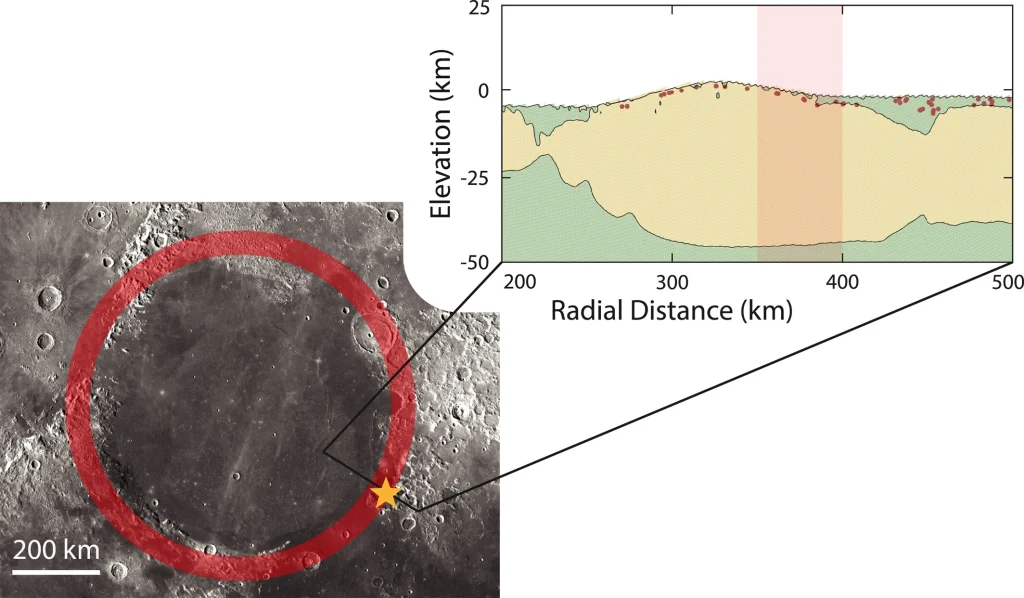
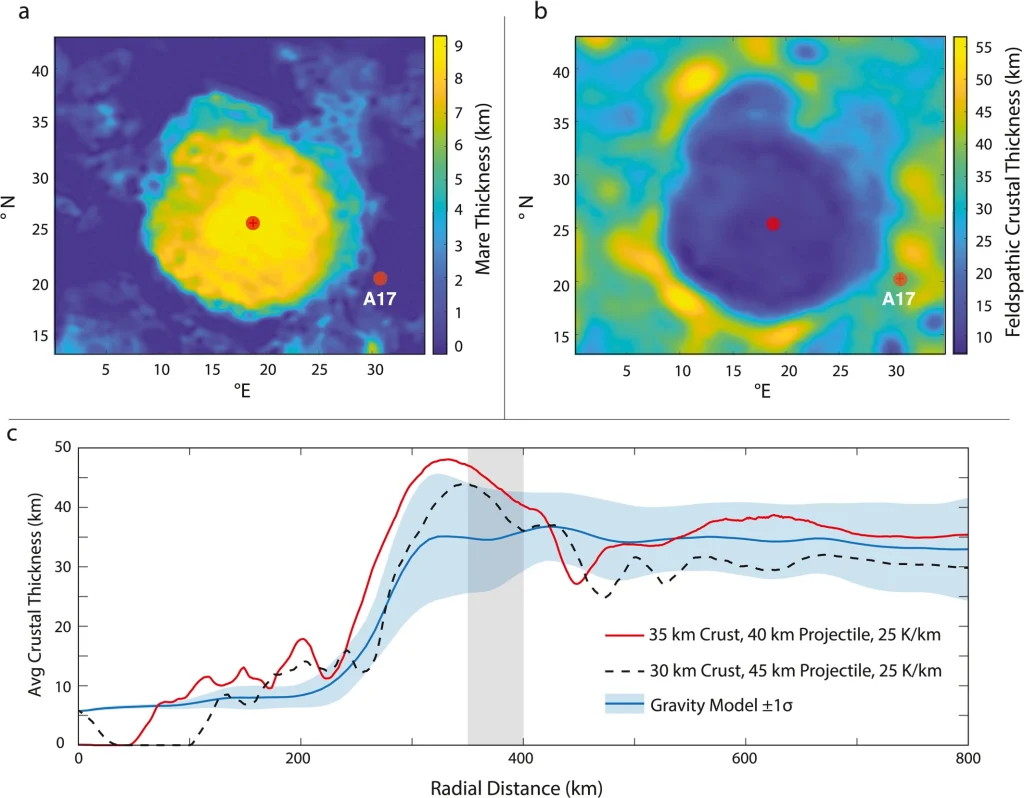
To test the new hypothesis, Bjonnes and his colleagues ran detailed computer simulations of basin-forming impacts using the iSALE-2D shock-physics code, a model capable of tracking both shock pressures and crustal flow in curved planetary targets. They focused on the Serenitatis Basin, a vast multiring structure 740–930 km (460–580 miles) across on the lunar nearside.
In parallel, the team reconstructed the pre-mare crustal thickness beneath Serenitatis using gravity inversion modeling based on NASA’s GRAIL data. By removing the basaltic layer that later flooded the basin, they recreated the Moon’s original crustal configuration at the time of impact.
Their simulations revealed that during the “collapse” stage of the crater’s formation, the period when the temporary cavity rebounds and settles, material originally buried between 45–65 km (28–40 miles) deep can move upward to within about 5 km (3 miles) of the surface. In this process, it experiences maximum shock pressures of about 6 GPa, gentle enough to preserve minerals in pristine condition.
Roughly 140 000 km³ (33 500 mi³) of such deep material, about 2% of near-surface ejecta, could be displaced during the event. This outcome fits the physical constraints of sample 76535, its mineralogy, shock history, and final position at the Apollo 17 site.
The team concluded that crater collapse, rather than the initial explosive excavation, likely carried the rock upward. “Big impacts can lift deep rocks to the surface without over-shocking them,” Bjonnes said. “The collapse process itself can be a slow, upward pull instead of a violent blast.”
Re-dating Serenitatis and what it means for lunar history
If 76535 was indeed exhumed during the Serenitatis impact, that event must have occurred about 4.25 billion years ago, according to the rock’s radiometric age. That pushes the formation of one of the Moon’s largest basins roughly 300 million years earlier than previous crater-count estimates near 3.9 Ga.
The difference may sound small, but in the early Solar System, a few hundred million years can mark the transition between planetary formation and geological stabilization. A 4.25 Ga Serenitatis means that the Moon’s heavy bombardment started earlier, and that the oldest basins, like South Pole–Aitken and Nectaris, are likely even older.
Some earlier studies using crater density already suggested Serenitatis could date to around 4.1–4.2 Ga, but without physical samples tied to those models, confidence remained low. By linking 76535 directly to the basin’s collapse process, the new study provides a concrete chronological marker. It also strengthens the idea that multiple lunar basins formed in rapid succession during the Moon’s first 300 million years.
This new timeline changes how scientists calibrate impact rates for Earth, Mars, and Mercury. Because Earth’s early crust has been recycled by plate tectonics, lunar surfaces act as the clock for inner Solar System impacts. Shifting that clock back by 300 million years reshapes our understanding of when the Earth cooled enough for oceans and continents to stabilize.
Rethinking the so-called Late Heavy Bombardment
The proposed new age for Serenitatis also adds weight to a growing scientific re-evaluation of the Late Heavy Bombardment hypothesis. For decades, planetary scientists have debated whether a sudden surge of asteroid impacts occurred between 3.5 and 4.1 billion years ago, or whether impacts simply declined steadily from the Solar System’s chaotic beginnings.
If Serenitatis formed 4.25 billion years ago, it supports the gradual-decline model. In that view, large impacts were already tailing off by the time the LHB was supposed to begin. This interpretation fits other recent findings, including new estimates that place the South Pole–Aitken Basin’s formation between 4.25 and 4.33 billion years ago.
The shift has major implications beyond the Moon. If the bombardment peaked earlier, then Earth’s surface may have stabilized sooner than thought, allowing oceans and primitive crust to persist without constant disruption from giant impacts. Mars, too, may have enjoyed a longer window of habitable conditions in its early history.
Still, scientists caution that the new age for Serenitatis, while compelling, is based on model interpretation. Future lunar sample returns and additional crater-dating studies will be needed to confirm whether the 4.25 Ga signal marks a true revision of the Moon’s chronology or an outlier from localized processes.
Apollo samples, new tools, and the next steps
Sample 76535 continues to illustrate the enduring scientific power of Apollo’s curated materials. Petrographic analysis shows it contains about 58% plagioclase, 37% olivine, and 4% orthopyroxene. These proportions indicate it crystallized deep in the crust at pressures of 220–250 MPa, equivalent to 48–58 km (30–36 miles) depth. Its slow cooling rate of about 4°C per million years confirms its deep origin, while the absence of high shock deformation implies a relatively calm journey to the surface.
More than fifty years later, modern modeling and new lunar datasets have allowed scientists to revisit these same samples and find fresh meaning in their chemistry and structure. The fact that one small troctolite continues to challenge planetary chronology shows how far computational tools have advanced since the Apollo era.
The implications extend to future missions as well. If crater collapse routinely lifts deep material upward, explorers in upcoming Artemis missions could look for “out-of-place” rocks along basin rims. Such material could provide direct windows into the Moon’s lower crust without the need for deep drilling.
According to Bjonnes, rocks like 76535 might not be rare. The trick is knowing where to look, and basin collapse zones are the right place. Future sample-return missions targeting these areas could refine the chronology of early lunar and planetary impacts even further.
Understanding planetary evolution
Reinterpreting Serenitatis at 4.25 billion years does more than update a date on a timeline. It changes how scientists visualize the early Solar System. If the Moon’s major basins formed earlier, Earth’s crust may have solidified under less violent bombardment than previously thought, offering a calmer environment for oceans and early life to emerge.
Such revisions also influence how researchers model the origin of planetary atmospheres and the delivery of water and organics. A more ancient and gradual impact record suggests volatiles were delivered over time instead of through one catastrophic spike in collisions.
By showing that large impacts can uplift deep crustal rocks without destroying them, this study adds a new mechanism to planetary geology. It shows that what happens after an impact can be as informative as the blast itself. And it reminds scientists that even after half a century, the Moon’s oldest samples still hold secrets waiting to be read.
References:
1 LLNL research rewrites a chapter of the Moon’s early history – LLNL – September 25, 2025
2 Evidence for an Early Formation of Serenitatis Basin at 4.25 Ga Shifts Lunar Chronology – Evan Bjonnes et al. – Geophysical Research Letters – September 18, 2025 – https://doi.org/10.1029/2025GL116654 – OPEN ACCESS

I’m a science journalist and researcher at The Watchers, contributing to the Epicenter edition, where I cover peer-reviewed scientific research and emerging discoveries across Earth and space sciences. With a background in astronomy and a passion for environmental science, I’ve worked in shark and coral conservation in Fiji, conducting reef and shark-behavior research, contributing to mangrove restoration, and earning PADI Open Water and Coral Reef Certifications. I bring a blend of scientific rigor and storytelling to illuminate the discoveries shaping our planet and beyond.

Macro photos of sample? Sample micrographs showing boundaries? Shock signatures on sample, shown? Isotopic analyses, e.g. to cross-reference origin/age data; a great age is suggested. Sample density? Comparative data? The obvious, foundational data on the sample seems to be entirely overlooked in this article here – in the papers? NASA, impeccable provenance. 850c a very comfortable industrial oven temperature historically for-sure. ‘Goodwill’, Willem Drees anyone? I would be far, far, far more interested in specimens pulled from and buried deep in our oceans, which truly speaks to ‘The Watchers’ and ‘those’ cycles. The obfuscation is on-point; well-done to LLNL and all involved!
Veritas nos liberabit.