
Suicide Basin GLOF sends Mendenhall River into flood stage as governor declares disaster, Alaska
Alaska issued a disaster declaration as an ongoing glacial lake outburst flood (GLOF) from Suicide Basin raised Mendenhall River into minor flood stage near Juneau. NWS expects the waterway to reach major flood stage on August 13, 2026, with a forecast crest of 4.91–5.06 m (16.1–16.6 feet).
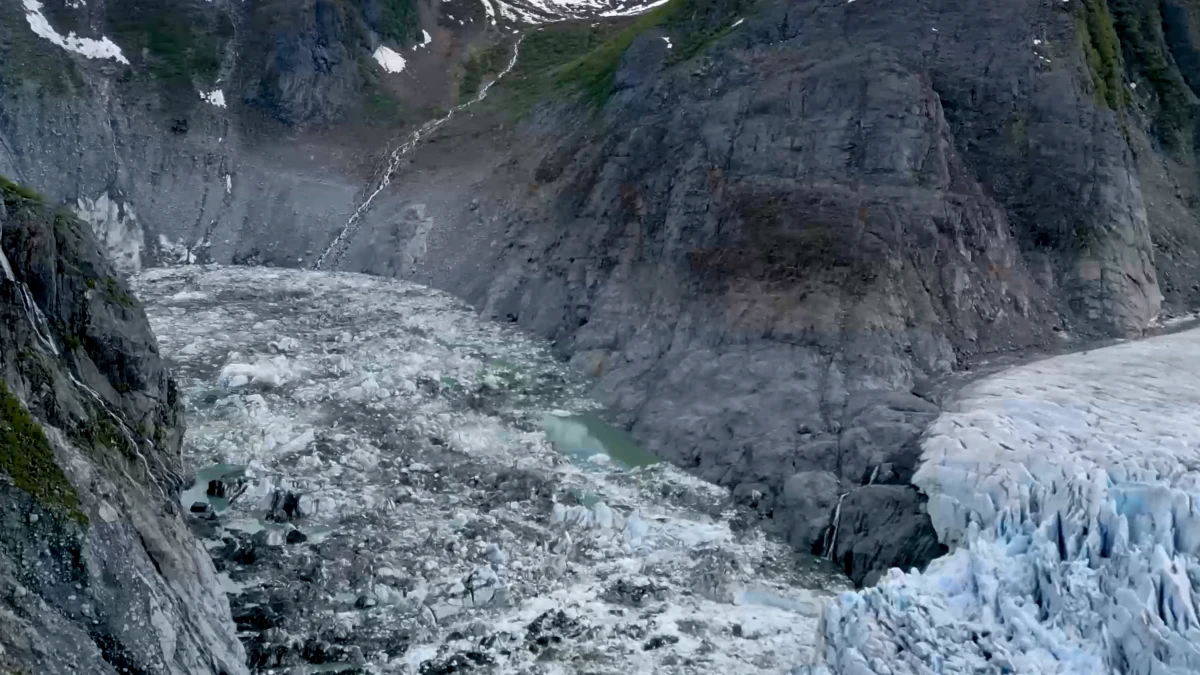
Aerial View facing Suicide Basin. Mendenhall Glacier on the lower right. Credit: Juneau Glacial Flood Dashboard
Flooding from Suicide Basin pushed Mendenhall River into minor flood stage near Juneau, Alaska, at 23:00 AKDT on August 12 (07:00 UTC on August 13), when the National Weather Service (NWS) reported 2.77 m (9.1 feet) and a rise rate of about 0.21 m/h (0.7 feet/h).
NWS forecasts a 4.91–5.06 m (16.1–16.6 feet) crest in major flood stage between 10:00 and 14:00 AKDT on August 13 (18:00–22:00 UTC).
The U.S. Geological Survey (USGS) recorded a provisional stage of 2.81 m (9.22 feet) at its Mendenhall River gauge near Auke Bay at 23:15 AKDT on August 12 (07:15 UTC on August 13), with discharge at about 328 m3/s (11 600 ft3/s). USGS labels the real-time measurements provisional and subject to revision.
NWS’s 23:00 AKDT update placed the water level inside Suicide Basin at about 384 m (1 261 feet) and falling as the release continued.

The NWS Flood Warning for Mendenhall Lake and River remains in effect until 04:30 AKDT on August 14, (12:30 UTC). NWS forecasts major flood stage around 09:00 AKDT on August 13, (17:00 UTC), followed by a crest between 10:00 and 14:00 AKDT (18:00–22:00 UTC). The forecast depends on the estimated volume and release rate from Suicide Basin and on whether the basin drains partially or fully.
The declaration follows formal requests for assistance submitted by the City andBorough of Juneau (CBJ) and the Central Council of the Tlingit and Haida Indian Tribes
of Alaska.
The declaration activates the State Public Assistance disaster recovery program and allows temporary waiver of administrative requirements that could obstruct immediate flood-prevention or mitigation work.
The State Emergency Operations Center elevated its operational status and said three emergency-management personnel would deploy to Juneau during the flood window.
“Glacial lake outburst floods have become a recurring issue in the region, triggering state and federal disaster recovery responses in both 2023 and 2024,” the Governor’s Office said in the press release.
“In 2025, the State of Alaska issued a preemptive disaster declaration when an outburst became imminent. Thanks to a temporary flood barrier constructed by CBJ and the U.S. Army Corps of Engineers (USACE), record-high water levels during the 2025 event were contained, preventing severe inundation in residential neighborhoods,” they added.

The Alaska Department of Transportation and Public Facilities closed Back Loop Bridge to vehicle and pedestrian traffic at 20:30 AKDT on August 12, because of Mendenhall River flooding. Mendenhall Loop Road is closed to through traffic between Montana Creek Road and Mint Way, while local access to River Road and View Drive remains open.
The CBJ listed the event as “Flood Warning – Active Response Underway,” advises evacuation from the mapped flood zone and keeps the emergency shelter at Floyd Dryden Gym open. Capital Transit shifted to flood detour routes at 17:00 AKDT on August 12, with routing subject to further changes as conditions develop.
The Tongass National Forest issued an emergency public-health and safety closure for the Mendenhall Glacier Recreation Area because of the glacial lake outburst flood.
The order covers lands, roads and trails in the recreation area, including Mendenhall Campground, Skaters Cabin, the Mendenhall Glacier Visitor Center and the Dredge Lakes Area. Forest Service officials said assessments were pending and were working toward reopening the visitor center by August 14, with other areas dependent on road and safety assessments.
An NWS Marine Weather Statement is in effect for Stephens Passage because trees and other debris from the ongoing Mendenhall River flood have entered the water.
NWS flood-stage guidance places more severe residential impacts higher in the forecast range. At 4.57 m (15.0 feet), major flooding is expected at multiple homes along View Drive, water approaches some River Road homes.

Meanwhile, up to 0.30 m (1 foot) of water is expected across Riverside Drive at Tournure Street and Mendenhall River School. At 4.88 m (16 feet), water begins overtopping the riverbank near Wildmeadow Lane and reaching additional low-lying areas and backyards.
It is to be noted that the stage thresholds describe forecast impacts and do not establish that those residential impacts have occurred during the 2026 event.
The upper end of the current forecast remains just below the Mendenhall River record from August 13, 2025. NWS reports the 2025 event at 5.07 m (16.65 feet), compared with a maximum forecast of 5.06 m (16.6 feet) for the current release. A new record cannot be established unless the observed crest reaches or exceeds the existing record.
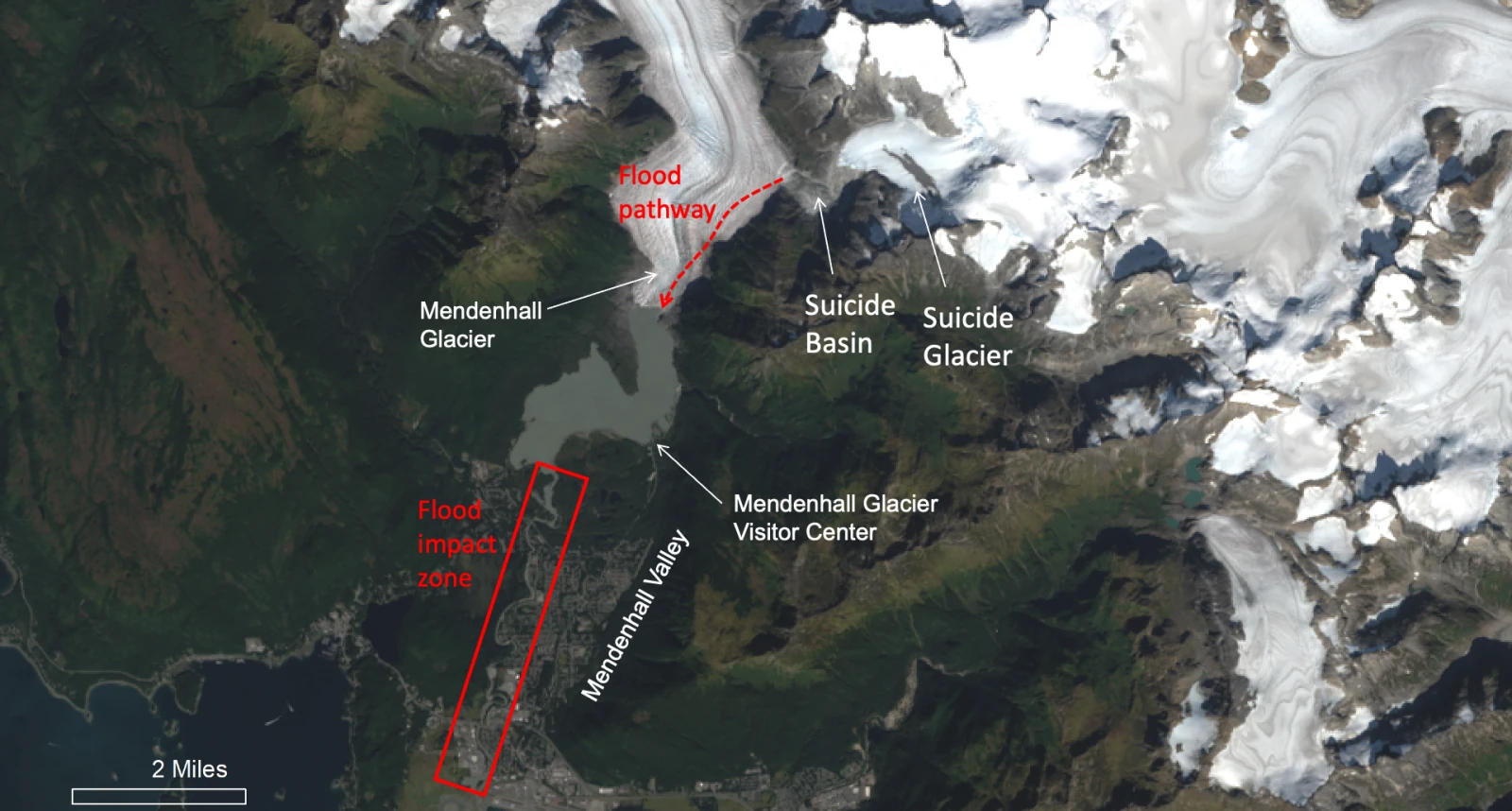
Suicide Basin is a partly glacierized marginal basin of Mendenhall Glacier that has produced recurring glacial lake outburst floods since 2011. The outburst flooding from the basin is an annual hazard associated with summer formation and drainage of the glacier-dammed lake, according to the USGS.
References:
1 Suicide Basin Monitoring and Current Conditions – NWS – August 13, 2026
2 Flood Statement – NWS – August 13, 2026
3 Emergency Flood Response – City and Borough of Juneau – August 13, 2026
4 Governor Dunleavy Issues Disaster Declaration in Response to Imminent Glacial
Flood Threat in Juneau – Alask Governor’s Office – August 12, 2026

Rishav Kothari is Editor-in-Chief of The Watchers, where he runs the newsroom and covers earthquakes, volcanoes, severe weather and space weather.
Published in the last 24 hours
- The Leonid meteor shower peaks on the night of November 17, exactly 60 years after the 1966 storm, when some observers reported meteors falling at up to 40 a second, though this year’s show should be closer to 15 an hour
- When Arctic air reached South Florida in January 2020, Miami fell to 40°F and the National Weather Service warned residents to watch for cold-stunned iguanas dropping out of the trees Epicenter
- In May 2024, the strongest solar storm in 20 years put northern lights over the southern US, and across the Plains, GPS-guided tractors built to plant within an inch drifted about 10 feet off their rows Epicenter
- In 1943, a flight instructor in Texas flew a two-seat training plane into the eye of a hurricane because he was curious, then landed and took the base weatherman up for a second pass Epicenter
