
Deadly storms prompt national disaster declaration in South Africa
Severe storms affecting South Africa from May 4 to 11, 2026, have caused at least 4 deaths, displaced more than 2 000 people, and disrupted infrastructure and essential services across multiple provinces, prompting authorities to declare a national disaster. The declaration covers the Western Cape, North West, Free State, Eastern Cape, Northern Cape, and Mpumalanga provinces. This is the fifth national disaster declaration since November 2025 and the fourth so far this year.

Satellite image of South Africa acquired at 14:10 UTC on May 11, 2026. Credit: EUMETSAT/Meteosat, Zoom Earth, The Watchers
The South African Weather Service (SAWS) issued an Orange Level 8 warning for disruptive rainfall on May 4, with risks including flooding of roads, bridges, and settlements, mudslides, and danger to life from fast-moving water. Over the next few days, heavy rainfall, strong winds, flooding, and snowfall have affected large parts of the Western Cape, Eastern Cape, Northern Cape, North West, Free State, and Mpumalanga.
The highest verified rainfall total was recorded at Joubertina, where cumulative rainfall from Monday, May 4, to Thursday, May 7, reached 301.2 mm (11.9 inches). Other major totals included 286.8 mm (11.3 inches) at Knysna Kleingrysbos, 285.6 mm (11.2 inches) at Knysna Diepwalle, 276.8 mm (10.9 inches) at Plett Newlands, 239.2 mm (9.4 inches) at Stormsrivier Forest Fern, 222.8 mm (8.8 inches) at Stormsrivier Witteklip, and 219.2 mm (8.6 inches) at Witfontein.
Storms affecting the Western and Eastern Cape between May 5 and 7 left at least one person dead and displaced more than 2 000 people. More than 45 road closures were reported, as well as power outages and flooding linked to overflowing rivers and dam systems.
Bongani Elias Sithole, the head of the National Disaster Management Centre, said the scale and severity of the weather system forced authorities to escalate the response to a national level.
This is now the fifth national disaster declaration since November 2025, following the November 2025 declaration over gender-based violence and femicide affecting the entire country; the January 2026 severe weather and widespread flooding that affected five provinces; the February 2026 drought conditions that affected three provinces; and the February 2026 foot-and-mouth disease outbreak that affected the entire country.

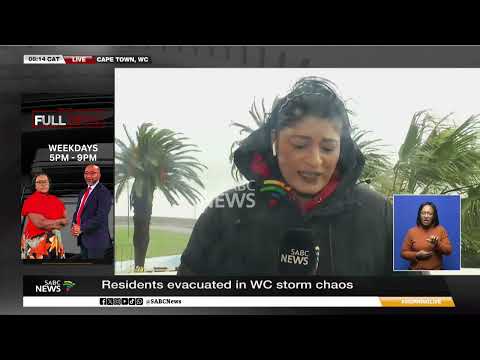
Another frontal system impacted the Western Cape on May 11, bringing more disruptive rainfall and flooding into Tuesday, May 12, resulting in 3 reported fatalities and the closure of all schools in the province until May 13.
Cape Town emergency services said they received 930 calls between 06:00 and 09:30 LT, with multiple reports of roofs blown off in Mitchells Plain, Hanover Park, and Wynberg.
Other emergency reports included flooded low-lying settlements, fallen trees, road flooding, and wind damage across parts of Cape Town and surrounding communities.
Local media reported that one person died when a tree fell on a car in Kenilworth, according to City Councilor Mikhail Manuel. Another person was killed by a falling tree in Genadendal, while a third person drowned in Klaarstroom.
Floodwater damaged roads and bridges in several provinces, while landslides blocked access routes in parts of the Garden Route District Municipality.
Gerhard Otto, the head of Disaster Management in the Garden Route, said the region is experiencing its worst flooding in 30 years.
Strong winds also affected parts of KwaZulu-Natal outside the provinces included in the national-disaster classification. IOL reported structural damage, uprooted trees, and injuries after trees collapsed in parts of the Midlands, with wind gusts reportedly exceeding 100 km/h (62 mph) in exposed areas.
References:
1 In photos: Cape storm wreaks havoc – GroundUp – May 11, 2026
2 National disaster for South Africa – Business Tech – May 11, 2026

Teo Blašković founded The Watchers in 2011 and edited it until 2026, covering seismic and volcanic activity, extreme weather, space weather and near-Earth objects. Articles on this page are his archive.
Published in the last 24 hours
- Flying glass cut a teacher in Russia but none of her 44 pupils, because when a meteor flashed across the sky in 2013, she told them to get under their desks Epicenter
- A South Dakota man put the widest and heaviest hailstone on US record in his freezer, and a power cut melted part of it before NOAA measured it at 8 inches across and nearly 2 pounds in 2010 Epicenter
- Black kites and brown falcons in northern Australia have been seen snatching smoldering sticks from wildfires, flying them into unburned grass and dropping them, starting new fires that send lizards, rodents and insects running straight toward the waiting birds Epicenter
- A levee protecting a highway north of San Francisco is pocked with animal burrows and only 3 feet wide in places, and a report warns this winter's El Niño could push water over the top Epicenter
