
Record March heat accelerates peak of wildflower bloom in Death Valley National Park
A record-breaking March heat wave across the southwestern United States accelerated the wildflower bloom cycle in Death Valley National Park, causing peak conditions to occur earlier than typical seasonal patterns. The National Park Service (NPS) reported that lower elevation flowers have already begun setting seed following intense heat and high winds, while the National Weather Service (NWS) reported that hundreds of daily temperature records were set or tied across parts of the region.
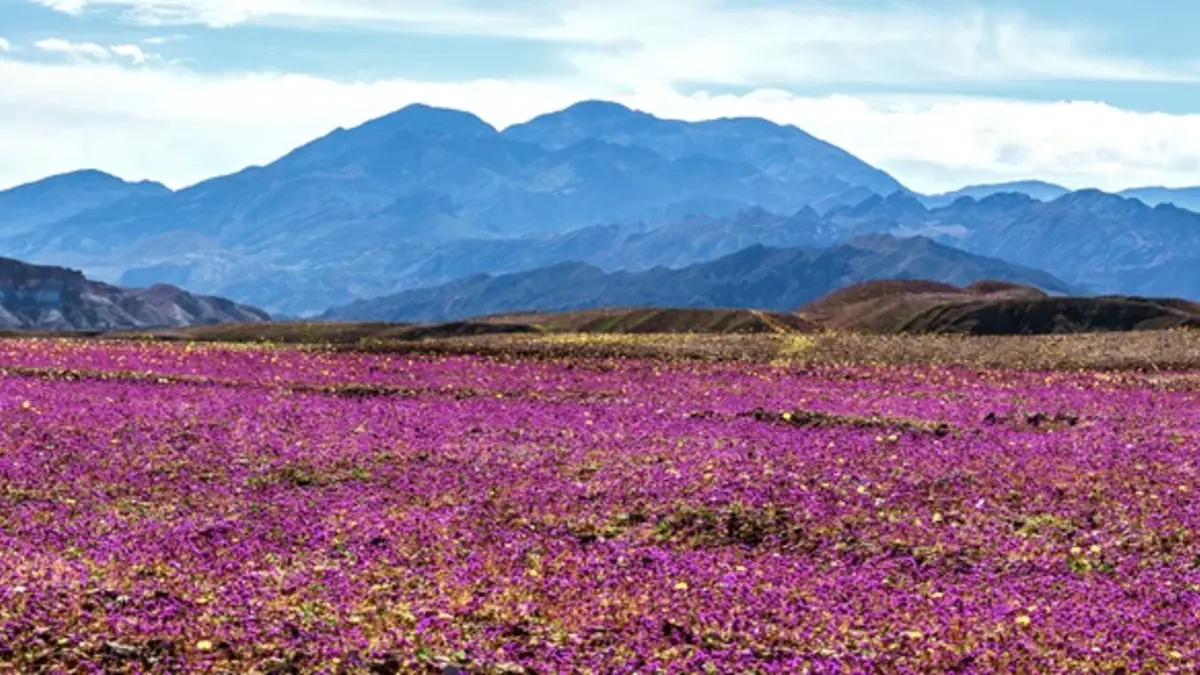
Wildflowers in Death Valley. Credit: National Park Service
A historic heat wave across the southwestern United States in March 2026 accelerated the progression of seasonal wildflower blooms in Death Valley National Park, leading to an earlier-than-usual peak in bloom conditions.
The National Weather Service (NWS) reported widespread record-breaking temperatures across parts of the region, with hundreds of daily temperature records set or tied as the heat wave intensified through March.
Extreme Heat Warnings and Heat Advisories were issued across Southern California, Nevada, and Arizona, affecting over 40 million people as temperatures rose well above seasonal averages.
According to the National Park Service (NPS), the combination of extreme heat and persistent high winds significantly shortened the bloom cycle. Wildflowers at lower elevations, previously forming extensive displays of yellow and purple, have already transitioned into seed production, marking the end of peak bloom conditions in those areas.
Recent field observations identified key bloom locations prior to peak decline, including Badwater Road between CA-190 and Sidewinder Canyon, Beatty Cutoff, and parts of Panamint Valley. Species observed across these areas included Desert Gold, Phacelia, Mojave Star, Gravel Ghost, and brittlebush, with remaining blooms now diminishing.
This year’s bloom is the best the park has seen since 2016 thanks to steady rainfall and warm temperatures in the last six months, NPS ranger Matthew Lamar told AP News.
Desert wildflowers in Death Valley are annuals, also referred to as ephemerals. They remain dormant as seeds until sufficient rainfall occurs, after which they rapidly sprout, grow, bloom, and return to seed before extreme heat and dry conditions resume.
By blooming simultaneously during favorable years, these plants attract pollinators that are otherwise limited in desert environments, including butterflies, moths, bees, and hummingbirds.
Typical bloom progression in Death Valley occurs in stages based on elevation. Lower elevations generally peak between February and mid-April, while mid-elevation zones at approximately 900–1 500 m (3 000–5 000 feet) develop blooms from mid-April to early May. Higher elevation regions, ranging from approximately 1 500–3 350 m (5 000–11 000 feet), usually sustain blooms from early May through mid-July.
The NPS reported that higher elevation blooms are still expected between April and June 2026, although these occur in localized clusters and do not produce the extensive landscape-scale displays typical of lower elevation superblooms.
Superblooms in Death Valley occur only under a specific combination of rainfall, temperature, and seasonal timing. Sufficient winter precipitation followed by moderate spring conditions is required to sustain prolonged flowering periods, while rapid warming events can significantly shorten bloom duration by accelerating the transition from flowering to seed production.
1 Wildflowers – National Park Service – March 16, 2026

I’m a science journalist and researcher at The Watchers, contributing to the Epicenter edition, where I cover peer-reviewed scientific research and emerging discoveries across Earth and space sciences. With a background in astronomy and a passion for environmental science, I’ve worked in shark and coral conservation in Fiji, conducting reef and shark-behavior research, contributing to mangrove restoration, and earning PADI Open Water and Coral Reef Certifications. I bring a blend of scientific rigor and storytelling to illuminate the discoveries shaping our planet and beyond.

Commenting rules and guidelines
We value the thoughts and opinions of our readers and welcome healthy discussions on our website. In order to maintain a respectful and positive community, we ask that all commenters follow these rules.