
Kona low triggers life-threatening flooding on Oʻahu’s North Shore, Hawaii
Life-threatening flash flooding struck Oʻahu’s North Shore, Hawaii, on March 20, 2026, after a slow-moving Kona low produced more than 330 mm (13 inches) of rain in parts of northern Oʻahu in about 12 hours from the evening of March 19 into the morning of March 20. Flooding in the Haleiwa and Waialua areas cut off road access, prompted evacuation orders, and triggered emergency response operations.

Cars submerged amid life-threatening flash floods in Oahu, on March 20, 2026. Credit: Adventure Hawaii/North Shore, Oahu, Hawaii.
Catastrophic flash flooding affected the North Shore of Oʻahu, Hawaii, on March 20, as extreme rainfall produced by a slow-moving Kona low inundated communities in Waialua and Haleiwa, prompting evacuations and emergency response operations under life-threatening conditions.
Preliminary rainfall estimates indicate totals exceeding 330 mm (13 inches) in approximately 12 hours between March 19 and 20 across parts of northern Oʻahu, with rainfall rates of 25–50 mm (1–2 inches) per hour reported. Approximately 127–254 mm (5–10 inches) fell within the first six hours, intensifying runoff and rapidly overwhelming drainage capacity.
Floodwaters covered roadways and low-lying areas, rendering key access routes impassable and isolating communities along the North Shore. Authorities issued evacuation orders for Waialua and Haleiwa as conditions deteriorated, and emergency shelters were opened in elevated areas to accommodate displaced residents.
Multiple homes have been damaged or destroyed; however, the total number of affected structures remains unclear.
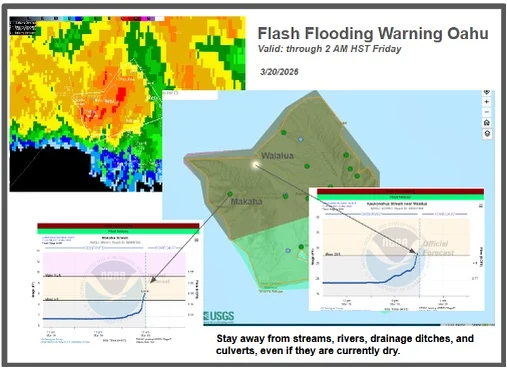
The National Weather Service said emergency managers were reporting drainage issues, standing water on roadways, and high streams on Oʻahu overnight, warning that conditions could change quickly in the dark.
The heavy rainfall follows another Kona low event that dropped nearly 1 000 mm (39 inches) of rain over the Island of Hawaii between March 10 and 16. Multiple islands recorded over 500 mm (20 inches) of rainfall during this period.
A Flash Flood Warning remains in effect until 08:00 HST on March 20 for the Island of Oʻahu. Floodwaters have cut off road access in and out of Haleiwa, and widespread flooding of roadways and low-lying areas is ongoing. Although rainfall rates have temporarily decreased, significant runoff continues to sustain high water levels and dangerous flooding impacts.
Additional bands of heavy rainfall moving in from the southwest are expected to continue over the area, which could lead to renewed rises in water levels and worsening flooding conditions.
“Move to higher ground now! This is an extremely dangerous and life-threatening situation. Do not attempt to travel unless you are fleeing an area subject to flooding or under an evacuation order,” said the NWS.
The Wahiawa Reservoir (Lake Wilson) and Helemano 6 Reservoir remain elevated, with water levels still high despite beginning to stabilize. Additional rises could further exacerbate downstream flooding along nearby streams, particularly near Otake Camp in Waialua.
Heavy showers continue to develop and move across the windward side of Oʻahu, with rainfall rates of 25–50 mm (1–2 inches) per hour. Water levels in streams remain elevated, particularly in the Waiahole, Waikane, and Kahana streams. Runoff is continuing to impact vulnerable low-lying areas and roadways through the morning hours.
Most streams, including Waiahole, Waikane, and Kahana, remain elevated, and continued runoff is expected to affect low-lying areas and roads throughout the morning.
References:
1 Areas Forecast Discussion for Hawaii – NWS – March 20, 2026
2 Oahu warned of ‘widespread catastrophic flooding’ as storm batters Hawaii – San Francisco Chronicle – March 20, 2026

I am an Assistant Editor and Severe Weather & Science Journalist at The Watchers, specializing in real-time severe weather coverage, geophysical event reporting, and research-driven scientific analysis. You can reach me at rishav(at)watchers(.)news.

Commenting rules and guidelines
We value the thoughts and opinions of our readers and welcome healthy discussions on our website. In order to maintain a respectful and positive community, we ask that all commenters follow these rules.