
Solar activity increases to high levels, Earth-directed CMEs possible in days ahead
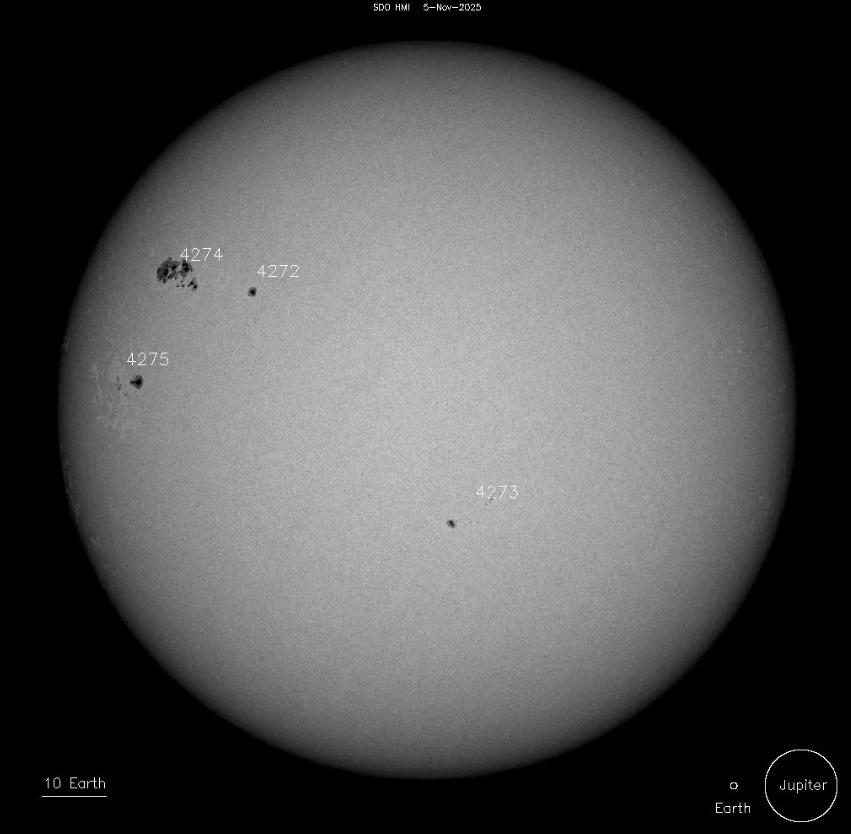
Two powerful X-class solar flares erupted on November 4, 2025 — an X1.8 from Region 4274 and an X1.1 from a region just beyond the east limb — launching CMEs largely off the solar limb. NOAA forecasts G1 – Minor to G2 – Moderate geomagnetic storming from late November 6 into 7 as Earth may experience a glancing shock from the flares combined with a coronal hole high-speed stream.

CME produced by X1.8 solar flare on November 4, 2025. Credit: NASA/SDO AIA 171, The Watchers
Two powerful X-class solar flares were recorded on November 4 — an X1.8 from Region 4274 and an X1.1 from a region just beyond the east limb. Both flares produced CMEs largely off the solar limb.
Although the eruptions were not Earth-directed, NOAA forecasts minor to moderate geomagnetic storming from late November 6 into November 7 as a glancing shock from these CMEs may combine with an incoming coronal hole high-speed stream.
The first X-class flare, an X1.8/1b flare, erupted at 17:34 UTC from Active Region 4274 (‘beta-gamma-delta’). The event produced Type IV radio emissions, a 160 sfu Tenflare, and a partial halo CME first visible in coronagraph imagery at 17:36 UTC.
The CME was directed primarily off the northeast limb, and model analyses indicate that most of the ejecta will pass behind Earth. However, forecasters note the possibility of a shock enhancement reaching Earth late on November 6 to early November 7.
The X1.1 flare erupted at 22:01 UTC, originating from a region just beyond the east limb near S15. It also produced a Type IV radio sweep and a non-Earth-directed CME moving off the southeast limb at 22:12 UTC.
Region 4274 remains magnetically complex and in a growth phase, carrying a beta-gamma-delta configuration often associated with major flaring potential.
Additional strong events remain possible, as confirmed by a M7.4 flare at 11:19 UTC on November 5.
The Space Weather Prediction Center (SWPC) has raised flare probabilities to 65% for M-class flares and 15% for X-class flares through November 7.

Solar wind conditions were near nominal levels in 24 hours to 12:30 UTC on November 5, with speeds between 341 km/s and 447 km/s, total field 3–7 nT, and a prolonged southward Bz near −6 nT.
SWPC’s forecast anticipates an increase in solar wind speed and magnetic field intensity as a coronal hole high-speed stream becomes geoeffective late on November 6. The stream may merge with trailing edges of CMEs ejected on November 3–4, resulting in enhanced geomagnetic activity through November 7.

The SWPC issued a G1 – Minor geomagnetic storm watch for November 6 and 7, with a slight chance of G2 – Moderate levels.
Storms of this intensity are capable of causing weak power grid fluctuations, minor satellite anomalies, and intermittent high-frequency radio degradation at high latitudes. Auroral activity could become visible across northern U.S. states, Canada, northern Europe, and high-latitude Asia, weather permitting.
Due to the flaring potential of the aforementioned regions and their rotation toward a more geoeffective position on the solar disk, additional Earth-directed CMEs are possible in the days ahead. The likelihood of such events will increase as Region 4274 and the adjacent active area move into better magnetic alignment with the Earth–Sun line.
Update
19:58 UTC, November 5
SWPC issued a G3 – Strong Geomagnetic Storm Watch for November 6 and 7, 2025, replacing all previous watches in effect.
Aurora may become visible across much of Canada and the northern United States, potentially extending as far south as Pennsylvania, Iowa, and Oregon.

References:
1 Forecast Discussion – NOAA/SWPC – 12:30 UTC on November 5, 2025

I'm a dedicated researcher, journalist, and editor at The Watchers. With over 20 years of experience in the media industry, I specialize in hard science news, focusing on extreme weather, seismic and volcanic activity, space weather, and astronomy, including near-Earth objects and planetary defense strategies. You can reach me at teo /at/ watchers.news.

Commenting rules and guidelines
We value the thoughts and opinions of our readers and welcome healthy discussions on our website. In order to maintain a respectful and positive community, we ask that all commenters follow these rules.