
Lahar from Mount Semeru traps truck near Gladak Perak, Lumajang, Indonesia
A secondary lahar flow originating from remobilized pyroclastic and tephra deposits on the southern flank of Mount Semeru, Indonesia, occurred on October 21, 2025, trapping a truck near Gladak Perak Bridge in Lumajang Regency, East Java. The rain-induced lahar, classified as a cold, non-eruptive sediment-water flow, moved through the Besuk Kobokan drainage, carrying a dense slurry of volcanic debris and runoff.
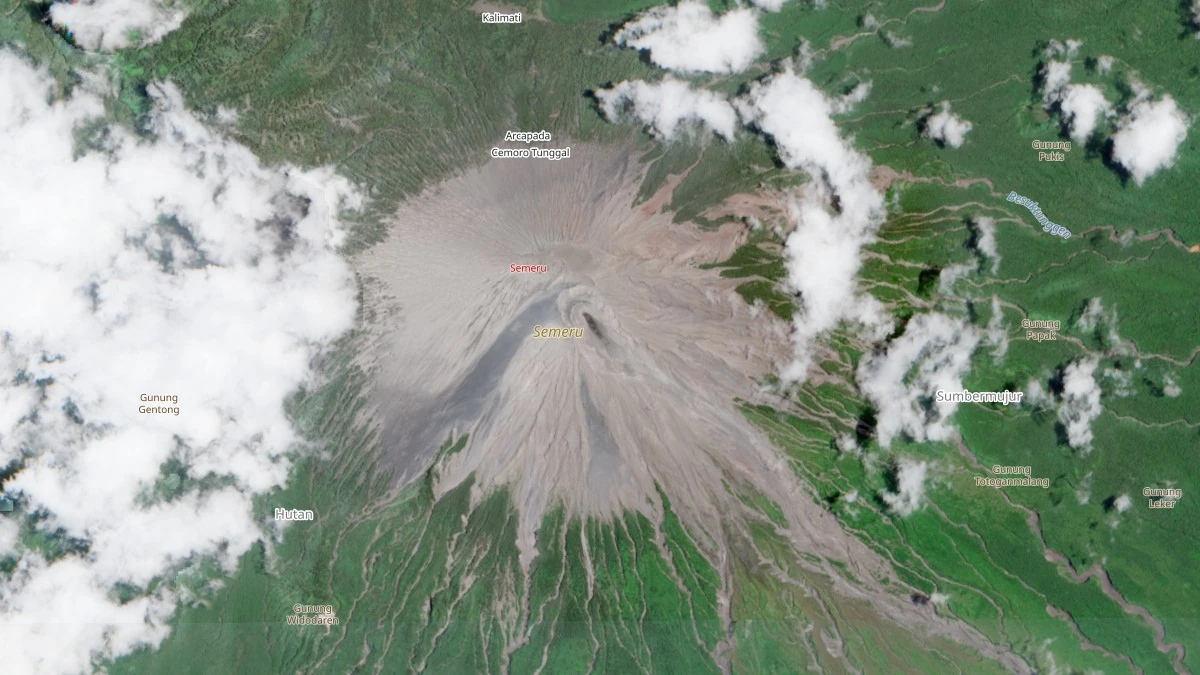
Satellite image of Semeru volcano on October 21, 2025. Credit: Copernicus EU/Sentinel-2, The Watchers
A rain-triggered lahar descended from Mount Semeru, East Java, Indonesia, on Tuesday, October 21, affecting the Gladak Perak Bridge area in Lumajang Regency.
Footage published on social media shows a truck surrounded by fast-moving lahar material within the Besuk Kobokan river channel, downstream of Mount Semeru. According to FPMKI, the event followed heavy rainfall earlier in the day that mobilized unconsolidated volcanic deposits along the upper reaches of the channel.
At the time of press, no official confirmation had been issued by the Lumajang Disaster Management Agency (BPBD Lumajang), the National Disaster Management Agency (BNPB), or the Center for Volcanology and Geological Hazard Mitigation (PVMBG).
Lahars, also referred to in the media as cold lava flows, are secondary volcanic mass flows composed of water, sand, and fine volcanic detritus. They form when rainfall or surface runoff entrains loose pyroclastic material, creating a high-density, gravity-driven flow that follows established drainage channels such as Besuk Kobokan. Lahars can occur long after eruptive activity has ceased and remain one of the most persistent hazards on Semeru’s flanks.
Mount Semeru is Indonesia’s highest volcano and remains in a continuous state of activity that began in 2020. Its eruptive output includes lava flows, pyroclastic avalanches, and sustained ash emission, leaving extensive loose deposits susceptible to remobilization. Lahars from these deposits have repeatedly impacted the Gladak Perak sector, including incidents involving vehicles and bridge damage recorded in 2023 and 2024.
Authorities regularly urge residents and sand-mining operators to avoid the Besuk Kobokan drainage and adjacent river valleys during rainfall, as hydrological triggers can rapidly generate new lahar flows without precursory eruptive signals.

I'm a dedicated researcher, journalist, and editor at The Watchers. With over 20 years of experience in the media industry, I specialize in hard science news, focusing on extreme weather, seismic and volcanic activity, space weather, and astronomy, including near-Earth objects and planetary defense strategies. You can reach me at teo /at/ watchers.news.

Commenting rules and guidelines
We value the thoughts and opinions of our readers and welcome healthy discussions on our website. In order to maintain a respectful and positive community, we ask that all commenters follow these rules.