
Significant temperature increase detected at Kawah II crater lake, Mount Kelimutu, Indonesia
A significant increase in water temperature and sulfur gas emissions was detected at Kawah II of Mount Kelimutu, East Nusa Tenggara, Indonesia, on August 26, 2025. The volcano is a well-known tourist destination due to its three color-shifting crater lakes. The last recorded eruption at this volcano took place in 1968 (VEI 1).

Kelimutu volcano's Kawah II crater lake in October 2014. Credit: VS
According to the Geological Agency of Indonesia (Badan Geologi), crater lake Kawah II (Tiwu Ko’ofai Nuwamuri) recorded a temperature of 34.2°C (93.6°F) on August 26, compared to 25.3°C (77.5°F) on August 14. The other two lakes, Kawah I (Tiwu Ata Polo) and Kawah III (Tiwu Ata Bupu), remained stable at 17.6°C (63.7°F) and 18.3°C (64.9°F), respectively.
The temperature anomaly was accompanied by a strong sulfur odor and visible surface gas emissions localized at Kawah II.
Despite this increase, no seismic activity, tremor, or significant degassing signals were detected at the volcano. The agency stated that current observations do not indicate magmatic intrusion, and the temperature rise is likely associated with intensified subaqueous fumarolic activity.
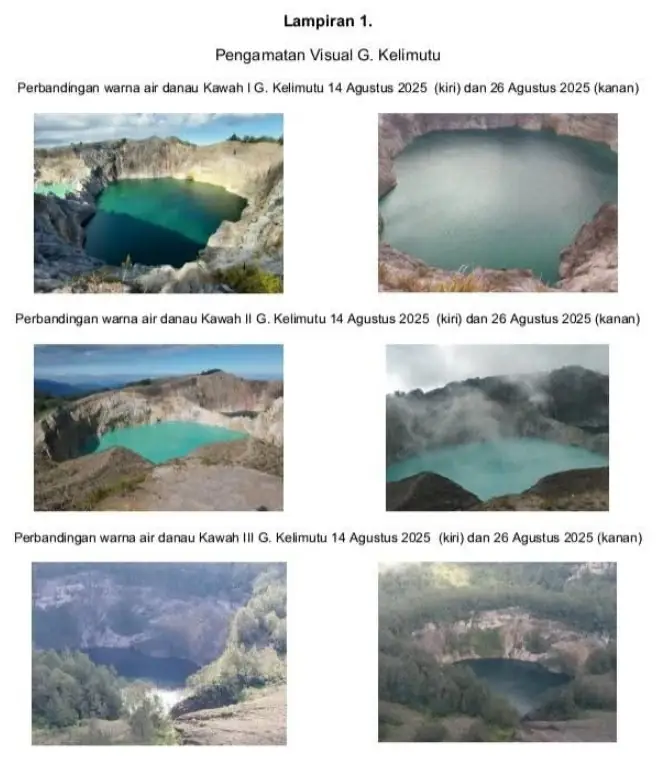
Color variations were also recorded across the three crater lakes. Kawah I changed from green to dark green, Kawah II remained light blue, while Kawah III remained dark green. These observations were supported by visual comparisons taken on August 14 and August 26.
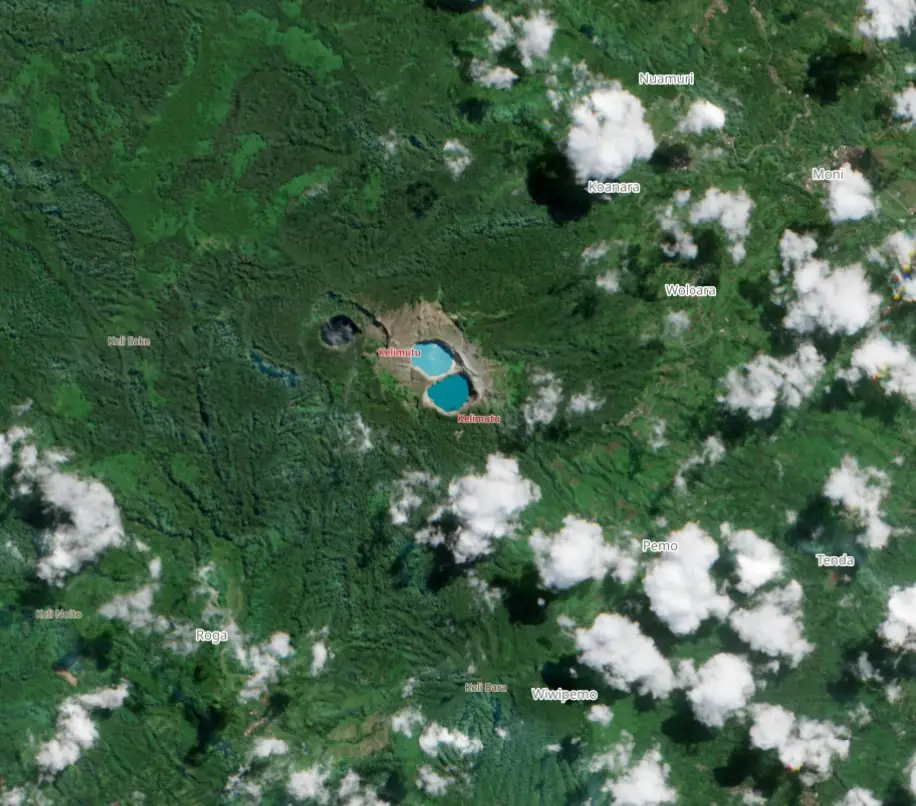
Mount Kelimutu is a small but historically active compound stratovolcano in central Flores Island, known for its three summit crater lakes with periodically changing colors. The eastern lakes, Kawah II and Kawah I, share a common crater wall and are both influenced by subaqueous geothermal activity.
The volcano lies within Kelimutu National Park and is a prominent domestic and international tourist destination due to the rare visual phenomena of its crater lakes, which change color in response to chemical and geothermal variations. Visitors frequently access the summit area via established trails and viewing platforms.
Kelimutu has experienced at least three confirmed eruptions during the Holocene period. The most recent eruption occurred from June 3 to July 29, 1968 (VEI 1), and was characterized by both explosive and effusive activity. Prior eruptions were recorded in May–June 1938 (VEI 2) and around 1865 ± 5 years (VEI 2).
Geololgical Agency noted that, although the temperature increase is significant, it does not currently indicate elevated volcanic hazard. However, due to the strong gas emissions and changing surface conditions, residents and visitors are advised to avoid approaching Kawah II.
Local authorities and the Regional Disaster Management Agency (BPBD) have been urged to coordinate with the Mount Kelimutu Volcano Observation Post in Kampung Kolorongo and the Center for Volcanology and Geological Hazard Mitigation (PVMBG) for continued monitoring.
Periodic evaluations will continue, and emergency updates will be issued if further changes are detected. The public is advised to remain calm and follow official instructions.

I'm a dedicated researcher, journalist, and editor at The Watchers. With over 20 years of experience in the media industry, I specialize in hard science news, focusing on extreme weather, seismic and volcanic activity, space weather, and astronomy, including near-Earth objects and planetary defense strategies. You can reach me at teo /at/ watchers.news.

Commenting rules and guidelines
We value the thoughts and opinions of our readers and welcome healthy discussions on our website. In order to maintain a respectful and positive community, we ask that all commenters follow these rules.