
Severe floods leave at least 25 dead and thousands displaced in Yola, Adamawa State, Nigeria
Torrential rain combined with suspected dam water release caused severe flooding in Yola, Adamawa State, Nigeria, on July 27, 2025, leaving at least 25 people dead, 55 injured, and thousands displaced.
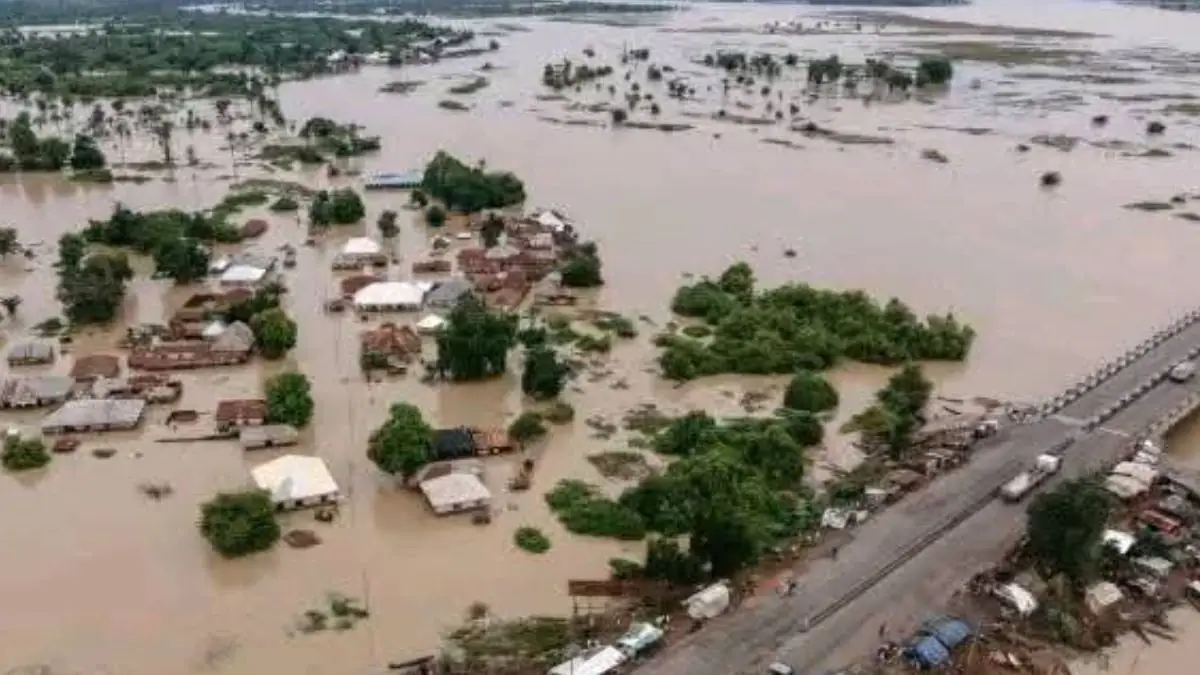
Image credit: Voice of Nigeria
Severe flooding struck the Yola North and Yola South local government areas of Adamawa State in the early hours of Sunday, July 27, following hours of intense rainfall and suspected water release from the Bole dam.
The hardest-hit communities include Shagari Phase II, Sabon Pegi, Yolde-Pate, Modire, Anguwan Tabo, Tashan Sani, and Ibnu Abbas (Yola Bypass), where entire streets and farmlands were submerged within hours.
The Adamawa State Emergency Management Agency (ADSEMA) and the National Emergency Management Agency (NEMA) initially confirmed five deaths and 55 injuries.
By July 29, state authorities, including Governor Ahmadu Fintiri, revised the toll to 25 confirmed fatalities, warning that more victims may be recovered as rescue operations continue. Many of the injured were treated at Modibbo Adama University Teaching Hospital in Yola.
Floodwaters destroyed homes, washed away property, and forced the evacuation of thousands. ADSEMA reports that 5 560 people have been relocated to temporary camps, with the largest shelter set up at Aliyu Mustafa College in Yola.
Authorities have also reported the loss of farmland, raising fears of food insecurity in the coming months.
Rescue operations involve joint teams from NEMA, ADSEMA, the Nigeria Security and Civil Defence Corps (NSCDC), the Nigerian Red Cross, and police mobile units equipped with marine rescue teams.
The state government has directed immediate distribution of relief materials, including food, bedding, and medical supplies, to displaced families.
The flood crisis has created secondary hazards. In Guyuk and Shelleng LGAs, displaced hippopotamuses from the flooded Kiri Dam have attacked communities, killing at least one person and destroying livestock.
Residents have appealed to wildlife authorities to contain the animals before further incidents occur.
Adamawa State experiences recurrent flooding during the rainy season due to a combination of factors including heavy rainfall, poor urban drainage, and periodic upstream dam water releases.
References:
1 Floods kill at least 25 people in northeastern Nigeria – AP News – July 29, 2025

I’m a science journalist and researcher at The Watchers, contributing to the Epicenter edition, where I cover peer-reviewed scientific research and emerging discoveries across Earth and space sciences. With a background in astronomy and a passion for environmental science, I’ve worked in shark and coral conservation in Fiji, conducting reef and shark-behavior research, contributing to mangrove restoration, and earning PADI Open Water and Coral Reef Certifications. I bring a blend of scientific rigor and storytelling to illuminate the discoveries shaping our planet and beyond.
Published in the last 24 hours
- In September 1859, a solar storm lit up the night sky so brightly that gold miners in the Rocky Mountains woke up after midnight and started cooking breakfast, convinced the aurora glowing over their camp was the sunrise Epicenter
- A patch of warm Pacific water that could become the strongest El Niño in more than 70 years sits thousands of miles from any American town, yet it is already the main reason NOAA expects a wetter winter across the South and a milder one across the North
- A 19-year-old Nebraska teacher reportedly tied her pupils together with twine and led them to safety through a blizzard in January 1888 Epicenter
- NASA built the Opportunity rover to last 90 days on Mars, and Martian winds helped keep it alive for nearly 15 years by blowing dust off its solar panels, until a planet-wide dust storm in 2018 blocked sunlight and silenced the rover Epicenter
