
Widespread flooding continues across Nigeria as death toll rises to 238
Heavy rainfall during Nigeria’s 2025 summer rainy season has affected 27 of the country’s 36 states, causing severe floods and river overflows that left at least 238 people dead and 826 injured. According to the National Emergency Management Agency (NEMA) and the European Commission’s Directorate-General for European Civil Protection and Humanitarian Aid Operations (DG ECHO), more than 135 000 people have been displaced and about 400 000 in total affected. The worst-hit states are Lagos, Adamawa, Akwa Ibom, Imo, Taraba, and Rivers, where over 47 000 houses and 60 000 ha (148 000 acres) of farmland have been destroyed or damaged.
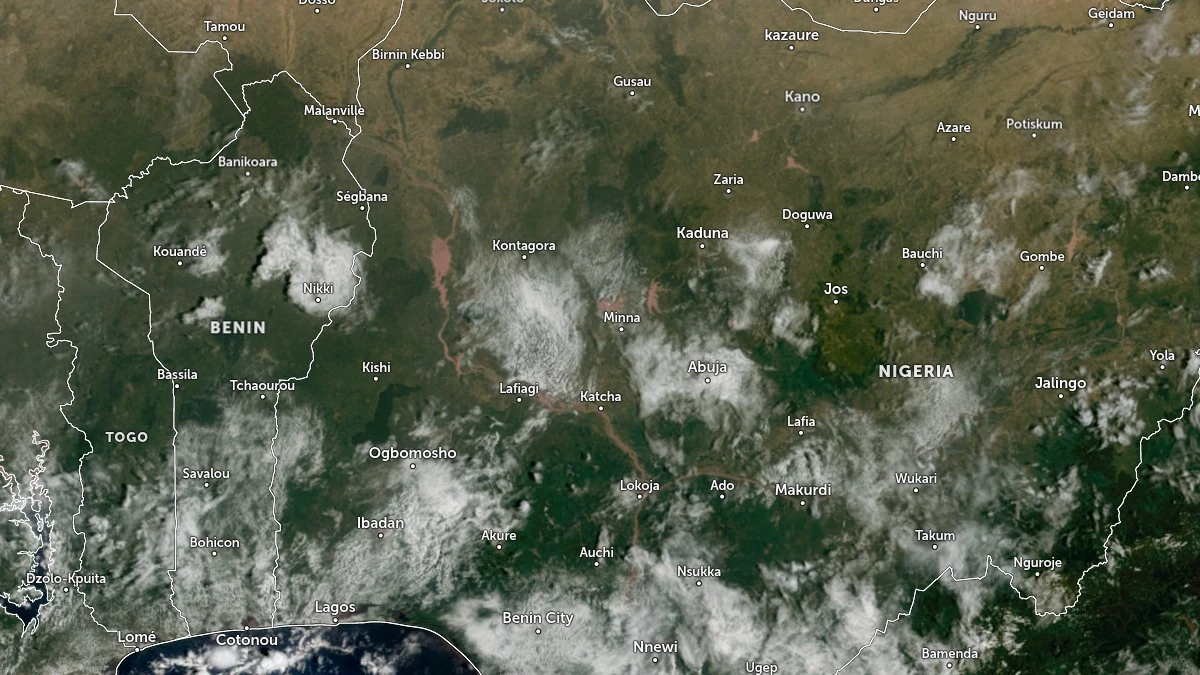
Satellite image centered over Nigeria at 08:50 UTC on October 17, 2025. Credit: EUMETSAT/Meteosat, Zoom Earth, The Watchers
Heavy seasonal rainfall has caused widespread flooding across 27 of Nigeria’s 36 states, leading to extensive destruction of homes, farmland, and infrastructure.
According to the European Commission’s Directorate-General for European Civil Protection and Humanitarian Aid Operations (DG ECHO) and the National Emergency Management Agency (NEMA), at least 238 people have died and 826 have been injured since the onset of the 2025 rainy season. More than 135 000 people have been displaced, with the total number of affected individuals approaching 400 000 nationwide.
The rainy season in Nigeria typically lasts from June to October. In 2025, persistent high-intensity precipitation occurred across the southern and central regions, causing the rivers Niger, Benue, and Cross to exceed normal flow levels. This led to overbank flooding that submerged settlements and farmlands along their floodplains.
The worst-impacted areas are Lagos, Adamawa, Akwa Ibom, Imo, Taraba, and Rivers states, where floodwaters inundated communities, washed away bridges, and damaged agricultural land.
DG ECHO reports over 47 000 houses destroyed or damaged and more than 60 000 ha (148 000 acres) of farmland lost to floods and sedimentation. Staple crops, including rice, cassava, and maize, have been heavily affected, intensifying food-security pressures.

Hydrological assessments from the Copernicus Emergency Management Service (CEMS) indicate that continuous heavy rainfall and river overflow remain the primary drivers of the disaster, with urban areas such as Lagos and Port Harcourt experiencing additional damage due to inadequate drainage and unplanned development in flood-prone zones.
NEMA has deployed emergency response teams in cooperation with the Nigerian Red Cross Society and state-level disaster agencies. Evacuations are ongoing in riverine communities of Adamawa and Taraba, where floodwaters remain high. Relief operations focus on temporary shelter, food assistance, and medical support.
Forecasts from the Nigeria Meteorological Agency (NiMet) and the CEMS Global Flood Awareness System (GloFAS) predict continued heavy rainfall during the next 48 hours over central and southern regions, maintaining a high risk of further flooding and river surges.
The 2025 floods are among Nigeria’s most damaging in recent years, approaching the 2022 disaster that killed more than 600 people and displaced over 1 million.

Teo Blašković founded The Watchers in 2011 and edited it until 2026, covering seismic and volcanic activity, extreme weather, space weather and near-Earth objects. Articles on this page are his archive.
Published in the last 24 hours
- A patch of warm Pacific water that could become the strongest El Niño in more than 70 years sits thousands of miles from any American town, yet it is already the main reason NOAA expects a wetter winter across the South and a milder one across the North
- A 19-year-old Nebraska teacher reportedly tied her pupils together with twine and led them to safety through a blizzard in January 1888 Epicenter
- NASA built the Opportunity rover to last 90 days on Mars, and Martian winds helped keep it alive for nearly 15 years by blowing dust off its solar panels, until a planet-wide dust storm in 2018 blocked sunlight and silenced the rover Epicenter
- In the winter of 1811–12, earthquakes near New Madrid, Missouri, shook so hard that witnesses saw the Mississippi River flow backward, and the shaking left a brand-new lake in Tennessee Epicenter
