
Level 4 HeatRisk alert issued for over 30 million people in the Southeastern United States
Extreme heat and humidity will affect large portions of the Southeastern United States from July 27 to 31, 2025, with over 30 million people under Level 4 Extreme HeatRisk alerts at the peak of the heatwave.

HeatRisk forecast for July 28, 2025. Image credit: NWS
A long-duration heat dome is forecast to intensify over the Southeastern United States between July 27 and 31, placing over 30 million people under Level 4 Extreme HeatRisk alerts, the highest classification issued by the National Weather Service (NWS).
The heat dome, a persistent region of high atmospheric pressure that traps warm air at the surface, has already brought extreme heat conditions to the eastern half of the country.
As of July 25, more than 80 million people were facing major or extreme heat-related impacts across the Eastern U.S., with the most dangerous conditions expected in the Southeast during the final days of July.
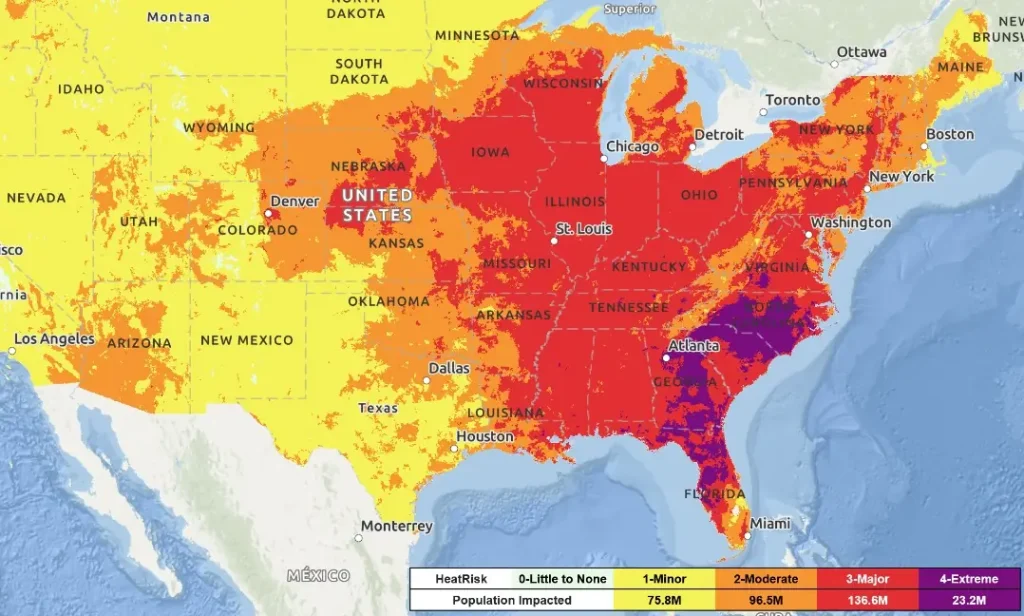
According to the NWS Weather Prediction Center (WPC), nearly 150 million people, close to half of the nation’s population, will be exposed to major or extreme heat risk by July 28.
This assessment is based on a combination of high daytime temperatures, persistent humidity, and insufficient overnight cooling. Forecast models indicate that maximum daytime temperatures will reach 38–40°C (100–104°F) across parts of Alabama, Georgia, Mississippi, South Carolina, and Florida.
Heat index values, which reflect the combined effects of heat and humidity on the human body, may exceed 49°C (120°F). In addition, nighttime temperatures are expected to remain near 26°C (79°F), offering minimal relief from the heat and increasing health risks for all exposed populations.
The NWS’ HeatRisk system categorizes Level 4 Extreme as rare and/or long-duration heat with little to no overnight relief.
The classification implies that the event is hazardous even for healthy individuals, and especially threatening to those without access to effective cooling or adequate hydration.
In this case, public health officials consider the Southeastern United States to be under the highest level of alert through at least July 31.
Meteorologists warn that the combination of sustained high temperatures and high dew points could result in life-threatening conditions, particularly for the elderly, outdoor workers, children, and people with chronic illnesses.
Bryan Jackson, meteorologist at the NWS WPC, said that this event stands out even for mid-summer. He noted that heat domes tend to form slowly and dissipate slowly, making them particularly dangerous due to their persistence.
WPC’s Zack Taylor added that the Southeast’s characteristic humidity usually moderates air temperature, but that this week’s event may break local records, with cities such as Columbia in South Carolina and Tallahassee in Florida at risk of tying or exceeding historical highs.
Gradual relief is expected to begin by August 2 as a cooler air mass begins shifting southeastward. Until then, however, extended heat safety measures remain in effect across all affected regions.

I’m a science journalist and researcher at The Watchers, contributing to the Epicenter edition, where I cover peer-reviewed scientific research and emerging discoveries across Earth and space sciences. With a background in astronomy and a passion for environmental science, I’ve worked in shark and coral conservation in Fiji, conducting reef and shark-behavior research, contributing to mangrove restoration, and earning PADI Open Water and Coral Reef Certifications. I bring a blend of scientific rigor and storytelling to illuminate the discoveries shaping our planet and beyond.

Commenting rules and guidelines
We value the thoughts and opinions of our readers and welcome healthy discussions on our website. In order to maintain a respectful and positive community, we ask that all commenters follow these rules.