
Supernova radiation linked to virus evolution in Lake Tanganyika, Africa
A supernova explosion approximately 2.5 million years ago may have influenced viral evolution on Earth in Lake Tanganyika, Africa’s deepest lake.
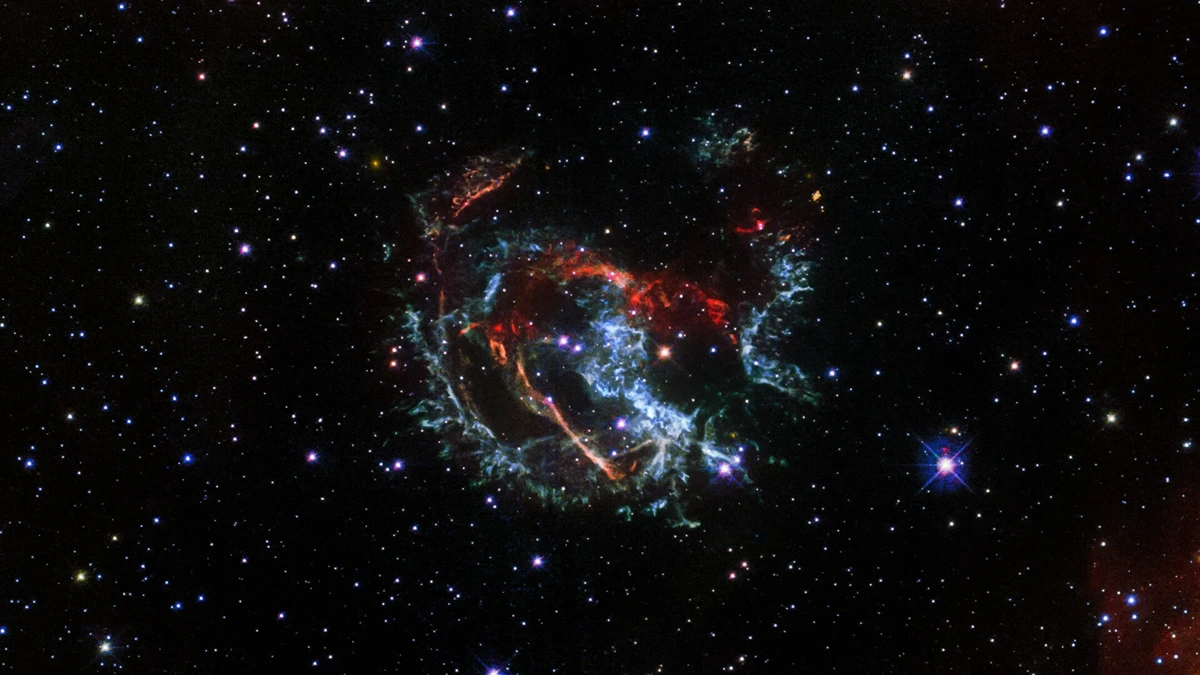
This Hubble Space Telescope image captures the supernova remnant 1E 0102.2-7219, located in the Small Magellanic Cloud, approximately 200 000 light-years away. Image credit: NASA, ESA, and J. Banovetz and D. Milisavljevic (Purdue University)
A supernova explosion 2.5 million years ago may have influenced viral evolution in Lake Tanganyika by increasing cosmic radiation, potentially driving mutations in viruses infecting aquatic life.
Researchers traced the explosion to the Upper Centaurus Lupus association, suggesting that heightened cosmic-ray exposure could have accelerated genetic changes in microorganisms with rapid adaptation cycles.
Geological records indicate a surge in virus species infecting fish in Lake Tanganyika during the same period, aligning with the supernova event and raising questions about cosmic radiation’s role in biological evolution.
A supernova explosion approximately 2.5 million years ago may have influenced viral evolution in Lake Tanganyika, Africa’s deepest lake.
Researchers at the University of California, Santa Cruz, propose that cosmic radiation from the event drove mutations in viruses infecting aquatic life, leading to the emergence of new species.
Tracing origins of cosmic influence
Understanding the impact of stellar explosions on Earth involves analyzing radioactive isotopes such as iron-60, which are ejected during a supernova and settle onto Earth’s surface. The deposits, found in deep-sea sediments, serve as timestamps marking past supernovae. Researchers have identified two major periods of heightened supernova activity, approximately 2.5 million and 6.5 million years ago.
Astronomical modeling traced the more recent supernova to the Upper Centaurus Lupus association, about 140 parsecs (457 light-years) away. The explosion likely propelled energetic particles toward Earth, affecting the atmosphere and potentially influencing biological evolution. Supernovae alter planetary environments by stripping ozone, increasing radiation exposure, and potentially accelerating mutation rates in microorganisms which are highly adaptive to environmental changes.
“It’s fascinating to explore how cosmic events could influence life on Earth,” Caitlyn Nojiri, lead researcher, noted.
Cosmic rays and DNA mutations
Supernovae release high-energy cosmic rays that, upon reaching Earth’s atmosphere, generate secondary particles capable of penetrating biological tissues. The interactions can cause double-strand breaks in DNA, leading to mutations. Microorganisms, with their rapid reproduction cycles, are susceptible to such genetic alterations, which could have contributed to evolutionary shifts in viruses.
Postdoctoral fellow Noémie Globus, co-author of the study, noted that a spike in cosmic radiation recorded in Earth’s geological record aligns with the estimated timeline of the supernova. The correlation suggests that increased cosmic-ray flux may have played a role in shaping microbial and viral evolution.
While some organisms may have suffered genetic damage, others could have developed radiation-resistant traits or beneficial mutations. This perspective shows the potential role of cosmic radiation as an evolutionary driver.
Viral diversification in Lake Tanganyika
The research team investigated whether the radiation event influenced viral evolution in Lake Tanganyika, an ancient lake with a unique ecosystem. Geological and biological records indicate a rapid increase in virus species infecting fish between two and three million years ago, aligning with the estimated period of heightened cosmic radiation.
Viruses, known for their high mutation rates, can rapidly adapt to environmental changes. Increased radiation exposure may have accelerated the process, leading to the emergence of new strains.
“We can’t say they are directly connected, but the timeframe is interesting,” Nojiri commented.
Further studies are needed to determine whether cosmic radiation directly influenced viral mutations or if other environmental factors contributed. Laboratory research has demonstrated that radiation exposure can induce genetic mutations in microorganisms, supporting the hypothesis that cosmic rays could have impacted viral evolution.
Role of supernovae in Earth’s history
Supernovae have shaped Earth’s environment by dispersing elements such as iron-60 which serve as markers of past cosmic events. The stellar explosions can also influence atmospheric chemistry, depleting ozone layers and altering climate patterns which in turn may impact ecological systems and evolutionary pathways.
Professor Enrico Ramirez-Ruiz, an astrophysicist and co-author of the study, focused on the significance of interdisciplinary research and said their study showcases the value of merging physics and biology to understand life’s evolution.
References:
1 Life in the Bubble: How a Nearby Supernova Left Ephemeral Footprints on the Cosmic-Ray Spectrum and Indelible Imprints on Life – Caitlyn Nojiri, Noémie Globus, and Enrico Ramirez-Ruiz – THE ASTROPHYSICAL JOURNAL LETTERS – January 17, 2025 – https://doi.org/10.3847/2041-8213/ada27a – OPEN ACCESS
2 Cosmic radiation from supernova altered virus evolution in Africa, study proposes – UC SANTA CRUZ – February 18, 2025

Rishika holds a Master’s in International Studies from Stella Maris College, Chennai, India, where she earned a gold medal, and an MCA from the University of Mysore, Karnataka, India. Previously, she served as a Research Assistant at the National Institute of Advanced Studies, Indian Institute of Science, Bengaluru, India. During her tenure, she contributed as a Junior Writer for Europe Monitor on the Global Politics website and as an Assistant Editor for The World This Week. Her work has also been published in The Hindu newspaper, showing her expertise in global affairs. Rishika is also a recipient of the Women Empowerment Award at the district level in Haryana, India, in 2022.

All the useless repetition in this article suggests it was written by AI and not proof-read by a human.
Poor quality. I hope this doesn’t continue.