
Over 550 earthquakes recorded at Campi Flegrei caldera, prompting school closures in Pozzuoli, Italy
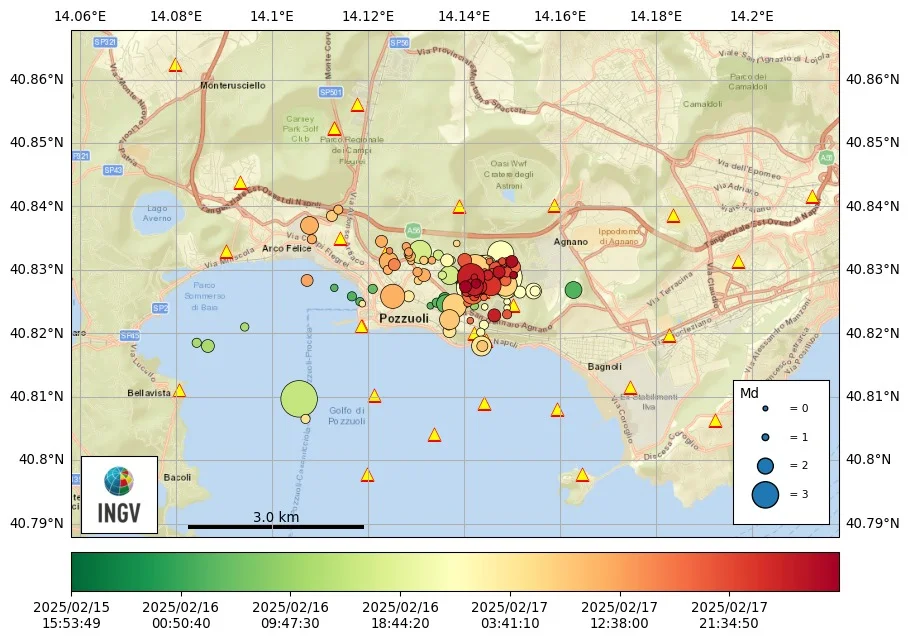
An intense earthquake swarm is in progress in the Campi Flegrei volcanic caldera, southern Italy, since 15:53 UTC on February 15, 2025. More than 556 earthquakes with magnitudes up to M3.9 were registered by 13:00 UTC on February 18. As a precautionary measure, schools in the town of Pozzuoli, which is close to the epicenter of the earthquakes, are closed today.

Earthquakes detected in Campi Flegrei area, Italy from February 15 - 18, 2025. Credit: INGV, The Watchers
An intense earthquake swarm started at Campi Flegrei volcanic caldera — also known as Phlegrean Fields — at 16:53 LT (15:53 UTC) on February 15, with the area recording more than 556 earthquakes by 13:00 UTC on February 18, according to data provided by the Italian National Institute of Geophysics and Volcanology (INGV).
The two strongest earthquakes measured M3.9. The first occurred in the Gulf of Pozzuoli at 15:30 LT (14:30 UTC) on February 16, and the second near Pozzuoli at 00:19 LT on February 17 (23:19 UTC on February 16).
In response to the increasing seismicity, Pozzuoli Mayor Gigi Manzoni ordered the closure of schools on February 18 to allow municipal technicians to conduct structural safety inspections.
The country’s Civil Protection Department also deployed volunteer emergency responders and established temporary shelters for displaced residents in Pozzuoli, Bacoli, and Naples.
Nello Musumeci, Civil Protection Minister, has appointed a special commissioner to oversee risk-prevention measures and has raised concerns over urban development in this seismically active region.
In the context of Campi Flegrei’s history, it’s worth noting that this swarm is notable but not unprecedented. For example, the 1982 – 84 bradyseismic crisis saw thousands of earthquakes, with some exceeding M4.0, leading to significant ground uplift and the evacuation of 40 000 residents.
INGV confirmed that the ongoing earthquake swarm is linked to bradyseism, a geological phenomenon in which ground levels rise or fall because of underground magma or hydrothermal activity. The Campi Flegrei region has been undergoing bradyseism since 2007, with studies indicating a steady accumulation of magma at depths of 4 to 6 km (2.5 to 3.7 miles) beneath the surface.
The ongoing swarm adds to the long history of seismic activity in the Campi Flegrei, a 13 km (8 miles) wide volcanic complex encompassing Naples and extending south into the Gulf of Pozzuoli.
The region’s geology is marked by extensive ground deformation, fumarolic activity, and seismicity because of the underlying magmatic and hydrothermal systems.
Campi Flegrei has experienced cycles of uplift and subsidence since Roman times, with the earliest known volcanic products dating back approximately 47 000 years.
The caldera was formed after two major explosive eruptions, the Campanian Ignimbrite eruption about 36 000 years ago and the Neapolitan Yellow Tuff (NYT) eruption around 15 000 years ago, which ejected over 40 km3 (9.6 mi3) of material.
After the NYT eruption, numerous smaller eruptions occurred from scattered vents both on land and underwater. Most activity was concentrated in three periods: 15 000 – 9 500 years ago, 8 600 – 8 200 years ago, and 4 800 – 3 800 years ago.
The most recent eruptions were recorded in 1158 CE at Solfatara and in 1538 CE (VEI 3) when the Monte Nuovo cinder cone was formed.
If this current swarm continues or intensifies with stronger quakes or increased ground deformation, it could approach crisis levels similar to past unrest periods. Right now, it’s a significant seismic event, but not yet at the level of a full-scale bradyseismic crisis.
References:
1 Seismic activity continues at Campi Flegrei – ANSA it English – February 17, 2025
2 Campi Flegrei earthquake swarm – INGV – Accessed on February 18, 2025
3 Campi Flegrei – GVP – Accessed on February 18, 2025

Rishika holds a Master’s in International Studies from Stella Maris College, Chennai, India, where she earned a gold medal, and an MCA from the University of Mysore, Karnataka, India. Previously, she served as a Research Assistant at the National Institute of Advanced Studies, Indian Institute of Science, Bengaluru, India. During her tenure, she contributed as a Junior Writer for Europe Monitor on the Global Politics website and as an Assistant Editor for The World This Week. Her work has also been published in The Hindu newspaper, showing her expertise in global affairs. Rishika is also a recipient of the Women Empowerment Award at the district level in Haryana, India, in 2022.

Commenting rules and guidelines
We value the thoughts and opinions of our readers and welcome healthy discussions on our website. In order to maintain a respectful and positive community, we ask that all commenters follow these rules.