
Over 200 earthquakes recorded during earthquake swarm in Campi Flegrei, Italy
An earthquake swarm began in the Campi Flegrei area of southern Italy at 16:53 LT (15:53 UTC) on February 15, 2025. The strongest in the series thus far was M3.9 on February 16.

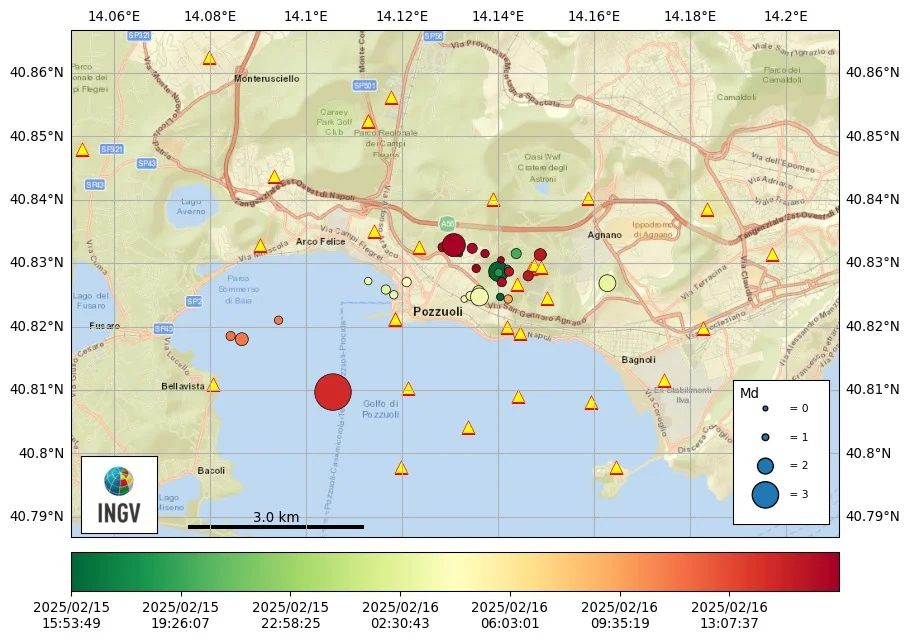
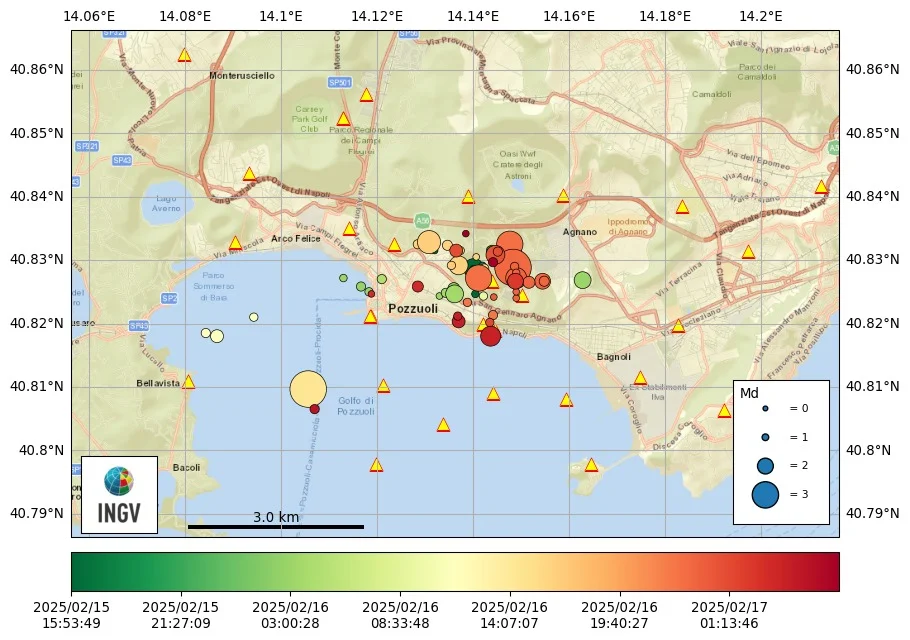
Earthquakes detected from February 15 - 17, 2025. Credit: INGV, The Watchers
A new earthquake swarm started at Campi Flegrei at 16:53 LT (15:53 UTC) on February 15. The area has recorded more than 203 earthquakes over the next 24 hours, with the strongest reaching M3.9 ± 0.3 on February 16, according to the Italian National Institute of Geophysics and Volcanology (INGV).
The earthquakes are concentrated in the caldera around Solfatara and Agnano.
The quakes are occurring at shallow depths between 0.2 km (0.12 miles) and 4.2 km (2.61 miles), a key characteristic of activity associated with ground deformation in Campi Flegrei.
Multiple earthquakes at varying depths were recorded on February 17, including M1.5 at 07:42 UTC, M2.7 at 07:14 UTC, M2.8 at 07:14:11 UTC, and M3.2 at 07:12 UTC.
The Campi Flegrei area has been experiencing increased seismic activity in recent years, with scientists closely monitoring potential geophysical changes. Further analysis will determine if the swarm is linked to ongoing subsurface magmatic processes or tectonic adjustments within the caldera.
The Campanian volcanoes, Vesuvius, Campi Flegrei, and the island of Ischia, represent the most monitored and studied volcanic areas in the world because of the risk associated with a possible resumption of volcanic activity.
The ongoing swarm adds to the long history of seismic activity in the Campi Flegrei, a 13 km (8 miles) wide volcanic complex encompassing Naples and extending south into the Gulf of Pozzuoli.
The region’s geology is marked by extensive ground deformation, fumarolic activity, and seismicity because of the underlying magmatic and hydrothermal systems.
Campi Flegrei has experienced cycles of uplift and subsidence since Roman times, with the earliest known volcanic products dating back approximately 47 000 years.
The caldera was formed after two major explosive eruptions, the Campanian Ignimbrite eruption about 36 000 years ago and the Neapolitan Yellow Tuff (NYT) eruption around 15 000 years ago, which ejected over 40 km3 (9.6 mi3) of material.
After the NYT eruption, numerous smaller eruptions occurred from scattered vents both on land and underwater. Most activity was concentrated in three periods: 15 000 – 9 500 years ago, 8 600 – 8 200 years ago, and 4 800 – 3 800 years ago.
The most recent eruptions were recorded in 1158 CE at Solfatara and in 1538 CE (VEI 3) when the Monte Nuovo cinder cone was formed.
References:
1 Campi Flegrei earthquake swarm – INGV – Accessed on February 17, 2025
2 Campi Flegrei – GVP – Accessed on February 17, 2025

Rishika holds a Master’s in International Studies from Stella Maris College, Chennai, India, where she earned a gold medal, and an MCA from the University of Mysore, Karnataka, India. Previously, she served as a Research Assistant at the National Institute of Advanced Studies, Indian Institute of Science, Bengaluru, India. During her tenure, she contributed as a Junior Writer for Europe Monitor on the Global Politics website and as an Assistant Editor for The World This Week. Her work has also been published in The Hindu newspaper, showing her expertise in global affairs. Rishika is also a recipient of the Women Empowerment Award at the district level in Haryana, India, in 2022.

Namaste!