
Eruption intensifies at Kilauea volcano with vigorous lava fountains, Hawai’i
Volcanic activity at Kilauea transitioned to a more vigorous phase at 04:00 UTC on December 29, 2024, with lava fountains rising 20 to 30 m (60 to 100 feet) high and covering 20% of the Halema’uma’u floor.
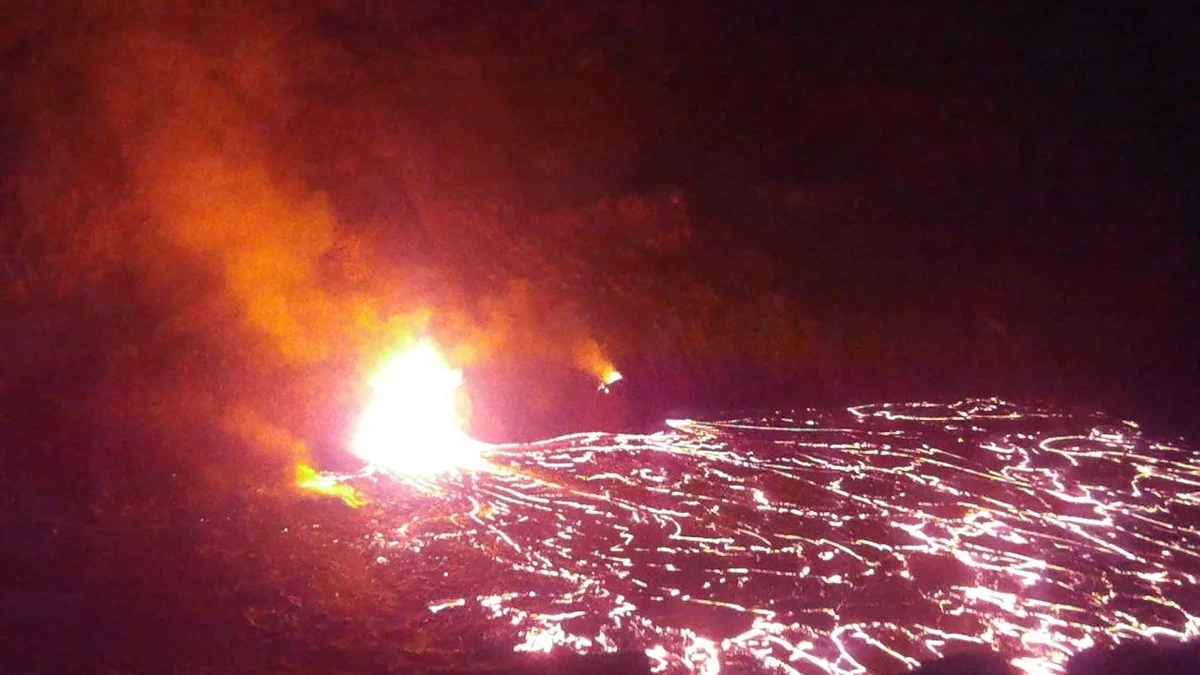
A striking view from the southern rim of Halemaʻumaʻu and the summit at Kilauea, captured at 01:16 UTC on December 29, 2024. Image credit: USGS/HVO
Volcanic activity at Kilauea intensified early December 29 (UTC), with lava fountains rising 20 to 30 m (60 to 100 feet) high. The molten rock had covered approximately 20% of the Halema’uma’u floor by this time.
Tremors steadily increased during this time but remained lower than those observed in the previous episodes. The lava fountaining that began at 17:15 LT (03:15 UTC, December 29) heralded a shift to more vigorous activity.
Tiltmeter readings from Uekahuna showed inflation beneath the summit continuing until 01:00 UTC followed by a flattening trend. Deflation was detected in the south region starting around 23:00 UTC on December 28.
Eruptive activity was sluggish earlier with lava emerging from northern vents on December 26. The low-effusion rate persisted for 2.5 days and was characterized by slow-moving lava flows.
Read more:
The current eruption began early on December 23 at approximately 12:20 UTC following increased seismic activity and rapid summit deformation detected around.
Lava fountains erupted from vents on the southwestern side of Halema’uma’u and reached heights of nearly 91 m (300 feet), spreading over 2.6 km2 (1 mi2) of the floor and covering about 25% of the Kaluapele summit area.
The U.S. Geological Survey (USGS) briefly raised the Aviation Color Code to Red and the Volcano Alert Level to Warning at 14:30 UTC. SO2 emissions during this initial phase exceeded 90 000 tonnes per day but decreased as the activity slowed.
The eruption paused around 02:00 UTC on December 24 after lava flows drained back into the eruptive vents. The phenomenon is known as a “drainback” and has been observed in previous eruptions including during the 1959 Kilauea Iki event.
After activity resumed on the morning of December 24, the eruption entered a second pause on December 25, before low-level lava effusion briefly resumed at 18:00 UTC on December 26.
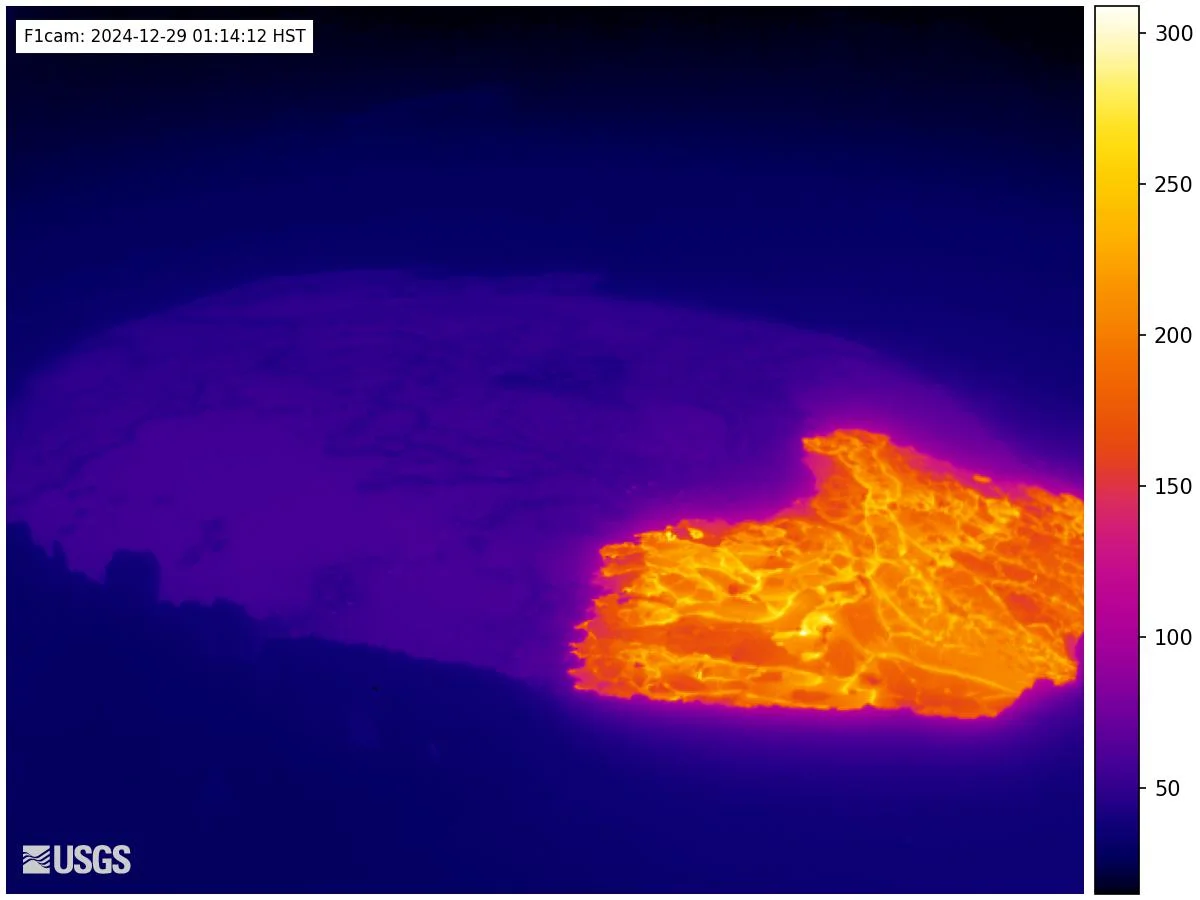
The eruption resumed again around 03:45 UTC on December 27, with lava fountains producing sluggish flows confined near the active vents though reduced in vigor. Volcanologists from the Hawaiian Volcano Observatory (HVO) report ongoing inflation at the summit signaling potential for continued activity.
The earlier eruptions took place in the Southwest Rift Zone in June and the East Rift Zone in September.
Kilauea had periods of activity throughout 2024 from September 15 to October 17. Fissures in the middle East Rift Zone produced lava flows covering approximately 0.63 km2 (0.24 mi2). During this phase, SO2 emissions peaked at 10 000 tonnes per day and lava effusion rates ranged between 5 and 15 m3 (176 to 530 feet3) per second.
Eruptive activity paused on October 17, and by September 23, alert levels were downgraded as seismicity and magma movement subsided.
Kīlauea’s eruptions are part of its long history of frequent volcanic activity, with over 74 confirmed eruptive periods during the Holocene. Main events include the prolonged East Rift Zone eruption from 1983 to 2018, which generated lava flows covering over 100 km2 (38 mi2), destroyed numerous homes, and expanded Hawai’i’s coastline.
Kīlauea is a basaltic shield volcano overlapping the eastern flank of Mauna Loa with a 3 x 5 km (1.9 x 3.1 miles) caldera that formed around 1 500 years ago. Its surface consists of lava flows younger than 600 years. The volcano is situated in an intraplate oceanic crust setting less than 15 km (9.3 miles) thick.
Ongoing hazards include elevated levels of volcanic gases, like SO2 and CO2, which can pose health risks to children and those with respiratory conditions. Other risks include rockfalls, ground cracking, and potential instability of the Halema’uma’u crater walls.
Residents and visitors are advised to minimize exposure to volcanic smog (vog).
References:
1 Kilauea volcano status report – HVO – Issued at 04:25 UTC on December 29, 2024
2 Kilauea – GVP – Accessed on December 29, 2024

Rishika holds a Master’s in International Studies from Stella Maris College, Chennai, India, where she earned a gold medal, and an MCA from the University of Mysore, Karnataka, India. Previously, she served as a Research Assistant at the National Institute of Advanced Studies, Indian Institute of Science, Bengaluru, India. During her tenure, she contributed as a Junior Writer for Europe Monitor on the Global Politics website and as an Assistant Editor for The World This Week. Her work has also been published in The Hindu newspaper, showing her expertise in global affairs. Rishika is also a recipient of the Women Empowerment Award at the district level in Haryana, India, in 2022.

Commenting rules and guidelines
We value the thoughts and opinions of our readers and welcome healthy discussions on our website. In order to maintain a respectful and positive community, we ask that all commenters follow these rules.