
Earthquake swarm in Hofsjökull volcano, Iceland

Map showing earthquake swarm activity around Hofsjökull volcano, Iceland, including the largest M3.3 on December 13, 2024. Image credit: TW/SAM, Google
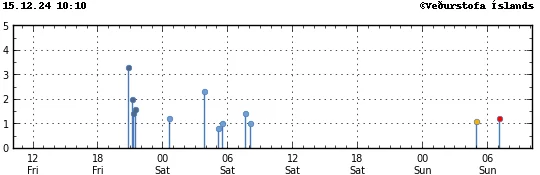
A notable earthquake swarm was registered in Hofsjökull volcano on December 13, with the largest earthquake detected as M3.3, occurring at 20:48 LT at a depth of 8.8 km (5.5 miles). The earthquake was centered near the western edge of Hofsjökull’s summit, located approximately 26 km (16 miles) east-southeast of Hveravellir.
Hofsjökull is an ice-capped volcano located in central Iceland, spanning 7 x 11 km (4.3 x 6.8 miles) beneath a glacier.
Icelandic Met Office (IMO) identified several smaller seismic events, ranging from M1.0 to M2.3, occurring at depths between 3.2 km (2 miles) and 10.6 km (6.6 miles).
A total of 12 earthquakes were recorded during this swarm, including 1 event with a magnitude less than 1, 8 events ranging from M1 to M2, 2 events between M2 to M3, and 1 event with a magnitude greater than 3.
Smaller earthquakes were recorded near Hofsjökull on December 14 and December 15, including an M2.3 event at a depth of 5.1 km (3.2 miles) on December 14.

Most recent data from December 15 includes an M1.2 earthquake located 25.9 km (16 miles) east-southeast of Hveravellir at a depth of 5.1 km (3.2 miles).
The swarm seems to have subsided for now, but experts caution that earthquake activity may resume in the same area in the coming days or weeks.
Hofsjökull volcano, situated at the glacier’s western edge, has not erupted in approximately 12 000 years. Flank fissures in the region have produced basaltic lava flows during the Holocene. A related volcanic system, nearby Kerlingarfjöll, features active fumaroles and steep-sided rhyolitic domes, showing Iceland’s diverse volcanic landscape.
Hofsjökull volcano connects Iceland’s 2 primary rift zones, bridging the Reykjanes-Langjökull rift in the west and the northeast rift zone in east-central Iceland. The area is characterized by basaltic and rhyolitic volcanic products, reflecting its complex magmatic history.
References:
1 Earthquake swarm in Hofsjökull volcano – Iceland Geology – December 13, 2024
2 Hofsjökull – earthquakes during the last 48 hours – IMO – December 15, 2024
3 Hofsjökull – GVP – Accessed on December 15, 2024

Rishika holds a Master’s in International Studies from Stella Maris College, Chennai, India, where she earned a gold medal, and an MCA from the University of Mysore, Karnataka, India. Previously, she served as a Research Assistant at the National Institute of Advanced Studies, Indian Institute of Science, Bengaluru, India. During her tenure, she contributed as a Junior Writer for Europe Monitor on the Global Politics website and as an Assistant Editor for The World This Week. Her work has also been published in The Hindu newspaper, showing her expertise in global affairs. Rishika is also a recipient of the Women Empowerment Award at the district level in Haryana, India, in 2022.
Published in the last 24 hours
- In September 1859, a solar storm lit up the night sky so brightly that gold miners in the Rocky Mountains woke up after midnight and started cooking breakfast, convinced the aurora glowing over their camp was the sunrise Epicenter
- A patch of warm Pacific water that could become the strongest El Niño in more than 70 years sits thousands of miles from any American town, yet it is already the main reason NOAA expects a wetter winter across the South and a milder one across the North
- A 19-year-old Nebraska teacher reportedly tied her pupils together with twine and led them to safety through a blizzard in January 1888 Epicenter
