
Radar images of asteroid 2024 ON during close approach to Earth on September 17
NASA’s Deep Space Network Goldstone Solar System Radar captured images of asteroid 2024 ON during its close approach to Earth last week, at a safe distance of 2.6 LD (~1 million km / 620 000 miles) from Earth.
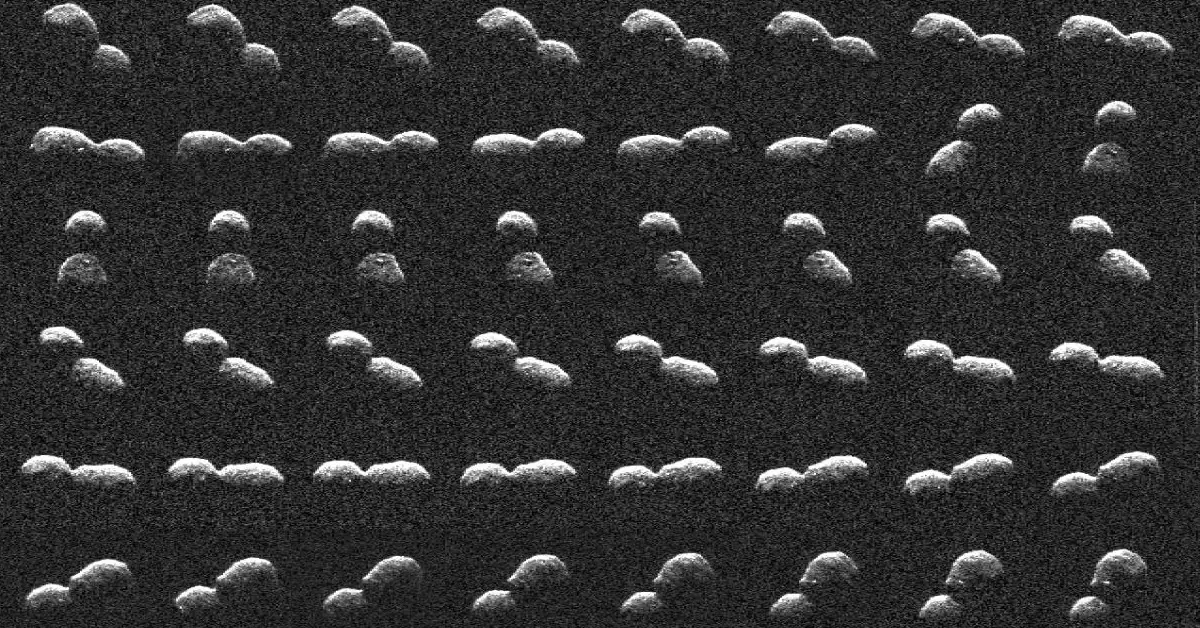
Image credit: NASA/JPL-Caltech
NASA’s Deep Space Network Goldstone Solar System Radar imaged asteroid 2024 ON – first observed by the NASA-funded ATLAS survey in Hawaii on July 27 – as it safely flew past Earth on Tuesday, September 17, 2024, at a safe distance of 1 million km (620 000 miles), approximately 2.6 times the distance between Earth and the Moon (LD).
Radar measurements showed the asteroid’s unique peanut shape, with two distinct lobes joined by a slender neck.
Similar to the asteroid 2024 JV33, which made a close approach to Earth a month prior, 2024 ON is likely a contact binary. This means it has two rounded lobes, separated by a distinct neck, with one lobe about 50% larger.
Radar images have revealed that 2024 ON measures approximately 350 m (1 150 feet) in length, with surface features as small as 3.75 m (12.3 feet) visible.
Bright radar spots observed on the surface are likely large boulders. The images capture about 90% of the asteroid’s rotation, which takes approximately six hours.
The radar images were captured just a day before the asteroid made its closest approach.

NASA is constantly monitoring near-Earth objects such as 2024 ON to determine any potential risks they may pose. Despite being classed as “potentially hazardous” due to its size and proximity, this asteroid presented no threat during its pass.
Monitoring such objects is essential to NASA’s planetary defense strategy, as it allows scientists to improve their understanding of asteroid orbits and reduce uncertainties about future impacts.
The Goldstone Solar System Radar captured precise photos of the asteroid as it approached, allowing astronomers to establish its size, shape, and rotational properties. This form of radar imaging is essential for analyzing near-Earth objects and predicting their future trajectories with higher accuracy.
References:
¹ PIA26451: NASA’s Planetary Radar Spies (Another) Peanut-Shaped Asteroid – NASA/JPL – Accessed September 20, 2024

Harsha Borah is an experienced content writer with a proven track record in the industry. Harsha has worked with LitSpark Solutions and Whateveryourdose, honing skills in creating engaging content across various platforms. A gold medalist in a state-level writing competition organized by Assam Tourism, Harsha’s travelogue on Tezpur was widely appreciated. Harsha’s article, "The Dark Tale of the Only Judge in India to Be Hanged," ranks second on Google and has garnered over 11 000 views and 8 900 reads on Medium. Outside of writing, Harsha enjoys reading books and solving jigsaw puzzles.

Commenting rules and guidelines
We value the thoughts and opinions of our readers and welcome healthy discussions on our website. In order to maintain a respectful and positive community, we ask that all commenters follow these rules.