
Typhoon “Bebinca” strikes southern Jiangsu, China as the strongest typhoon since records began
Typhoon “Bebinca” struck Jiangsu province in China on Monday, September 16, 2024, with gust speeds of 151 km/h (94 mph), making it the strongest typhoon to hit the province since records began.
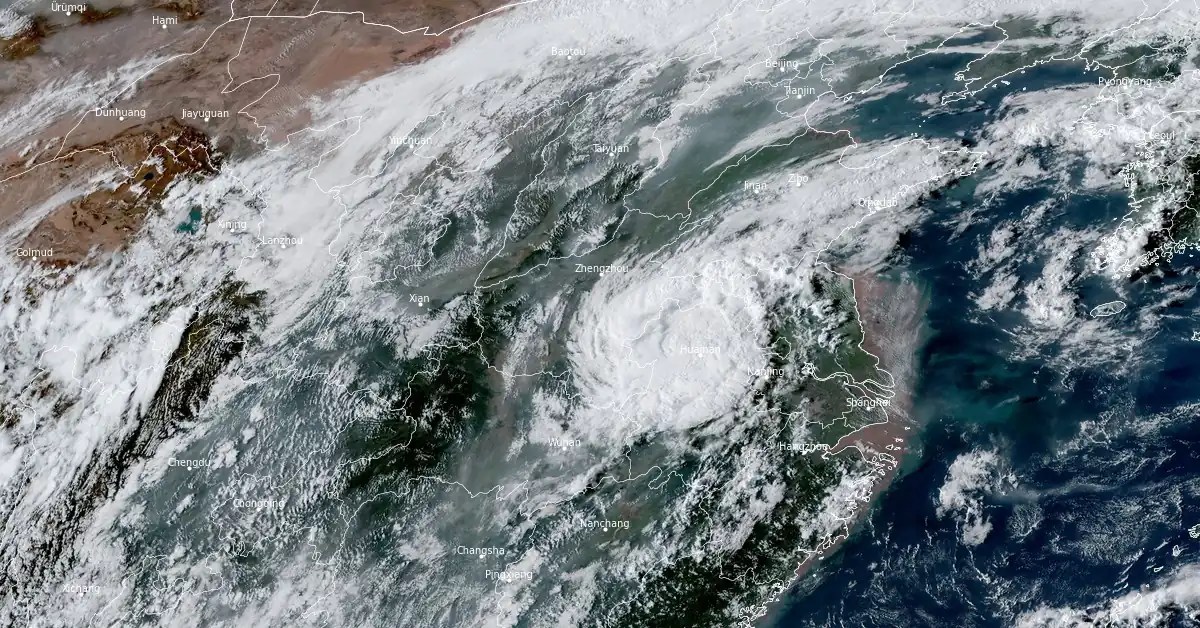
Image credit: JMA/Himawari-9, RAMMB/CIRA, The Watchers. Acquried at 08:00 UTC on September 17, 2024
Typhoon “Bebinca” is now the strongest typhoon to hit southern Jiangsu since meteorological records there began. The maximum gust speeds recorded in Suzhou were around 150 km/h (94 mph) and in Wuxi, the speeds clocked in at 139 km/h (86 mph). Both of these records broke the previous records for gust speeds.
Winds at the Jiangsu Sutong Bridge were so powerful that drivers struggled to keep their vehicles in place and prevent them from toppling over. Visuals online show a truck driver on the bridge holding on to his truck to prevent the winds from turning his truck over.
The storm also produced more than a dozen tornadoes in northern parts of the province.
Bebinca made landfall in Shanghai on Monday, September 16 at around 07:30 local time (LT), bringing heavy rains, strong winds, and severe flooding along with it. It was the strongest storm to hit the city since Typhoon “Gloria” which struck in 1949.
By Monday afternoon Bebinca had weakened as it moved to the Jiangsu Province were it brought strong winds and heavy rains. As of 06:00 LT on Monday, 46 300 people had been relocated across Jiangsu, and over 20 000 vessels had taken shelter from the typhoon, according to the Provincial Flood Control and Drought Relief Headquarters.
Several bridges over the Yangtze River and expressways across Jiangsu implemented traffic control measures on Monday, while several subway sections in Nanjing, Suzhou, Wuxi, and other cities in the province suspended operations.
The province mobilized more than 130 000 inspection personnel, including 33 500 conducting dike inspections and risk assessments.
The storm had already caused widespread damage across Shanghai, where roughly 10 000 trees fell due to the strong winds. The storm caused 414 000 people in the city to evacuate before it even made landfall. Upon landfall, the city saw severe flooding and winds clocking in at 151 km/h (94 mph). Roughly 60 000 rescue workers and firefighters had to be deployed in the affected regions.
At least 1 person was injured, 380 homes were left without power, 4 houses were damaged, and 53.4 ha (132 acres) of land was affected. More than 14 00 flights and 570 trains were also canceled due to the storm.

I am an Assistant Editor and Severe Weather & Science Journalist at The Watchers, specializing in real-time severe weather coverage, geophysical event reporting, and research-driven scientific analysis. You can reach me at rishav(at)watchers(.)news.

Commenting rules and guidelines
We value the thoughts and opinions of our readers and welcome healthy discussions on our website. In order to maintain a respectful and positive community, we ask that all commenters follow these rules.