
Increased volcanic activity at Home Reef volcano in Tonga, sailors advised to maintain distance

Featured image: Satellite image of Home Reef volcano on June 15, 2024. Credit: Copernicus EU/Sentinel-2, The Watchers
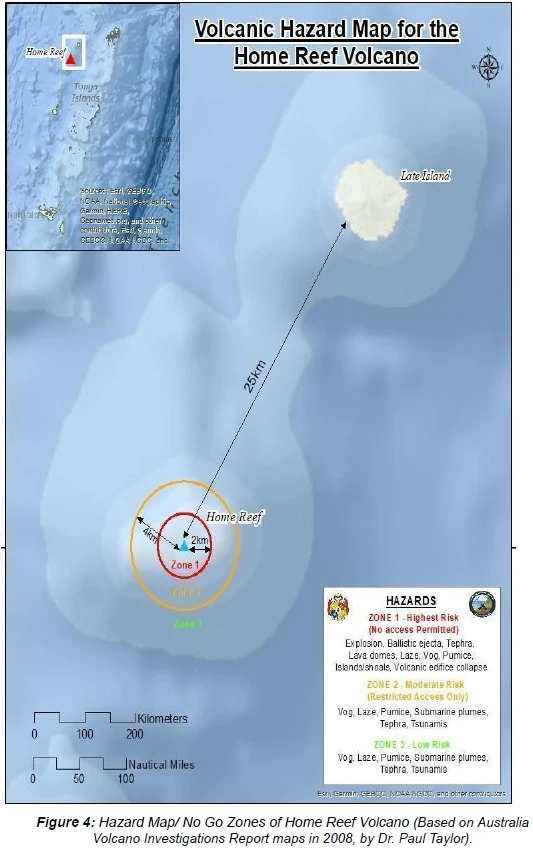
Tonga Geological Services is reporting increased volcanic activity at Home Reef volcano, urging all mariners to stay away at least 4 km (2.4 miles) from the volcano.
Over the past 24 hours, two new volcanic thermal anomalies were recorded at the volcano, showing an increased trend to a moderate stage.
As per the latest update from the GOES-18 ABI satellite, ash and clouds are being emitted out of the volcano and are moving southeast. Moderate thermal anomalies were present as per the latest Mordis Mirova satellite imagery from June 17, which indicates a rise in the volcanic radiative power (VRP) compared to the non-numeric VRP values shown on June 16.
Volcanic Radiative Power (VRP) is a measure of the thermal energy emitted by a volcanic eruption in the form of infrared radiation. This metric is useful for quantifying the intensity and magnitude of volcanic activity, particularly during eruptions.

In 24 hours to 14:40 LT on June 17, the Tonga Geological Services recorded a total of 7 thermal anomalies, compared to the 3 that were detected in the 24 hours before that.
According to their public notice released on June 17, a strong anomaly was detected in the Sentinel-2 satellite imagery from June 15 that suggested a new batch of magma rising from the volcano’s feeder pipe. The advancing lava flow is enlarging the island towards the east, and the volcano’s shape appears to be more rounded now.
The volcanic activity poses a low risk to Vava’u and Ha’apai communities but sailors are advised to sail beyond 4 km (2.4 miles) from Home Reef until further notice.

The last eruption at this volcano was in 2023 when pilots reported ash plumes up to 300 m (984 feet) on October 17 and 18.
From May 22 to September 9, 2022, Sentinel-2 satellite images revealed visible discolored water plumes, indicating underwater volcanic activity.
On September 10, 2022, a significant eruption occurred, producing both lava flow and a new island. By 01:39 LT, a volcanic gas plume was detected, and by 12:59 LT, a new island about 70 m (229.65 feet) in diameter and 10 m (32 feet) high was visible.
Further activity on September 19 – 20 saw ash-laden plumes rise to 3 km (1.6 miles) a.s.l., followed by another event on October 5 with an ash plume reaching 3 km (1.8 miles) a.s.l. and drifting 5 km (3.10 miles) southeast.
Another island formed during major eruption on August 7 and 8, 2006. By August 12, the island was approximately 1.5 km (0.9 miles) wide. Pumice rafts from this eruption reached Fiji and the east Australian coast by March-April 2007. Erosion reduced the island to a 75 m (246.06 feet) wide fragment by December.
Another significant eruptive period from March 1 to 5, 1984, produced an explosion column reaching 12 km (7.4 miles) high and formed a new island measuring 500 m (1640 feet) by 1 500 m (4921 feet) and 30 m (98 feet) to 50 m (164 feet) high. Explosions continued until March 5, with water discoloration extending into April. Large pumice rafts indicated the eruption’s strength and far-reaching effects.
References:
1 Public notice on Home Reef volcano #1 – Tonga Geological Services – June 17, 2024
2 Public notice on Home Reef volcano #2 – Tonga Geological Services – June 18, 2024
3 Geological summary and eruptive history – Home Reef – GVP

I am an Assistant Editor and Severe Weather & Science Journalist at The Watchers, specializing in real-time severe weather coverage, geophysical event reporting, and research-driven scientific analysis. You can reach me at rishav(at)watchers(.)news.

Commenting rules and guidelines
We value the thoughts and opinions of our readers and welcome healthy discussions on our website. In order to maintain a respectful and positive community, we ask that all commenters follow these rules.