
Activity at Ambrym volcano increased to major unrest state, Vanuatu
Featured image: Ambrym volcano on January 25, 2022. Credit: VMGD
Activity at Ambrym volcano in Vanuatu has increased from the minor unrest state to the major unrest state on January 25, 2022. Consequently, the Vanuatu Meteorology and Geo-hazards Department (VMGD) has raised the Volcanic Alert Level from Level 1 to Level 2.
New scientific analysis suggests that the activity at Ambrym volcano has increased significantly at around 04:00 LT on January 25, 2022.1
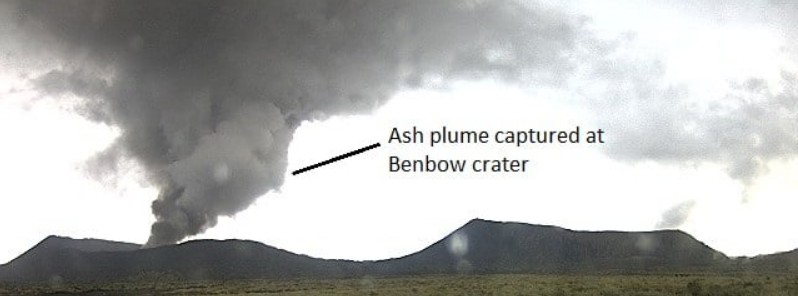
While seam emissions were observed at the Marum crater, significant steam, ash and gas emissions were observed at Benbow since 05:15 LT this morning. Volcanic hazards remain at the summit craters area and the southeast part of Ambrym Island (e.g., major cracks from 2018).
Latest observations and daily analysis of the Ambrym seismic data from the volcano monitoring system confirm that the Ambrym volcano activity has increased and is continuing in the Major unrest Level.
The lava lakes that used to appear in Benbow and Marum craters have disappeared since the December 2018 eruption. The remaining activity inside active craters consists of ongoing steam emissions.

Image credit: VMGD
While people from Ambrym and neighboring islands will not see the volcanic glow at night, with this current volcanic activity, it is a useful reminder that eruptions can occur at any level of unrest with little or no warning, VMGD said.
All tourism agencies, local authorities, people of Ambrym and the general public are reminded that due to the current volcano activity and presence of cracked areas at the caldera, the danger zone remains at the Permanent Exclusion Zone at Benbow and the Danger Zone A at Marum which are set about a radius of 1 km (0.6 miles) from Benbow and 2 km (1.2 miles) from Marum.
There are life safety hazards within these hazard zones, VMGD warns.
Due to the presence of active rifts and faults at the South-East area of Ambrym, communities concerned are advised not to access within 500 m (X feet) from major cracks (Danger Zone). There is a possibility (low) that earthquake or volcanic activity may start from this area.

Image credit: VMGD
Geological summary
Ambrym, a large basaltic volcano with a 12 km (7.4 miles) wide caldera, is one of the most active volcanoes of the New Hebrides arc. A thick, almost exclusively pyroclastic sequence, initially dacitic, then basaltic, overlies lava flows of a pre-caldera shield volcano.
The caldera was formed during a major plinian eruption with dacitic pyroclastic flows about 1 900 years ago. Post-caldera eruptions, primarily from Marum and Benbow cones, have partially filled the caldera floor and produced lava flows that ponded on the caldera floor or overflowed through gaps in the caldera rim.
Post-caldera eruptions have also formed a series of scoria cones and maars along a fissure system oriented ENE-WSW. Eruptions have apparently occurred almost yearly during historical time from cones within the caldera or from flank vents. However, from 1850 to 1950, reporting was mostly limited to extra-caldera eruptions that would have affected local populations.2
References:
1 VANUATU VOLCANO ALERT BULLETIN N°1 – AMBRYM ACTIVITY – VMGD – Tuesday January 25th 2022
2 Ambrym – Geological summary – GVP

I'm a dedicated researcher, journalist, and editor at The Watchers. With over 20 years of experience in the media industry, I specialize in hard science news, focusing on extreme weather, seismic and volcanic activity, space weather, and astronomy, including near-Earth objects and planetary defense strategies. You can reach me at teo /at/ watchers.news.

Commenting rules and guidelines
We value the thoughts and opinions of our readers and welcome healthy discussions on our website. In order to maintain a respectful and positive community, we ask that all commenters follow these rules.