
Acid rain from Ambae reaches four islands as Vanuatu readies emergency response
Ambae’s Manaro Voui volcano remained in minor eruption on March 6, 2026, as Vanuatu’s government approved emergency response measures after acid rain and ash impacts spread beyond the island. Authorities maintained Alert Level 3 and prepared evacuation plans in case activity escalates further, but said no mass evacuation had been ordered at this stage.

Image credit: VMGD
Vanuatu’s Meteorology and Geo-Hazards Department maintained Volcanic Alert Level 3 over Ambae volcano as of March 6, with the official danger area remaining Danger Zone B, extending 3 km (1.8 miles) around the active vents inside Lake Voui.
The activity prompted Vanuatu’s cabinet to convene an emergency meeting on March 6 as authorities assessed whether the ongoing activity could require a broader evacuation response. Prime Minister Jotham Napat said that activity at Manaro volcano is increasing, and Penama province is preparing evacuation plans for a possible eruption, Radio New Zealand reports.
The National Disaster Management Office (NDMO) is monitoring activity, and authorities are urging residents to be ready to evacuate.
The current activity at the volcano is characterized by sustained ash and volcanic gas emissions, elevated seismic unrest, continuing signs that magma is close to the surface, and production of acid rain – one of the most widespread and immediately damaging consequences of the current phase, with effects now extending well beyond Ambae itself.
VMGD Director Levu Antfalo confirmed that acid rain had reached the islands of Santo, Malakula, Pentecost, and Ambrym, a significant geographic spread from the eruption source. Ambae lies approximately 310 km (190 miles) northwest of the capital Port Vila, but the reach of its acid rain output shows that the hazard footprint of the current eruption is not confined to the island’s resident population.
Antfalo explained that sulfur dioxide emissions react with rainfall to produce sulfuric acid precipitation, which burns crops on contact and degrades any uncovered water supply, including wells, open drums, and rainwater tanks.
“It burns their protein source, like vegetables,” Antfalo said, adding that rivers and freshwater sources are also being affected, with elevated acidity harming fish and prawns.
Weekly activity reporting compiled by the Smithsonian Institution’s Global Volcanism Program for the period February 25–March 4, based on VMGD observations and satellite data, said seismicity remained high and was characterized by continuous volcanic tremor and volcano-seismic events. Gas-and-ash emissions continued through that period, and high sulfur dioxide output persisted in satellite observations.
The eruption intensified after a long period of unrest that had remained below the eruptive threshold. Before the current phase, Manaro Voui had been held at Alert Level 2 since at least late 2021, with unrest marked mainly by steam and gas emissions and a smaller exclusion zone.
By late February, the activity had shifted into a clear eruptive phase, and the alert level was raised to 3 as the hazard footprint expanded around the summit vent system.
Observed plume heights confirm that the eruption is producing ash-bearing emissions capable of affecting areas beyond the immediate crater. Plumes peaked at approximately 4 900 m (16 100 feet) above sea level on February 24, the highest recorded in the current phase, with subsequent episodes during February 28–March 4 reaching up to 4.3 km (2.7 miles) above sea level.
On March 5, VMGD confirmed that volcanic cloud emissions were continuing and that the plume contained ash and sand. The emissions are significant on Ambae because ashfall can contaminate water supplies, damage crops, reduce air quality, and create additional loading on roofs and exposed infrastructure.
Volcanic gas is a second major hazard in the current phase. Satellite observations detected high sulfur dioxide concentrations during the eruption, indicating continued magmatic degassing. Sulfur dioxide exposure can aggravate respiratory conditions and, when combined with rainfall, can contribute to acid deposition that affects crops, surface water, and roofing materials.
On a densely inhabited volcanic island with limited alternative ground, that hazard has practical consequences even without a major explosive escalation.
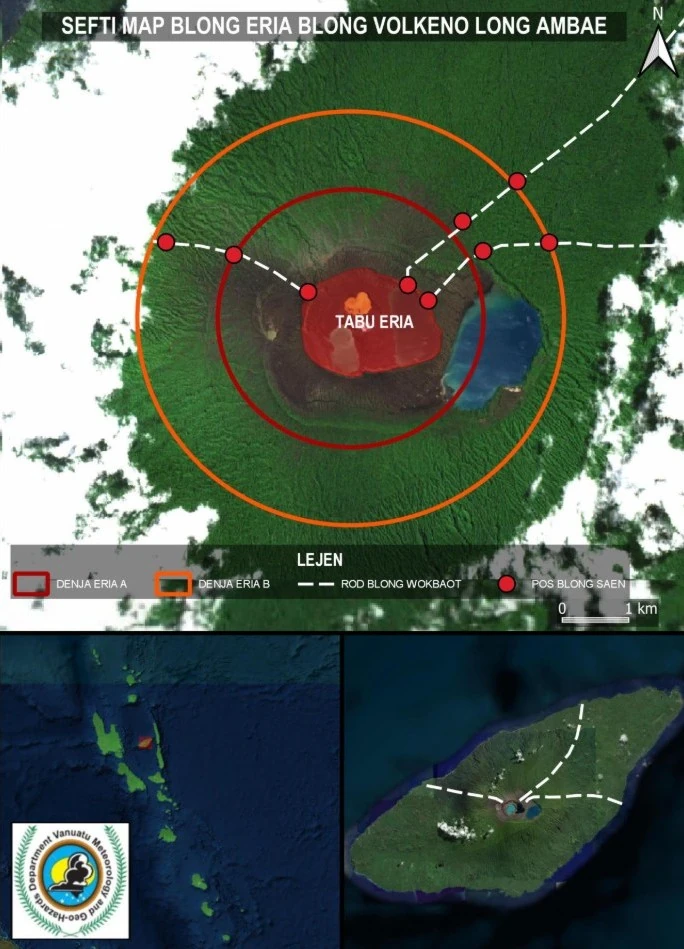
The exclusion zone around the active vent remains the most immediate life-safety measure. A 3 km (1.8 miles) radius around Lake Voui is currently off limits because of the risk from eruptive activity close to the crater, including ash-rich emissions and proximal ejecta.
VMGD warnings have specifically directed residents to avoid drainages and river channels during heavy rainfall. Fresh ash deposits can be rapidly remobilised into lahars, which can move downslope with little warning and affect areas well outside the crater rim.
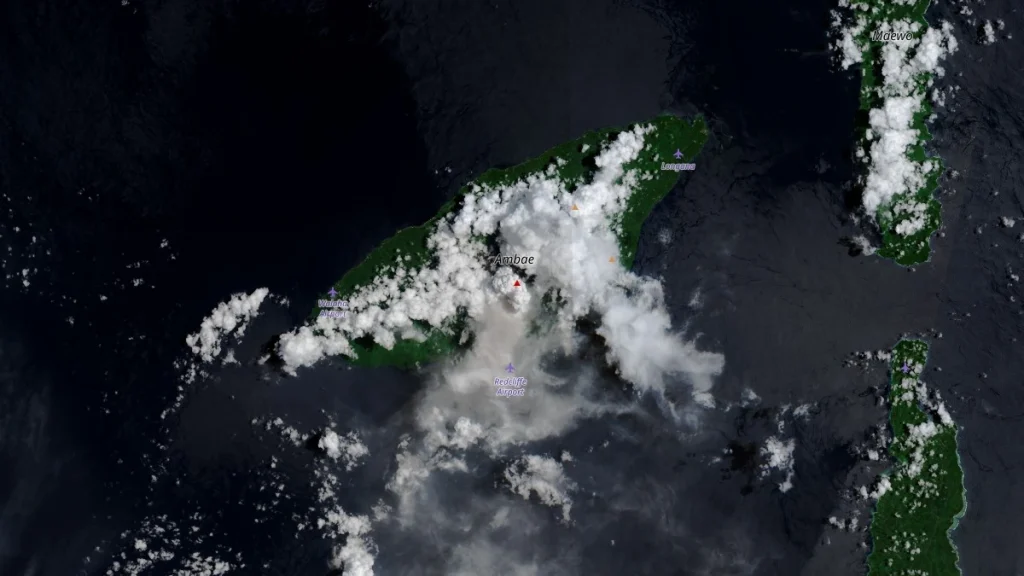
Ambae has a resident population of approximately 11 000 and no separate high-ground refuge outside the volcanic edifice itself. That geography means evacuation planning is not a precautionary detail but a main part of hazard management.
Ambae was fully evacuated in 2017 after the volcano escalated to Alert Level 4, described by the National Disaster Management Office as the first time in living memory an entire island’s population had been evacuated due to volcanic activity.
A second large-scale displacement followed in 2018 during another major crisis, when ash deposits up to 30 cm (1 foot) deep blanketed parts of the island, and the government considered permanent relocation.
Those two eruptive events showed that conditions on the island can deteriorate quickly once eruptive activity intensifies and ashfall, gas exposure, flooding, and slope instability begin to overlap. The current situation has not yet reached that threshold, but the earlier evacuations explain why authorities are acting before a new island-wide order has been issued.
References:
1 Vanuatu’s cabinet holds emergency meeting as Ambae volcano escalates – RNZ – March 6, 2026
2 Acid rain falls on Vanuatu islands as volcano continues to belch ash – RNZ – March 6, 2026
3 Ambae volcano – GVP – Accessed on March 6, 2026

I'm a dedicated researcher, journalist, and editor at The Watchers. With over 20 years of experience in the media industry, I specialize in hard science news, focusing on extreme weather, seismic and volcanic activity, space weather, and astronomy, including near-Earth objects and planetary defense strategies. You can reach me at teo /at/ watchers.news.

Commenting rules and guidelines
We value the thoughts and opinions of our readers and welcome healthy discussions on our website. In order to maintain a respectful and positive community, we ask that all commenters follow these rules.