
Tornado leaves at least four dead and more than a dozen injured in southwest Michigan, United States
Severe storms and tornadoes struck southwest Michigan, United States, on March 6, 2026, killing at least four people and injuring more than a dozen in Branch and Cass counties. Homes were destroyed, trees uprooted, and power infrastructure damaged as emergency crews carried out search and rescue operations through the night.
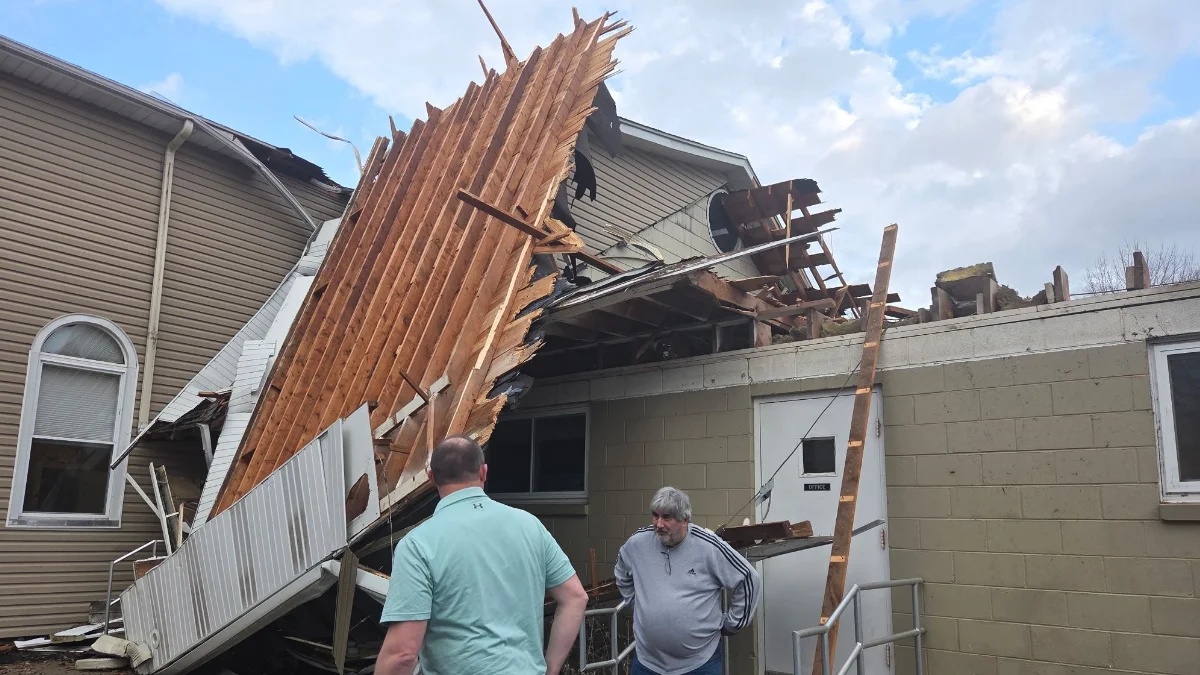
First Congregational United Church of Christ in Union City damaged by a tornado in southwest Michigan on March 6, 2026. Credit: First Congregational United Church of Christ in Union City
Severe storms and tornadoes moved across southwest Michigan on March 6, causing fatalities and widespread damage in Branch and Cass counties. Authorities continued response operations overnight as crews searched damaged areas and treated injured residents.
In Branch County, three people were killed, and 12 were injured in the Union Lake area near Union City, according to the Branch County Sheriff’s Office. Three of the injured were hospitalized.
Emergency responders conducted search and rescue operations through the night while medical teams treated injured residents.
Part of the First Congregational United Church of Christ in Union City was damaged, although its nearly 150-year-old grand piano was spared.
“There was only one person there at the time, and they are unharmed. While we are still assessing the damage, it appears to have struck the office side of the building, but missed the sanctuary (including the Steinway piano). The parsonage also appears to be in good shape. No one was home at the time,” the church said.
In Cass County, one fatality and several injuries were reported after a tornado touched down near Edwardsburg on the afternoon of March 6. Cass County Emergency Manager Manny DeLaRosa said multiple large structures, including homes and pole barns, sustained damage ranging from major structural impacts to complete destruction.
Cass County Sheriff Clint Roach reported several injuries in addition to the confirmed fatality, reported WZZM 13.
Cass County Board Chair Jeremiah Jones issued the local state of emergency Friday evening, as local resources are being stretched to their limits, and the county may need additional assistance. Heavy rainfall on the evening of March 6 delayed some cleanup efforts, which are expected to continue on March 7.
Widespread power outages were reported across the affected regions. Midwest Energy and Communications reported that 1 458 customers were without power at 21:00 local time (LT) on March 6.
Michigan Governor Gretchen Whitmer activated the state’s Emergency Operations Center to assist local authorities and coordinate resources for the affected counties. State officials said the center would help monitor the evolving situation and support response efforts.

I am an Assistant Editor and Severe Weather & Science Journalist at The Watchers, specializing in real-time severe weather coverage, geophysical event reporting, and research-driven scientific analysis. You can reach me at rishav(at)watchers(.)news.

My healing prayers to all affected.
Last EF4 tornado was April 02, 1977. F3 hit Gaylord 2022, Kalamazoo 1980 then some nasty pre that date which ’53, ’56,’ 65 example years… may give us a pointer, thermally…
We’ve had deeper, longer CONUS northern cold (why?) with warm ocean-temp anomalies off California, and, humidity to catalyse.
Interesting seeing the seismicity (triggers) ramp contiguously USA. Biased to say ‘No link!’
Look at that tornado vortex and tell me you can’t see electrostatic-stress in the driving seat?
Wider, look at the arctic vortex split, think static in dry air, charge movement in the rarefied stratosphere, nested rotation because planet-spin, vectors and even the possibility of zero-sum loci -where does that energy go?
Electrons, charge-separation. Recall the development of magnetic-field difference Canada-Siberia.. another ‘moment’ to ponder. Now, what about ‘Wunderwaffe’!!???
Thank you Rishav, we appreciate you.
Thank you for sharing your thoughts, Barry. Michigan has indeed experienced several notable tornado events over the decades, and historical comparisons can be helpful when examining severe weather patterns.
And I agree, large-scale climate patterns like the polar vortex and jet streams do influence these storms and their intensities.
While there is research that suggests that factors like seismic activity and electromagnetic conditions influence weather patterns in some regions, the data is still limited and requires further research to be accepted as the general consensus.