
Height of Hunga Tonga-Hunga Ha’apai eruption reached 30 km (98 500 feet) a.s.l., Tonga

Image credit: OMPS, NASA/NOAA Suomi NPP
Eruptive column produced by the massive eruption of the Hunga Tonga-Hunga Ha'apai volcano in Tonga at 04:10 UTC on January 15, 2022, likely reached a height of about 30 km (98 500 feet) above sea level.
The data is coming from Ozone Mapping and Profiler Suite (OMPS) Limb Profiler aboard the Suomi NPP satellite.
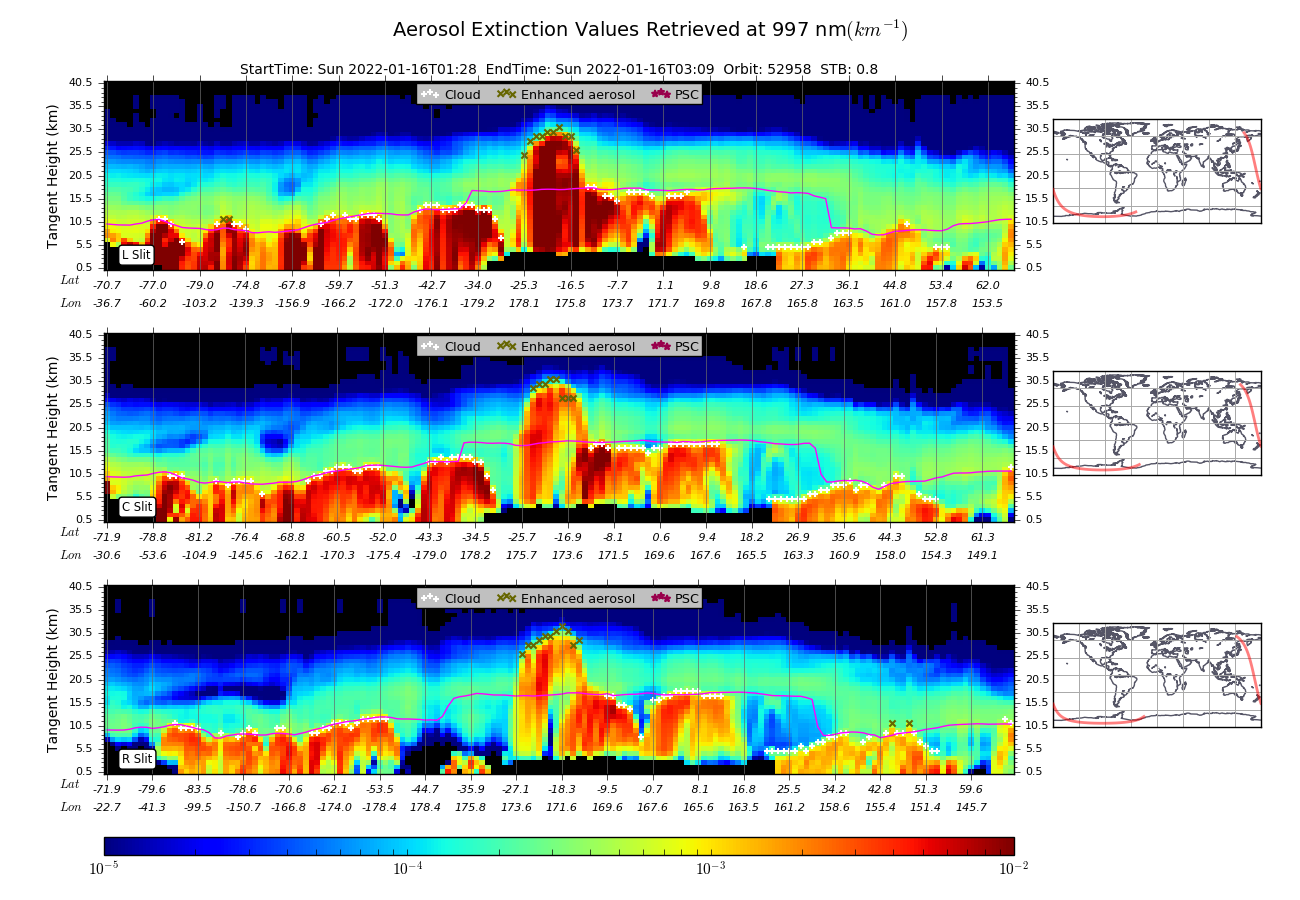 Other estimates suggest the cloud could have reached as high as 39 km (127 900 feet) a.s.l.
The eruption produced a huge shockwave that circled the planet two times.
A 1.2 m (4 feet) high tsunami hit Tonga's capital Nuku'alofa within 30 minutes of the eruption, and reached countries as far away as Japan and United States.
The Tongan Navy has reported major damage in the Ha'apai Islands after they were hit by waves estimated to be 5 – 10 meters (16 – 33 feet) in height and reaching 500 meters (1 640 feet) inland.
Authorities confirmed one fatality in Tonga, a 50-year-old British woman who died after she was washed away while trying to rescue her dongs. Two people died in Peru after tsunami waves reached South America several hours later.
All communication lines in Tonga have been disrupted, likely as a result of heavy ashfall, leaving the island nation cut off from the rest of the world.
"From what little updates we have, the scale of the devastation could be immense- especially for outer lying Islands. We are trying hard to establish contact with our colleagues at Tonga Red Cross and establish the scale and specific nature of the support they need," said Katie Greenwood, IFRC’s Pacific Head of Delegation.
Read more:
Massive eruption at Hunga Tonga-Hunga Ha'apai produces huge shockwave and 1.2 m high tsunami, Tonga – The Watchers

Teo Blašković founded The Watchers in 2011 and edited it until 2026, covering seismic and volcanic activity, extreme weather, space weather and near-Earth objects. Articles on this page are his archive.
Published in the last 24 hours
- A fog linked to about 12 000 excess deaths in London in 1952 puzzled scientists for decades, until researchers reconstructed how coal smoke formed acidic haze Epicenter
- In 2012, cameras filming a thunderstorm in western China caught ball lightning by accident, and its 1.64-second glow carried iron, silicon, and calcium from the soil it rose out of Epicenter
- Strong El Niño reinforces above-normal winter precipitation outlook across southern and eastern U.S.
