
Nashville’s wettest February on record, 3 killed in Tennessee floods

Featured image: Landslide on I-24, Tennesee. Credit: WSMV
The city of Nashville in Tennesse experienced its wettest February on record, NWS reports. This month was also its 7th wettest month of all time. Floods caused by the latest storm to hit the state left at least 3 people dead.
With 342.13 mm (13.47 inches) of rain through February 23, Nashville broke its record for wettest February since measurements began. The previous record was set in 1880 with 314.19 mm (12.37 inches). The third wettest record for the city was sed in 1890 with 278.13 mm (10.95 inches) and the fourth in 2018 with 277.11 mm (10.91 inches).
The wettest month on record for Nashville is May 2010 with 417.32 mm (16.43 inches) and the second wettest is January 1937 with 374.65 mm (14.75 inches).
This February was also the wettest month on record in Crossville – with 309.88 mm (12.20 inches) through February 23, and the fourth wettest month since records began. The wettest month on record for the city of Crossville is March 1975 with 389.63 mm (15.34 inches).
So how wet has February 2019 been so far? Here's some stats:
#1 wettest February ever in #Nashville & #Crossville
#7 wettest month of all time in #Nashville
#4 wettest month of all time in #Crossville pic.twitter.com/iM7lTyiTCy— NWS Nashville (@NWSNashville) February 24, 2019
Three people around Tennessee died due to weather-related incidents since February 6, including one in Cheatham County, FOX17 Nashville reports.
TEMA reports that a woman was swept away by swift water. A second death occurred in Hawkins County because of a mudslide and Saturday night a man died in Knox County after being submerged in a vehicle.
Water, water everywhere! Here is the rainfall total so far this record setting month. (radar estimate adjusted with gauge data) Looks like 10-15 inches for almost all of Middle Tennessee. #tnwx pic.twitter.com/xwo1MhqCZN
— NWS Nashville (@NWSNashville) February 24, 2019
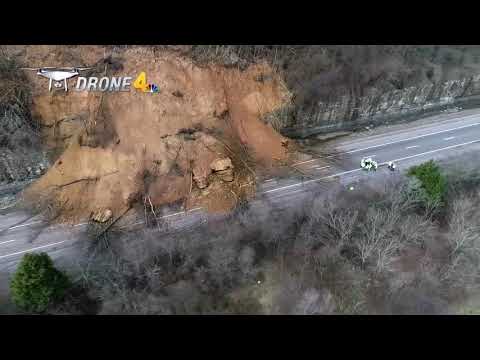
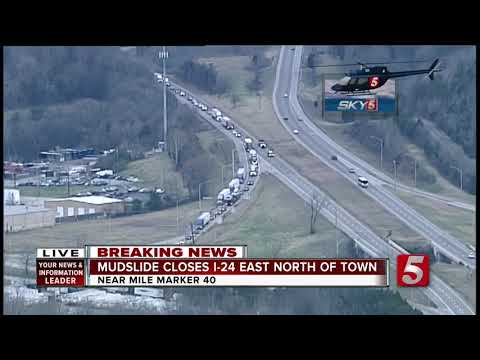
Tennessee Department of Transportation crews have a long-term closure in place on Interstate 24 eastbound in northwest Davidson County, where a landslide at mile marker 42 occurred at approximately 22:00 local time, February 23.
Traffic on I-24 eastbound is currently being diverted onto Old Hickory Boulevard at Exit 40 to I-65 or Briley Parkway.
The full scope of necessary slope repairs will not be known until the material can be cleared from the slide site. A TDOT contractor is preparing to begin this process, but due to the unstable conditions around the area, the work will likely be slow going.
While TDOT cannot give a firm estimate for re-opening at this time, the department advises drivers to plan for the closure to be in place at least a week. Once a repair schedule is confirmed, TDOT will provide updated information.
Tennessee governor Bill Lee declared a State of Emergency on February 23, due to rising flood waters and the potential for more severe weather.
"Our departments and agencies are monitoring the ongoing weather developments in our state and they are coordinating to be fully prepared," Lee said.
In response to the flooding and severe weather potential, this afternoon TEMA activated the Tennessee Emergency Management Plan and put a State of Emergency in Place in Tennessee.
"Everyone should pay close attention to weather forecasts today and have multiple ways to receive weather watches and warnings," said TEMA Director Patrick Sheehan. "Those who may have experienced any storm or flooding damage already should contact their county emergency management agencies to report issues, contact their insurance agencies, and keep track of any repairs they make."

Teo Blašković founded The Watchers in 2011 and edited it until 2026, covering seismic and volcanic activity, extreme weather, space weather and near-Earth objects. Articles on this page are his archive.
Published in the last 24 hours
- The fastest wind gust ever measured on Earth, 253 mph, hit an oil island off Australia during Cyclone Olivia in 1996, and nobody noticed for more than a decade, until experts reading old data quietly took the record from New Hampshire's Mount Washington Epicenter
- In 1954, a grapefruit-sized meteorite crashed through a roof in Sylacauga, Alabama, and struck Ann Hodges as she napped on her couch Epicenter
- A meteorite blew a crater beside a village near Lake Titicaca in 2007, and dozens of villagers who went to see it got headaches and nausea, though tests found nothing the rock had added to the water Epicenter
- The people who pay closest attention to the weather are the ones storms have already cost the most, a study of 946 students found, with one damaging storm making little difference to how much attention a student paid, but two or more making a clear one Epicenter
