
Study: How Sun influences lightning and thunder activity on Earth
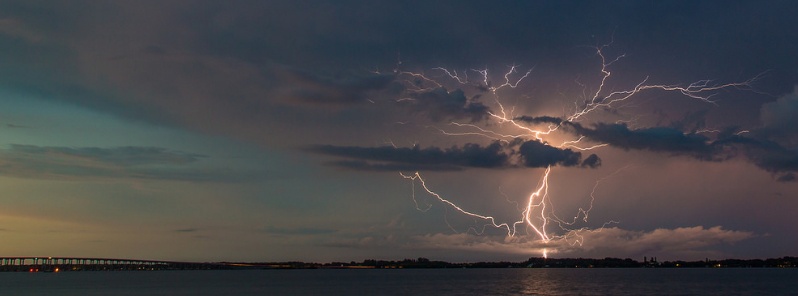
Featured image: Lightning over Satellite Beach, Florida seen across the Indian River Lagoon from Melbourne, Florida. Credit: Michael Seeley
Japanese researchers have taken the first steps to understand how the Sun's rotational cycle influences lightning activity on Earth. The answers were found in diaries dating back to the 1700s.
"It is well known that long-term – centennial to millennial-scale – variations of solar activity influences terrestrial climate," said Hiroko Miyahara, first author on the paper published recently in EGU's Annales Geophysicae. "However, it is not well established whether the Sun influences the daily or monthly weather."
Miyahara referred to the 27-day solar rotational period, which is the average time it takes for the Sun to rotate on its axis. Since the Sun consists of plasma, the equator rotates quicker than its poles. When areas of high activity, such as sunspots, face Earth, there's an increase in ultraviolet rays and decrease in energetic particles showering the atmosphere.
"Thunderstorm and cloud activities sometimes show a 27-day period, and this has long been studied to uncover a possible important link to solar rotation," study authors said.
"Because the 27-day variations in the solar forcing parameters such as solar ultraviolet and galactic cosmic rays become more prominent when the solar activity is high, it is expected that the signal of the 27-day period in meteorological phenomena may wax and wane according to the changes in the solar activity level."
"In this study, we examine in detail the intensity variations in the signal of the 27-day solar rotational period in thunder and lightning activity from the 18th to the 19th centuries based on 150-year-long records found in old diaries kept in Japan and discuss their relationship with the solar activity levels. Such long records enable us to examine the signals of solar rotation at both high and low solar activity levels."
The researchers examined the records for mentions of thunder and lightning events between May and September, when the influence from the cold Siberian air mass is weak in Japan and found peaks of lightning and thunder activity occurs every 24 to 31 days, the same time window it takes the sunspots to rotate completely.
It's a strong signal, especially when the yearly-average number of sunspots is high.
"We found that the signal of the solar rotational period in the thunder and lightning activity increases as the solar activity increases. We also discuss the possibility of the impact of the long-term climatological conditions on the signals of the 27-day period in thunder/lightning activities."
Reference:
"Solar rotational cycle in lightning activity in Japan during the 18–19th centuries" -Hiroko Miyahara et al. – Annales Geophysicae (2018). DOI: 10.5194/angeo-36-633-2018 – OPEN ACCESS

Teo Blašković founded The Watchers in 2011 and edited it until 2026, covering seismic and volcanic activity, extreme weather, space weather and near-Earth objects. Articles on this page are his archive.
Published in the last 24 hours
- The storms drenching California this week are fed by a river in the sky, a band of water vapor that can carry up to 15 times the flow of the Mississippi River, and this winter’s near-record El Niño could keep aiming more of them at the West Coast
- Malawi continues Bris AI weather forecasting tests ahead of operational integration Epicenter
- Right about now, Voyager 1 is crossing a line no human-made object has ever reached, a full light-day from Earth, which means a message NASA sends tonight won't arrive until tomorrow night, and the spacecraft's answer won't make it home until the night after that
- G1 geomagnetic storm watch remains in effect as NOAA forecasts Kp 4.67 late on November 17 and early on November 18
