
CZ-3B rocket body re-entry recorded over Paraguay
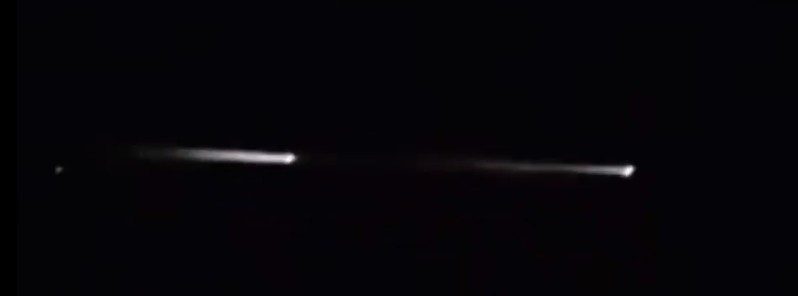
Image credit: CZ-3B re-entry over Paraguay on March 10, 2018.
The body of Chinese Long March 3B rocket, also known as CZ-3B, launched December 10, 2017, re-entered Earth's atmosphere around 05:52 UTC on March 10 over Paraguay, creating a spectacular show.
The American Meteor Society (AMS) received just one witness report via its partner Exoss and archived it as AMS event #960-2018. However, the event was observed and recorded by many people. See videos below:


This object has International Designation 2017-078B and NORAD Number 43040. The rocked launched Alcomsat 1 on December 10, 2017 from Xichang Satellite Launch Center in China.
According to Professor Blas Antonio Servín Bernal, a small fuel tank was found in the city of Canindeyú, Paraguay, on the border with Brazil, between Paraná and Mato Grosso do Sul.
A similar re-entry event took place at 23:32 UTC on January 27, 2018 over Pucallpa, Peru. Several fuel tanks were recovered by the Peruvian Air Force near the Puno region of Peru after they were notified by local residents. This was re-entry of Russian SL-23 rocked body (international designation 2017-086D).


Exoss team later surveyed information about the event and found the following piece of the rocket in Puno region of northern Peru.


Teo Blašković founded The Watchers in 2011 and edited it until 2026, covering seismic and volcanic activity, extreme weather, space weather and near-Earth objects. Articles on this page are his archive.
Published in the last 24 hours
- The storms drenching California this week are fed by a river in the sky, a band of water vapor that can carry up to 15 times the flow of the Mississippi River, and this winter’s near-record El Niño could keep aiming more of them at the West Coast
- Malawi continues Bris AI weather forecasting tests ahead of operational integration Epicenter
- Right about now, Voyager 1 is crossing a line no human-made object has ever reached, a full light-day from Earth, which means a message NASA sends tonight won't arrive until tomorrow night, and the spacecraft's answer won't make it home until the night after that
- G1 geomagnetic storm watch remains in effect as NOAA forecasts Kp 4.67 late on November 17 and early on November 18
