
Floods and landslides as record rain hits Hawaii

Featured image: Floods in Maui, Hawaii on December 20, 2017. Credit: AKAKU
Several days of heavy rain caused widespread flooding on Maui and the Big Island, Hawaii this week.
Heavy rains started Tuesday night but the worst hit Wednesday, December 20. According to NWS, Kahului Airport recorded nearly 67 mm (2.65 inches) of rainfall in 1 hour early Wednesday. Within 24 hours, the airport received 146.8 mm (5.78 inches), breaking the old record of 81.5 mm (3.21 inches) set in 1955.
205.7 mm (8.1 inches) of rain was measured at Wailuku in the 24-hour period ending 20:00 local time Wednesday. During the same period, West Wailuaiki recorded 172.2 mm (6.78 inches), Haiku 157.7 mm (6.21 inches), Hana Airport 119.8 mm (4.72 inches), Puu Kukui 115.4 mm (4.54 inches), Waikapu Country Club 113 mm (4.45 inches) and Mahinahina 108.4 mm (4.27 inches).
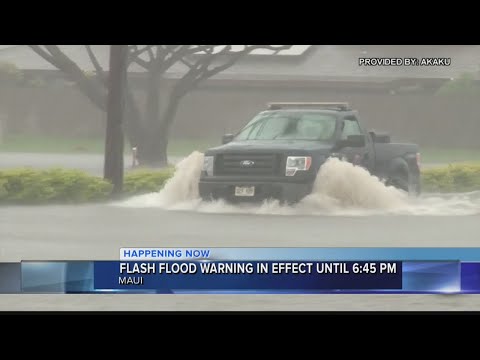
The rains led to closures of the Central Maui landfill, Waiehu Golf Course, Kanaha Park and all recreational park facilities, including gymnasiums, pools, and fields. Bus service was also suspended along Dairy Road and Kamehameha Avenue due to flooding, the Hawaii News Now reports. Roadways closed included Ulaino Road and Waikoloa roads in Hana, Dairy Road at Hana Highway, and Puunene Avenue. Meanwhile, flooding made Kahekili Highway near mile marker 7 impassable.

Power was knocked out to about 3 000 customers in Wailuku and Waikapu between 10:00 and 12:00 local time, after a tree branch fell on power lines. Traffic signals were out at several intersections.

Teo Blašković founded The Watchers in 2011 and edited it until 2026, covering seismic and volcanic activity, extreme weather, space weather and near-Earth objects. Articles on this page are his archive.
Published in the last 24 hours
- In 2017, El Niño rains turned part of Peru's Sechura Desert into a lake more than four times the size of Lake Tahoe, and families went out on wooden rafts to fish it Epicenter
- A rose-colored rock found in the Sahara in 2022 turned out to be a piece of Mars more than 4.1 billion years old Epicenter
- Northern lights are possible at high latitudes on November 17 and 18 as NOAA forecasts minor (G1) geomagnetic storms from coronal hole wind
- In February 2022, SpaceX launched 49 Starlink satellites into a solar storm so mild that forecasters rated it minor, and within days 38 of them had fallen back and burned up, because the storm had swollen the thin air they were flying through Epicenter
