
Newly discovered asteroid 2017 QB35 to flyby Earth at 0.93 LD on September 3
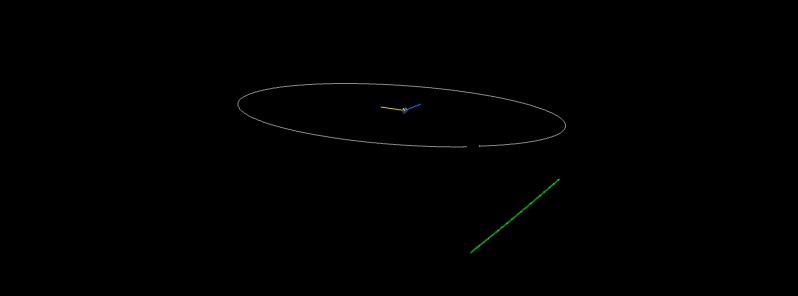
Featured image: The green line indicates the object's apparent motion relative to the Earth, and the bright green marks are the object's location at approximately one-hour intervals. The Moon's orbit is gray. The blue arrow points in the direction of Earth's motion and the yellow arrow points toward the Sun. Credit: Minor Planet Center
A newly discovered asteroid designated 2017 QB35 will flyby Earth at 0.93 LD (~357 120 km / 221 904 miles) on September 3, 2017. This is the 28th known asteroid to flyby Earth within 1 lunar distance since the start of the year (according to data available September 20, 2017).
First observed at Mt. Lemmon Survey on August 31, 2017, asteroid 2017 QB35 belongs to the Aten group of asteroids. Its estimated diameter is between 3.7 and 8.3 m (12 – 27 feet). It will make the closest approach to our planet at 08:41 UTC on September 3, 2017, at a speed (relative to the Earth) of 18.02 km/s.
[ Ephemeris | Orbit Diagram | Orbital Elements | Physical Parameters | Close-Approach Data ]
The discovery of asteroid 2017 QB3 came on the same day as a huge, Amor-class asteroid named 3122 Florence (1981 ET3) flew past Earth at 18.38 LD (~7 million km / 4.4 million miles / 0.047 AU). Florence is the largest asteroid to pass this close to our planet since the first near-Earth asteroid was discovered over a century ago. Its diameter is between 4 and 9 km (2.5 and 5.6 miles).
References:
Asteroid 2017 QB35 at Minor Planet Center; at CNEOS

Teo Blašković founded The Watchers in 2011 and edited it until 2026, covering seismic and volcanic activity, extreme weather, space weather and near-Earth objects. Articles on this page are his archive.
Published in the last 24 hours
- Four small asteroids will pass close to Earth from November 21 to 23
- Male toads abandoned a pond in Italy five days before a deadly 2009 earthquake, while a scientist was counting them Epicenter
- An asteroid was spotted 19 hours before it exploded over Sudan in 2008, and students picked its pieces off the desert Epicenter
- A wave up to 3 m (10 feet) high rose out of Lake Michigan on a sunny June morning in 1954 and swept fishermen off Chicago’s piers, and when a second came 10 days later, warnings had cleared the shore Epicenter
