
Visualizing milestones of the ExoMars 2016 mission
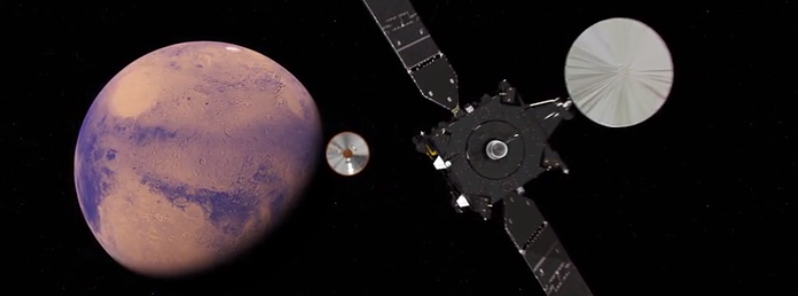
Image credit: TW
The European Space Agency (ESA) has established the ExoMars programme to research the question if life ever existed on Mars. The programme will investigate the Martian environment through two missions. The first one, consisting of an Orbiter plus and Entry, Descent and Landing Demonstrator Modul will launch in 2016, and the second, featuring a rover, in 2018.
A series of video animations for the purpose of visualizing milestones of the ExoMars 2016 mission, its launch and cruise to Mars, were released by ESA on February 17, 2016.
Video copyright: ESA/ATG medialab
ExoMars 2016 missions comprise the Trace Gas Orbiter and Entry, Descent and Landing Demonstrator Module, Schiaparelli. The mission launch is scheduled on a four-stage Proton-M/Breeze-M rocket from Baikonur in the period between March 14 to 25, this year, as shown in the video above.
About ten-and-a-half hours after launch, the spacecraft will separate from the rocket and deploy its solar wings. After two weeks, the high-gain antenna will be deployed, and Schiaparelli will separate from TGO seven months later, on October 16. Three days afterwards it will enter the Martian atmosphere and TGO will begin its entry into Mars orbit at the same time.
Animation visualizing part of the ExoMars 2016 mission’s cruise to Mars. The animation is depicted with the entry, descent and landing demonstrator module, Schiaparelli, mated to the Trace Gas Orbiter. Video copyright: ESA/ATG medialab
Animation is visualizing the ExoMars entry, descent and landing demonstrator module, Schiaparelli, approaching Mars after separating from the Trace Gas Orbiter (TGO). Schiaparelli is set to enter the Martian atmosphere on October 19, while TGO will enter orbit around Mars. Video copyright: ESA/ATG medialab
Featured image copyright: ESA/ATG medialab

Published in the last 24 hours
- Male toads abandoned a pond in Italy five days before a deadly 2009 earthquake, while a scientist was counting them Epicenter
- An asteroid was spotted 19 hours before it exploded over Sudan in 2008, and students picked its pieces off the desert Epicenter
- A wave up to 3 m (10 feet) high rose out of Lake Michigan on a sunny June morning in 1954 and swept fishermen off Chicago’s piers, and when a second came 10 days later, warnings had cleared the shore Epicenter
- Just 12 inches of rushing water can carry away most cars, and more than half of US flood drownings happen to people who drive into flood water Epicenter
