
Coldest June since measurements began in Adélie Land, Antarctica
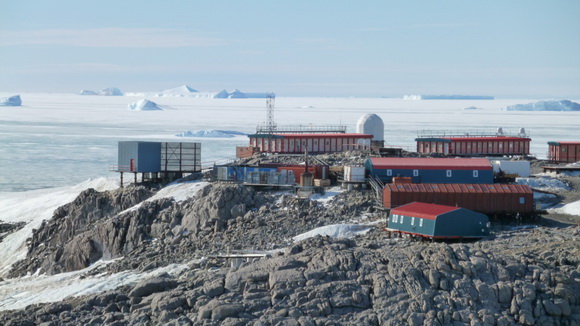
Image credit: Dumont d'Urville @ Météo-France / O. Traullé
Meteo-France is reporting an unusually cold month of June at their station base Dumont d'Urville located in Adélie Land (Terre Adélie), Antarctica. They recorded an average temperature of -22.4° C throughout June, which is 6.6° C lower than normal temperature for the period from 1981 – 2010.
This makes June 2014 the coldest June since measurements began in 1956, and the second coldest month of all months combined (after September 1958 with -23.5° C).
The daily temperature for June was also beaten with -34.9° C recorded, previous record was -33.4° C.
Two other elements make June an unusual month there. Although the region is accustomed to strong winds, June was particularly low. The average was less than 36% of normal (22 km/h as opposed to usual 35.3 km/h). That makes June 2014 the second least windy month since the beginning of the measurements (21 km/h in 1978).
Finally, they report, there was a 60% surplus of sunshine (11.8 hours on average against 7.4 which is normal for the period from 1991 – 2010).
These three factors combined (cold, no wind, excess exposure) may indicate that disturbances were fewer than usual and/or they evolved at lower latitude than usual.
In apparent contradiction to these data, the snowfall has been reported 7 times, a figure close to the average of 8.5.
Adélie Land is one of the five districts with the Crozet Archipelago, the Kerguelen Islands, Saint Paul and Amsterdam and the Scattered islands constituting the Community of French Southern and Antarctic Lands (TAAF). The administration is based in St. Pierre, Reunion.

Image credit: Frédéric REMY, LEGOS Réalisation J-P. Humblot / IPEV. Location marker: TW (Source)
Source: Meteo France

Teo Blašković founded The Watchers in 2011 and edited it until 2026, covering seismic and volcanic activity, extreme weather, space weather and near-Earth objects. Articles on this page are his archive.
Published in the last 24 hours
- High Risk of excessive rainfall covers Florida’s Space Coast as St. Johns River near Cocoa reaches 5.67 m
- Four small asteroids will pass close to Earth from November 21 to 23
- Cyclone Akvan weakens after landfall near Gopalpur; more than 300 000 evacuated in Odisha, India
- A broad low over southeastern Florida and the northwestern Bahamas has a 30 percent chance of subtropical or tropical development within 48 hours and a 50 percent chance within 7 days, the National Hurricane Center says

South Pole
What does this mean for the planet I wonder?
Is this Global Warming in reverse?