
New meteor shower and possible meteor storm on May 24th
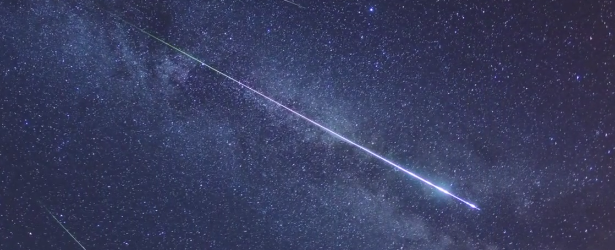
Image credit: NASA
On the night of May 24 Earth will possibly pass through the dust trail left by Comet 209P/LINEAR in its past orbits. If this happens we might see a brief but intense burst of meteor activity. No one has ever seen it before and although nothing is certain at this time, many mathematical models are predicting that this could be the most intense meteor shower in more than a decade.
The meteor shower is now named May Camelopardalids and predictions run from less than 100 meteors per hour up to unlikely, but possible, meteor storm as high as 1000 per hour. This meteor shower favors observers in Canada and continental US.
Comet 209P/LINEAR was discovered in February 2004 by the Lincoln Near-Earth Asteroid Research project, a cooperative effort of NASA, the Massachusetts Institute of Technology Lincoln Laboratory, and the US Air Force. It is a relatively dim comet that dips inside the orbit of Earth once every five years as it loops around the sun.
Two years ago, meteor experts Esko Lyytinen of Finland and Peter Jenniskens at NASA Ames Research Center announced that Earth was due for an encounter with debris from Comet 209P/LINEAR. The result, they said, could be a significant meteor outburst.
Other experts agreed, in part. There is a broad consensus among forecasters that Earth will indeed pass through the debris streams on May 24th. However, no one is sure how much debris is waiting. It all depends on how active the comet was more than a century ago when the debris streams were laid down.
"We have no idea what the comet was doing in the 1800s," says head of NASA's Meteoroid Environment Office, Dr. Bill Cooke. As a result of the uncertainty, "there could be a great meteor shower—or a complete dud."
The best time to look is during the hours between 6:00 and 08:00 UTC on May 24th. That's when an ensemble of forecast models say Earth is most likely to encounter the comet's debris.
"We expect these meteors to radiate from a point in Camelopardalis, also known as 'the giraffe', a faint constellation near the North Star," he continues. "It will be up all night long for anyone who wishes to watch throughout the night."
Because this is a new meteor shower, surprises are possible. Outbursts could occur hours before or after the forecasted peak.

Video courtesy Science @ NASA

Teo Blašković founded The Watchers in 2011 and edited it until 2026, covering seismic and volcanic activity, extreme weather, space weather and near-Earth objects. Articles on this page are his archive.
Earlier reporting
Nothing on Watchers was published in the last 24 hours. These are older articles.
- Asteroid 2026 WA passed Earth at 126,400 km, about a third of the Moon's distance, at 07:59 UTC on November 17
- On October 22, 2017, a single flash of lightning stretched 515 miles from eastern Texas to near Kansas City, a distance that takes eight hours to drive, and nobody realized how far it had gone until scientists went back through the satellite data years later Epicenter
- CPC posts a slight risk of heavy rain from the Gulf Coast to the Northeast urban corridor November 25-29, and a moderate risk of West Coast wind and Sierra snow on November 25
- Florida's east coast faces a moderate flash flood risk Wednesday through Friday, with 4 to 8 inches of rain forecast and the St. Johns River near Cocoa already in major flood at 17.13 feet
