
Three significant fireballs over the weekend
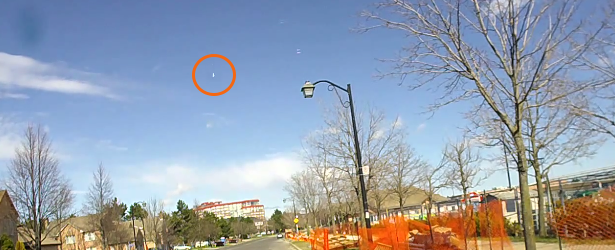
Image credit: TW
American Meteor Society (AMS) said three significant fireballs were observed over the weekend.
A large fireball with numerous sonic booms fell over Arkansas on Friday night, May 2nd. Another bright fireball was seen over North Carolina Saturday night, May 3rd. A daytime fireball over Ontario on May 4th marks the third significant event for this weekend.
The map below, courtesy of AMS, shows the trajectory for all three events.

Three Significant Fireballs – May 2nd, 3rd & 4th. Image credit: AMS
An extremely bright daylight fireball seen from Ontario and the state of New York on May 4th was caught on car dashcams. Preliminary reports place the time of the event near 20:16 UTC with a brightness rivaling the sun.
You can see this fireball in the videos below:

Video courtesy of Dean Mean
My wife noticed a small ball of fire appearing to fall through the sky and I thought it was fireworks since I only managed to see the trail of smoke. We reviewed the video footage on my Blackvue 1080P dashcam and there it was- awesome! (I edited the video to trim out the excess footage)

Video courtesy of Sergey Z
All three fireballs were concurrent with the Eta Aquarid meteor shower although they may not be related.
Featured image courtesy of Dean Mean. Edit: The Watchers

Teo Blašković founded The Watchers in 2011 and edited it until 2026, covering seismic and volcanic activity, extreme weather, space weather and near-Earth objects. Articles on this page are his archive.
Published in the last 24 hours
- High Risk of excessive rainfall covers Florida’s Space Coast as St. Johns River near Cocoa reaches 5.67 m
- Asteroid 2026 WJ to pass Earth at 1.7 lunar distances at 04:20 UTC on November 22, with 2026 WD following at 4.4 lunar distances on November 23
- Cyclone Akvan crossed the north Andhra Pradesh and south Odisha coasts close to Gopalpur on November 20 with 70-80 km/h winds gusting to 90, and has weakened into a deep depression
- A broad low over southeastern Florida and the northwestern Bahamas has a 30 percent chance of subtropical or tropical development within 48 hours and a 50 percent chance within 7 days, the National Hurricane Center says
