
86 new meteor showers discovered
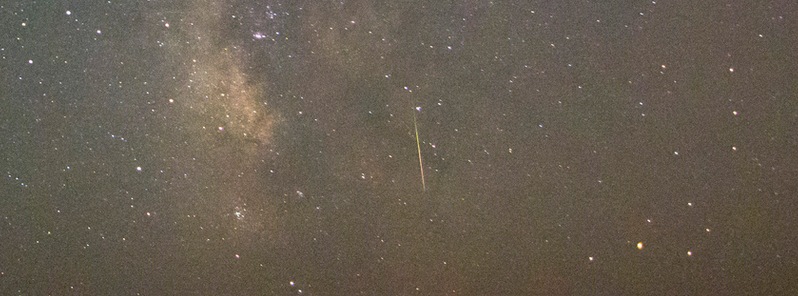
Featured image: Perseid Meteor Shower, Sounion, Attica, Greece, August 12, 2015. Image credit: csath07 (CC-Flickr).
86 new meteor showers have joined the already well known crowd of Perseids, Leonids and Geminids. Astronomers observed the events using a network of security video cameras redesigned to monitor space debris passing through the Earth's atmosphere.
The meteor showers come from the trail of particles left behind by a comet or asteroid, which is important as discovery of new showers revealed previously unknown sources of dust.
“The cool thing is, we are not just doing surveillance of meteors in the night sky. Now we also have a three-dimensional picture of how dust is distributed in the Solar System,” said Peter Jenniskens, an astronomer at the SETI Institute in Mountain View, California.
Majority of the dust particles are no bigger than a grain of sand, however, some of them are large enough to persist on their journey through the atmosphere and potentially cause damage to the planet's surface.
Meteors, popularly know as the shooting-stars, are continually scattered around the globe, however a meteor shower occurrence is a special phenomena in a way that a significant number of them seems to be visually coming from the same point in the sky. At least 750 possible meteor showers have been reported to the International Astronomical Union (IAU) by the meteor observers around the world, however only a small number of them has been confirmed.
A team of astronomers lead by Jenniskens have set up the cameras at three locations in northern California to confirm or reject reported showers. The Cameras for Allsky Meteor Surveillance (CAMS) project has pointed 60 security cameras in different directions to capture the highest possible numbers of shooting stars. Each camera per se has a narrow field of view, however, when together they cover a broad angle of sky centered directly overhead and extending down to 30° above the horizon.
“CAMS is about getting massive data sets on meteors, so you can see through all the scatter to get at those new showers,” explained Phil Bland, a planetary scientist at Curtin University in Perth, Australia.
Since its beginning in 2010, the CAMS project has reported over 250 000 meteors. Three-quarters of them were just random singletons and the rest of them have been a part of a meteor shower group. 81 showers have been confirmed by CAMS, and 86 new ones have been discovered.
Among the newly discovered showers is the one noticed on the Southern Hemisphere during early December, which seems to be radiating from the Vela constellation. This shower is very strong, so it seems a bit peculiar it hadn't been noticed earlier, Jenniskens added. When the newly confirmed shower peaked in the March 2013 the skywatchers have observed a bright flash of a rock-sized object hitting the Moon.
The research papers describing the newest finding have been accepted for publication in the Icarus journal.
Source: Nature

Earlier reporting
Nothing on Watchers was published in the last 24 hours. These are older articles.
- On October 22, 2017, a single flash of lightning stretched 515 miles from eastern Texas to near Kansas City, a distance that takes eight hours to drive, and nobody realized how far it had gone until scientists went back through the satellite data years later Epicenter
- CPC posts a slight risk of heavy rain from the Gulf Coast to the Northeast urban corridor November 25-29, and a moderate risk of West Coast wind and Sierra snow on November 25
- Florida's east coast faces a moderate flash flood risk Wednesday through Friday, with 4 to 8 inches of rain forecast and the St. Johns River near Cocoa already in major flood at 17.13 feet
- Cyclone Akvan to make landfall between Nellore and Visakhapatnam around noon on November 20, IMD forecasts 120-130 km/h winds gusting to 145
