
Don't miss the Arietids – daylight meteor shower!
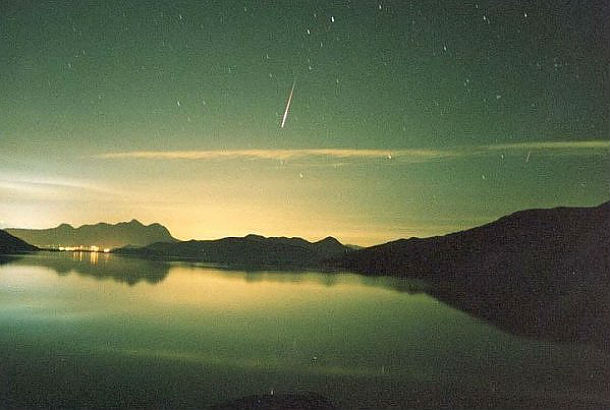
Image credit: Yan On Sheung/courtesy of NASA images
Thousands of meteors streak across the sky every year in early June. Sun above the horizon makes most of the shower activity invisible at it most intense period. These daylight meteors are called the Arietids. Arietid meteor shower is in fact one of the strongest of the year with a maximum rate of 50-80 per hour.
The Arietids stream from a radiant point (the point in the sky from which the meteors appear to radiate) in the constellation Aries, which lies just 30 degrees from the Sun in June and are best seen during daylight hours. No one is sure where Arietid meteoroids really come from. Some astronomers suspect they are debris from the sungrazing Asteroid 1566 Icarus while others suggest and Comet 96P/Machholz.

Skymap showing sky around Arietid radiant (Credit: SpaceWeather.com)
The best time to viewing Arietids is just before sunrise. The Arietid radiant rises in the east about 45 minutes before the sun, from both of Earth's hemispheres. Face east and start watching an hour or two before the start of dawn and continue your vigil until the sky brightens in the east.
Predawn Arietids skim horizontally through the upper atmosphere from radiants near the horizon, so they are also known as "earthgrazers". Spectacular Earthgrazers are usually slow and bright, streaking far across the sky. You can watch another smaller daylight meteor shower at the same time, Zeta Perseids.
Sources: SpaceWeather.com, AstroBob, Meteor Showers Online

Published in the last 24 hours
- Asteroid 2026 WJ to pass Earth at 1.7 lunar distances at 04:20 UTC on November 22, with 2026 WD following at 4.4 lunar distances on November 23
- High Risk of excessive rainfall covers Florida’s Space Coast as St. Johns River near Cocoa reaches 5.67 m
- Cyclone Akvan crossed the north Andhra Pradesh and south Odisha coasts close to Gopalpur on November 20 with 70-80 km/h winds gusting to 90, and has weakened into a deep depression
- A broad low over southeastern Florida and the northwestern Bahamas has a 30 percent chance of subtropical or tropical development within 48 hours and a 50 percent chance within 7 days, the National Hurricane Center says

Why have I never heard of this meteor shower before? It's not on any Meteor schedule I've ever had…