
Geminid meteor shower peaks around December 13/14, 2013

Image credit: ScienceAtNASA
Earth is entering a stream of debris from Comet 3200 Phaethon, source of the annual Geminid meteor shower. This year's meteor shower peak is expected around December 13/14. Visual meteor rates are still low, but first meteorids will start appear in the coming days.
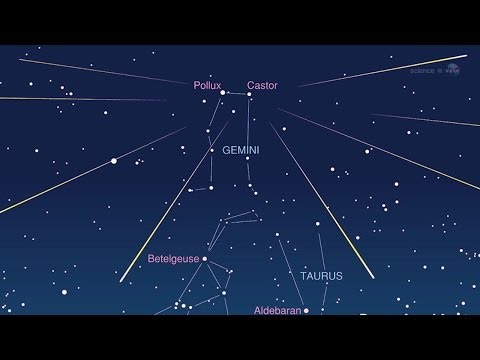
Geminids are one of the finest, and probably the most reliable, of the major annual showers presently observable. The shower’s peak this year has a waxing gibbous Moon to contend with, and observers must make the best of the brief dark-sky spell during the hours between midnight and dawn when the constellation Gemini is high in the sky. This year's Zenithal Hourly Rate (ZHR) is 120 meteors per hour.
The meteors from the Geminids travel in relatively medium speed compared to other showers at about 35 kilometers per second making them fairly easy to spot. The meteors often disintegrate at heights above 38 kilometers.

Geminids sky chart (Credit: IMO)
Canadian Meteor Orbit Radar (CMOR) is starting to pick up echoes from Geminid meteoroids. Radar map below from December 4 shows activity in constellation Gemini.

Radar map shows a concentration of activity in the constellation Gemini on December 4, 2013 (Credit: CMOR)
Geminid meteor shower is the only meteor shower to be linked to an asteroid. The parent object of the Geminid shower, 3200 Phaethon, was discovered and photographed in 1983 by the Infrared Astronomical Satellite and has the appearances of a small Earth-crossing asteroid. This object does not exhibit the usual features of a comet such as the nebulous head and long tail and so was place among the asteroids. Most researchers believe that Phaethon is the burned-out remnant of a once-active comet.

Earlier reporting
Nothing on Watchers was published in the last 24 hours. These are older articles.
- Asteroid 2026 WA passed Earth at 126,400 km, about a third of the Moon's distance, at 07:59 UTC on November 17
- On October 22, 2017, a single flash of lightning stretched 515 miles from eastern Texas to near Kansas City, a distance that takes eight hours to drive, and nobody realized how far it had gone until scientists went back through the satellite data years later Epicenter
- CPC posts a slight risk of heavy rain from the Gulf Coast to the Northeast urban corridor November 25-29, and a moderate risk of West Coast wind and Sierra snow on November 25
- Florida's east coast faces a moderate flash flood risk Wednesday through Friday, with 4 to 8 inches of rain forecast and the St. Johns River near Cocoa already in major flood at 17.13 feet

Something significant is prophesied to happen around the time of this meteor shower; interested that the word "asteroid" was included in the text. Perhaps something bigger than a few meteors is about to fill the skies!