
Lyrid meteor shower peaks this week
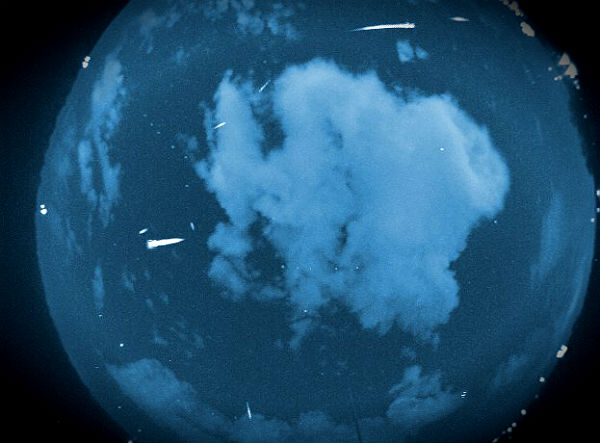
Featured image: Composite of 2009 Lyrids over Huntsville, Ala. (Credit: NASA/MSFC/Danielle Moser)
Earth is approaching the debris field of ancient Comet Thatcher, source of the annual Lyrid meteor shower. Every year in late April Earth passes through the dusty tail of Comet Thatcher (C/1861 G1), and the encounter causes a meteor shower – the Lyrids. This year the shower peaks on Saturday night, April 21st. Forecasters expect 10 to 20 meteors per hour but unmapped filaments of dust in the comet’s tail sometimes trigger outbursts 10 times stronger. A nearly-new moon on those dates will provide perfect dark-sky conditions for meteor watching. Flakes of comet dust, most no bigger than grains of sand, strike Earth’s atmosphere traveling 49 km/s (110,000 mph) and disintegrate as streaks of light.

Lyrid meteors are typically as bright as the stars in the Big Dipper, which is to say of middling brightness. But some are more intense, even brighter than Venus. These “Lyrid fireballs” cast shadows for a split second and leave behind smokey debris trails that linger for minutes.
Occasionally, the shower intensifies. Most years in April there are no more than 5 to 20 meteors per hour during the shower’s peak. But sometimes, when Earth glides through an unusually dense clump of comet debris, the rate increases.

Lyrid meteor shower LIVE CHAT!
On Saturday, April 21, from 03:00 a.m. to 9:00 a.m. UTC (convert to your local time),meteor experts Dr. Bill Cooke, Danielle Moser and Rhiannon Blaauw from NASA’s Marshall Space Flight Center will answer questions about the Lyrids via a live Web chat. (Click HERE a few minutes before 03 a.m. EDT on Saturday, April 21. The chat module will appear at the bottom of the page. After log in, wait for the chat module to be activated, then ask your questions!)

Earlier reporting
Nothing on Watchers was published in the last 24 hours. These are older articles.
- Asteroid 2026 WA passed Earth at 126,400 km, about a third of the Moon's distance, at 07:59 UTC on November 17
- On October 22, 2017, a single flash of lightning stretched 515 miles from eastern Texas to near Kansas City, a distance that takes eight hours to drive, and nobody realized how far it had gone until scientists went back through the satellite data years later Epicenter
- CPC posts a slight risk of heavy rain from the Gulf Coast to the Northeast urban corridor November 25-29, and a moderate risk of West Coast wind and Sierra snow on November 25
- Florida's east coast faces a moderate flash flood risk Wednesday through Friday, with 4 to 8 inches of rain forecast and the St. Johns River near Cocoa already in major flood at 17.13 feet

Will this be visible in the uk? What’s the best time to view?