
Lyrid meteor shower peaks on April 22
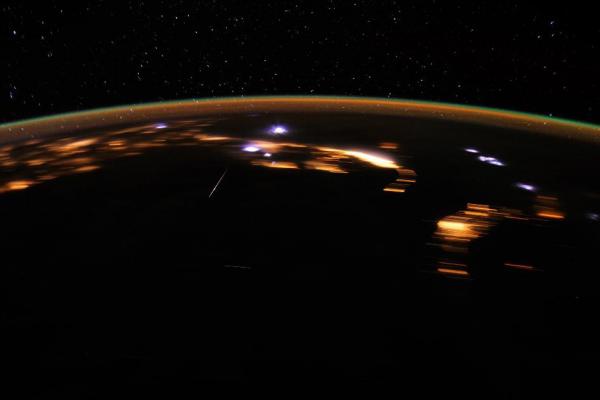
Image credit: Picture of the Earth and a Lyrid meteor taken by astronaut Don Pettit. (ISS)
Lyrid meteor shower, considered to be the oldest of meteor showers, is an average shower usually producing about 20 meteors per hour at its peak. This shower runs annually from April 16 – 25 and its peak this year is predicted to occur near 18:00 UTC on April 22.
These meteors can sometimes produce bright dust trails lasting several seconds but the second quarter moon (42% of full) will present a slight problem this year. This year's Lyrids will certainly not be a strong display but as Robert Lunsford wrote for the AMS "… it may be used as a warm-up for the stronger Eta Aquariids, which peak in early May under better conditions."
The radiant of the Lyrid meteor shower, the point in the sky where the meteors seem to emerge from, is located in the constellation Lyra, near this constellation's brightest star, Vega. Vega is one of the brightest stars in the sky during this time of the year.

Lyrid meteor shower – approximate radiant near bright star Vega in Lyra constellation. Image credit: Stellarium / Edit: The Watchers
Lyrids are best seen from the northern hemisphere where the radiant is high in the sky at dawn.
The source of Lyrid meteor shower is the long-period Comet C/1861 G1 Thatcher. The April Lyrids are the strongest annual shower of meteors from the debris of a long-period comet, mainly because as far as other intermediate long-period comets go (200 – 10,000 years), this one has a relatively short orbital period of about 415 years.

Comet C/1861 G1 Tatcher orbit diagram. Image credit: NASA / JPL
The Lyrids have been observed for the past 2600 years.

Teo Blašković founded The Watchers in 2011 and edited it until 2026, covering seismic and volcanic activity, extreme weather, space weather and near-Earth objects. Articles on this page are his archive.
Earlier reporting
Nothing on Watchers was published in the last 24 hours. These are older articles.
- On October 22, 2017, a single flash of lightning stretched 515 miles from eastern Texas to near Kansas City, a distance that takes eight hours to drive, and nobody realized how far it had gone until scientists went back through the satellite data years later Epicenter
- CPC posts a slight risk of heavy rain from the Gulf Coast to the Northeast urban corridor November 25-29, and a moderate risk of West Coast wind and Sierra snow on November 25
- Florida's east coast faces a moderate flash flood risk Wednesday through Friday, with 4 to 8 inches of rain forecast and the St. Johns River near Cocoa already in major flood at 17.13 feet
- Cyclone Akvan to make landfall between Nellore and Visakhapatnam around noon on November 20, IMD forecasts 120-130 km/h winds gusting to 145
