
February auroras and blue flashes
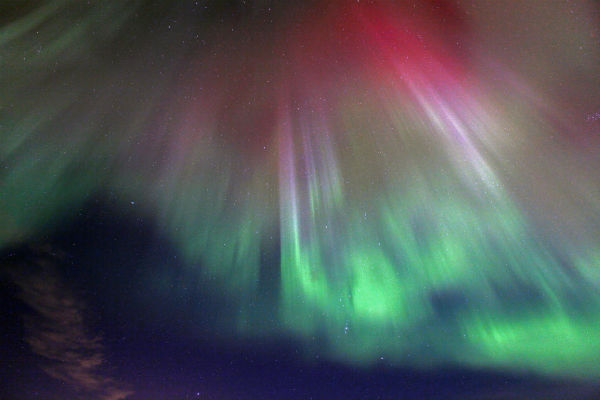
Featured image: Aurora over Vaasa, Finland (Credit: Kaj Hoglund)
A CME impact followed by a gusty solar wind stream have combined to produce bright lights around the Arctic Circle on Feb. 26-29. Arctic sky watchers should be on alert for more auroras tonight.

The green flash, the fleeting emerald light that sometimes appears just above the setting sun (Once thought to be a fable, the green flash was popularized by Jules Verne in his 1882 novel “Le Rayon Vert”). Peter Rosén photographed rare blue flash from Stockholm, Sweden, on Feb. 29th as it can be seen below.

A mirage magnifies tiny differences in the atmospheric refraction of red, green and blue light. Blue flashes are generally harder to see than green flashes, because blue flashes blend into the surrounding blue sky. When the air is exceptionally clear, however, the blue flash emerges. (SpaceWeather)

Earlier reporting
Nothing on Watchers was published in the last 24 hours. These are older articles.
- On October 22, 2017, a single flash of lightning stretched 515 miles from eastern Texas to near Kansas City, a distance that takes eight hours to drive, and nobody realized how far it had gone until scientists went back through the satellite data years later Epicenter
- CPC posts a slight risk of heavy rain from the Gulf Coast to the Northeast urban corridor November 25-29, and a moderate risk of West Coast wind and Sierra snow on November 25
- Florida's east coast faces a moderate flash flood risk Wednesday through Friday, with 4 to 8 inches of rain forecast and the St. Johns River near Cocoa already in major flood at 17.13 feet
- Cyclone Akvan to make landfall between Nellore and Visakhapatnam around noon on November 20, IMD forecasts 120-130 km/h winds gusting to 145
