
Late April visibility window allows blue auroras over Arctic regions
Blue auroras are likely over Arctic regions in late April 2026 as seasonal solar geometry allows sunlight to illuminate the upper atmosphere while ground-level skies remain sufficiently dark. The phenomenon is linked to ionized nitrogen emissions that are typically too faint to detect but can be amplified under these conditions.
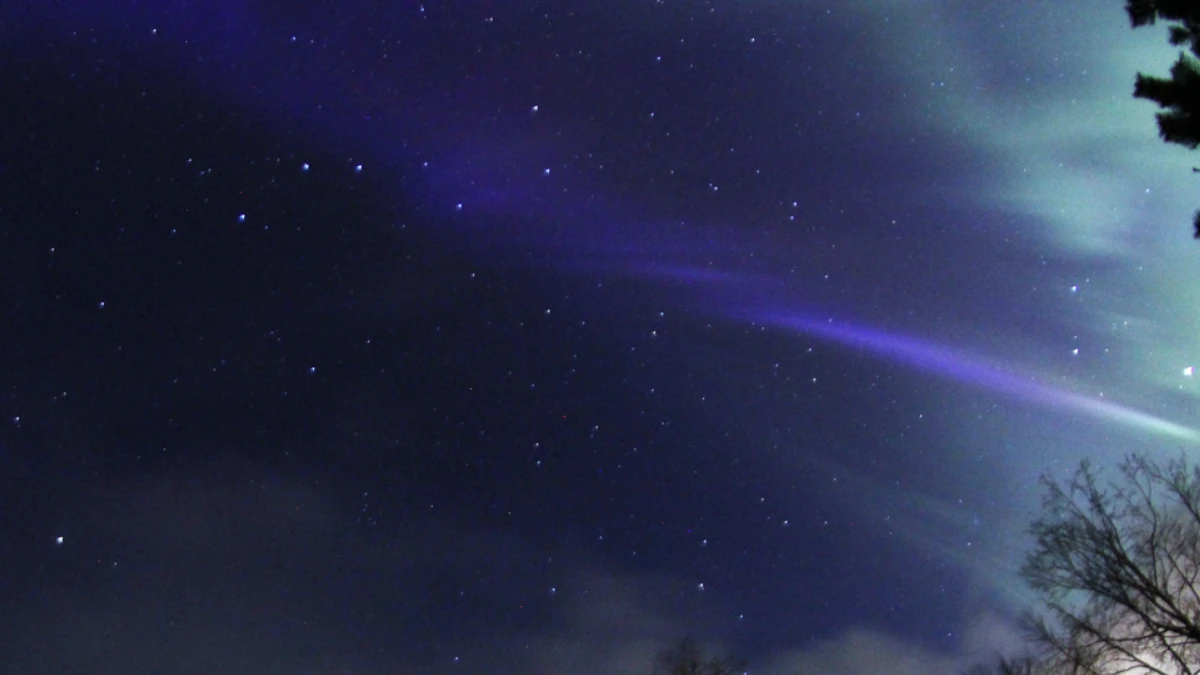
Blue aurora in Norway on April 21, 2026. Credit: Geir T. Birkeland Oye/Spaceweather.com
Late April conditions across high-latitude regions are opening a narrow observational window for blue auroras, produced by ionized nitrogen, that can be observed from the ground.
The effect depends on the Sun remaining just below the horizon, enabling sunlight to reach the upper atmosphere while the sky at lower altitudes remains dark enough for auroral visibility.
Auroras are usually dominated by green and red emissions generated by atomic oxygen. Blue emissions originate from ionized molecular nitrogen (N₂⁺), which produces light at a wavelength of approximately 427.8 nm. The low concentration of nitrogen ions at high altitudes normally keeps this emission below naked-eye visibility.
Solar geometry during Arctic spring alters that threshold. At high latitudes, the Sun remains near −13° below the horizon, allowing solar radiation to illuminate atmospheric layers at altitudes of around 200 km (124 miles), where nitrogen ions are present.
Resonant scattering increases the intensity of the blue emission under these conditions. Nitrogen ions absorb incoming sunlight and re-emit it at their characteristic wavelength, raising the brightness of the otherwise faint signal to detectable levels.

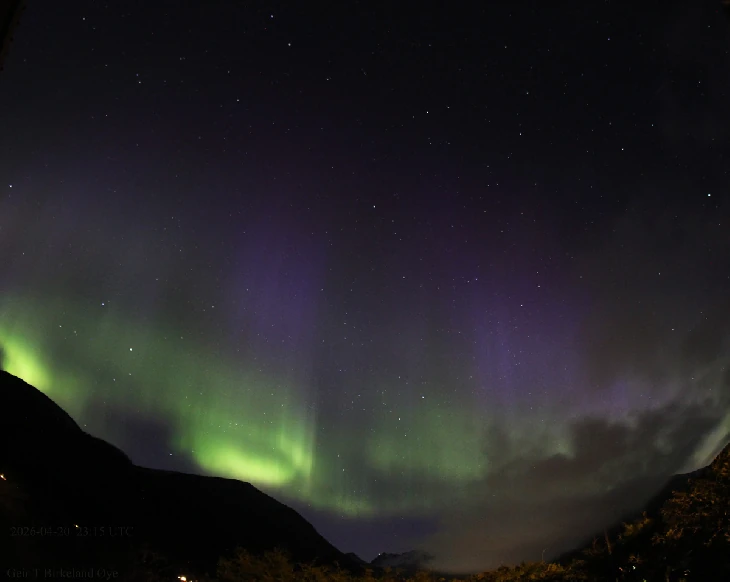
A blue aurora was reported on April 21 from Ørsta, Norway, less than 320 km (200 miles) south of the Arctic Circle, according to Spaceweather.com. The observation matches the expected seasonal configuration, where a sunlit upper atmosphere coincides with sufficiently dark skies at ground level.
The visibility window recurs annually during spring in Arctic regions as increasing solar elevation modifies the balance between atmospheric illumination and darkness. The process does not require elevated geomagnetic activity and instead depends on geometric conditions that enhance the visibility of existing auroral emissions.

I am an Assistant Editor and Severe Weather & Science Journalist at The Watchers, specializing in real-time severe weather coverage, geophysical event reporting, and research-driven scientific analysis. You can reach me at rishav(at)watchers(.)news.

Commenting rules and guidelines
We value the thoughts and opinions of our readers and welcome healthy discussions on our website. In order to maintain a respectful and positive community, we ask that all commenters follow these rules.