
Several low level M-class solar flares occurred today
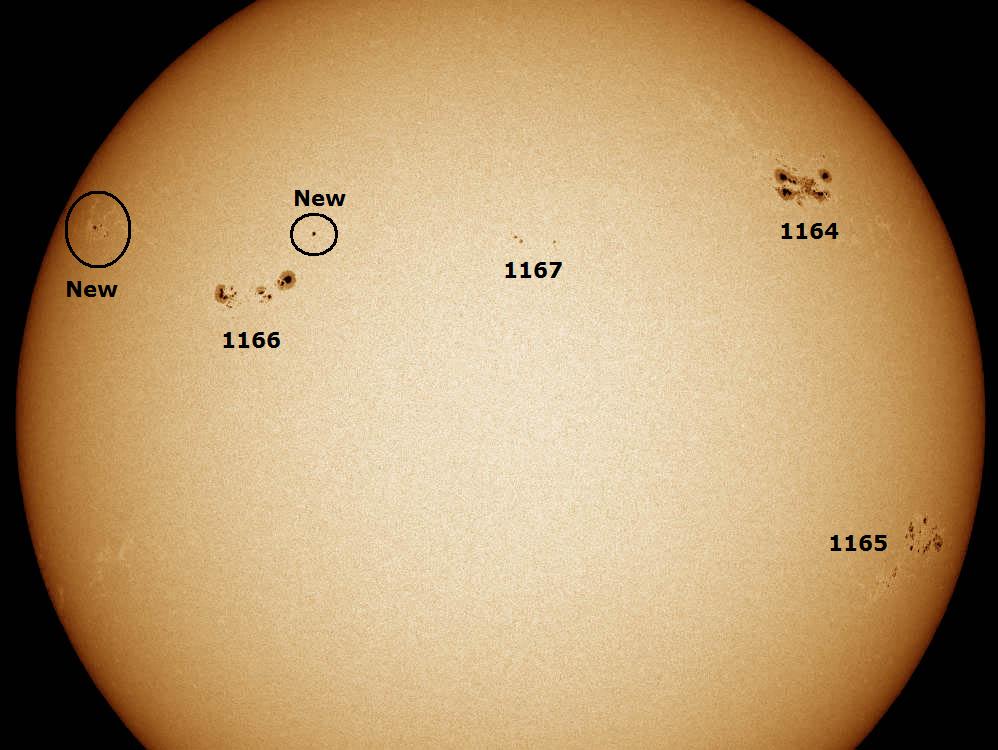
Image credit: TW
Several low level M-Class flares have taken place around each of the big three regions 1164, 1165 and 1166 during the early parts of Monday. The largest one of these thus far was an M1.8 around Sunspot 1165. Sunspot 1165 will begin to rotate onto the western limb over the next few days and 1164 will make its way onto the limb soon after.
Solar Flux Update: The 20:00 UTC Solar Flux reading on Sunday from Penticton was 143. This is once again another high for Cycle 24. The last time the solar flux was as this level, was January 2005.
There is a small chance that a Coronal Mass Ejection (CME) that took place on Thursday will reach earth by today and this could trigger minor geomagnetic storming at high latitudes. At the same time, it could either miss or be too weak to stir up much activity. (SolarCycle24)

- Global D-Region Absorption


Latest report by NOAA Space Weather Prediction Center

Earlier reporting
Nothing on Watchers was published in the last 24 hours. These are older articles.
- On October 22, 2017, a single flash of lightning stretched 515 miles from eastern Texas to near Kansas City, a distance that takes eight hours to drive, and nobody realized how far it had gone until scientists went back through the satellite data years later Epicenter
- CPC posts a slight risk of heavy rain from the Gulf Coast to the Northeast urban corridor November 25-29, and a moderate risk of West Coast wind and Sierra snow on November 25
- Florida's east coast faces a moderate flash flood risk Wednesday through Friday, with 4 to 8 inches of rain forecast and the St. Johns River near Cocoa already in major flood at 17.13 feet
- Cyclone Akvan to make landfall between Nellore and Visakhapatnam around noon on November 20, IMD forecasts 120-130 km/h winds gusting to 145
