
Approaching active sunspot region aiming Earth

Image credit: TW
A significant active region is set to emerge over the sun's northeastern limb. The underlying sunspots are not yet visible from Earth, but the region's towering magnetic canopy is already in view.
NASA's Solar Dynamics Observatory (SDO) took this picture during the early hours of Feb. 23rd:
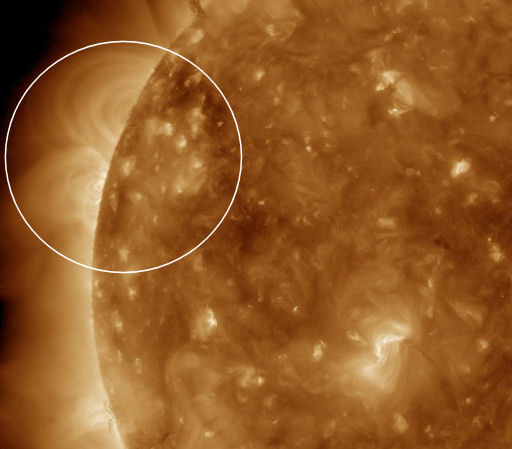
A better view is had by NASA's STEREO-B probe, stationed over the sun's eastern limb where it can see the region from top down. Recent movies beamed back by STEREO-B show flashes of extreme UV radiation and hints of magnetic instability. This could herald a period of renewed solar activity when the region turns toward Earth in the days ahead. Or the action could peter out beforehand. (SpaceWeather)
Current sun status:
X-ray Solar Flares
6-hr max: B4 1840 UT Feb23
24-hr: C1 1223 UT Feb23
Planetary K-index
Now: Kp= 0 quiet
24-hr max: Kp= 1 quiet
Interplanetary Mag. Field
Btotal: 4.1 nT
Bz: 0.6 nT north

Earlier reporting
Nothing on Watchers was published in the last 24 hours. These are older articles.
- On October 22, 2017, a single flash of lightning stretched 515 miles from eastern Texas to near Kansas City, a distance that takes eight hours to drive, and nobody realized how far it had gone until scientists went back through the satellite data years later Epicenter
- CPC posts a slight risk of heavy rain from the Gulf Coast to the Northeast urban corridor November 25-29, and a moderate risk of West Coast wind and Sierra snow on November 25
- Florida's east coast faces a moderate flash flood risk Wednesday through Friday, with 4 to 8 inches of rain forecast and the St. Johns River near Cocoa already in major flood at 17.13 feet
- Cyclone Akvan to make landfall between Nellore and Visakhapatnam around noon on November 20, IMD forecasts 120-130 km/h winds gusting to 145
