
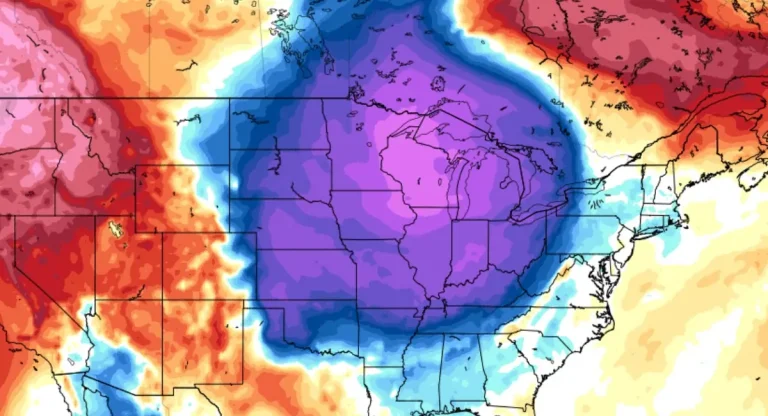
• Cross-polar flow and weak polar vortex drive early-season cold anomaly across North America

    A strong early September cold air intrusion is forecast to affect much of the central and eastern United States from September 3 to 7, 2025, with daytime highs of 15–20°C (59–68°F) and overnight lows of 7–9°C (44–48°F) across the Midwest and Great Lakes, up to 10°C (18°F) below average for this time of year. This development also marks a rapid seasonal transition. 

  • Weak La Niña and disrupted vortex forecast to bring colder 2025/26 winter to northern U.S., southern Canada, and parts of Europe

    A weak La Niña and signs of a disrupted polar vortex are forecast to shape colder-than-average winter conditions across the northern United States, southern Canada, and parts of Europe during the 2025/26 season. Early seasonal outlooks suggest a higher likelihood of Arctic air intrusions and persistent cold anomalies from December 2025 through February 2026.

  • Polar vortex collapse to influence spring weather across U.S. and Canada

    Large-scale pressure changes following a strong sudden stratospheric warming event in mid-March 2025, which caused the collapse of the polar vortex, are expected to drive spring weather patterns across Canada and the United States into May. Northerly winds are expected to bring colder air into parts of North America, while high-pressure zones may lead to warmer conditions in the central U.S. and southern Canada. The shifts in weather patterns are consistent with the typical effects observed following a polar vortex disruption, where the jet stream becomes more erratic, leading to unusual temperature distributions and weather events.

  • Final polar vortex collapse of the season begins

    The final polar vortex collapse of the 2024–25 winter season has begun with one of the strongest sudden stratospheric warming (SSW) events being forecast to develop and bring late-season cold to much of the U.S.

  • Weakest polar vortex for October in 40 years could affect winter weather across North America and Europe

    The polar vortex forming over the Northern Hemisphere in 2024 is at its weakest point for early October in the last 40 years, with potential consequences for winter weather patterns across North America and Europe. The vortex’s unusual behavior this season could lead to significant disruptions in cold outbreaks in parts of the eastern United States, Canada, and Europe.
