
Loudest gravitational-wave signal yet opens first direct window onto a black hole’s event horizon
Scientists have used the loudest gravitational-wave signal ever recorded to extract the first observational evidence of signatures from a newly formed black hole’s event horizon, opening a new way to probe one of the most extreme environments in the universe where general relativity and quantum physics are expected to meet. The findings, published in Nature on June 24, 2026, are based on GW250114, the strongest binary black hole merger detected to date.
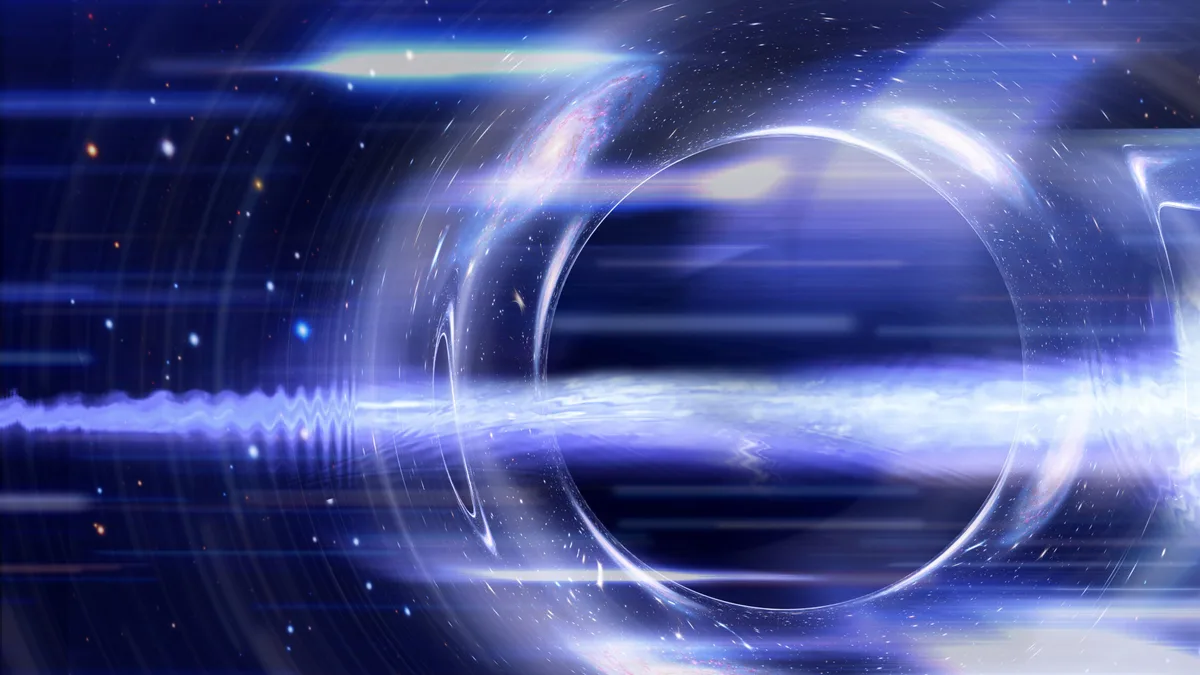
Credit: Carl Knox, OzGrav, Swinburne University of Technology Astrophotography: Blake Estes and Christian Sasse, iTelescope
By isolating a previously predicted component of the post-merger signal known as a direct wave, the researchers measured two fundamental properties of the remnant black hole, its rotation frequency and surface gravity, from the region immediately surrounding the event horizon.
The study was led by Dr Ling (Lilli) Sun and PhD candidate Neil Lu of the ARC Centre of Excellence for Gravitational Wave Discovery (OzGrav) and the Australian National University, together with collaborators in Canada, the United States and Spain.
An event horizon marks the point where the escape speed equals the speed of light. Because nothing in the universe travels faster than light, anything crossing that boundary becomes permanently trapped. Although black holes cannot be observed directly, the violent merger that forms one produces gravitational waves carrying information about the extreme gravity surrounding the newly formed object.
GW250114 was recorded by the two Laser Interferometer Gravitational-Wave Observatory (LIGO) detectors in the United States. According to the researchers, the signal was about three times stronger than GW150914, the first gravitational-wave detection announced a decade ago, allowing them to identify a faint feature known as a direct wave.
“We measured the last sound the black holes made when they crashed,” Neil Lu said. “Hidden within that signal is a small component, called direct waves, that had not previously been well understood. Our new analysis allows us to decipher this component and extract unique information from close to the event horizon.”
The direct wave was predicted to preserve information about the newly formed black hole immediately after the merger. The team’s measurements agree with theoretical predictions, providing the first observational evidence that this previously elusive signal can be isolated from gravitational-wave data.
Black holes also distort the surrounding fabric of spacetime through an effect known as frame dragging. As they rotate, they drag spacetime with them, creating a region near the event horizon where nothing can remain stationary relative to a distant observer. The researchers say the new analytical technique makes it possible to study this extreme environment directly using gravitational-wave observations.
“We studied GW250114, the loudest binary black hole signal observed to date, about three times louder than the first gravitational-wave signal detected a decade ago,” Dr Sun said. “Our analysis shows that this exceptionally loud signal can be used as a powerful probe of the remnant black hole’s horizon, allowing us to measure its two fundamental properties, rotation frequency and surface gravity.”
“These measurements mark a first step towards future tests of general relativity with direct waves,” Lu added.
The researchers say the technique provides a new observational window onto the region closest to a black hole’s event horizon, where general relativity and quantum physics intersect. As gravitational-wave observatories become more sensitive, future detections could allow increasingly detailed tests of gravity under some of the most extreme conditions known in the universe.
References:
1 Scientists Find a Way to Study the Event Horizon Where Light & Sound Are Swallowed for Eternity – Ozgrav – June 25, 2026
2 GW250114 reveals signatures of post-merger black-hole horizon – Lu, N., Ma, S., Piccinni, O.J. et al. – Nature – June 24, 2026 – https://doi.org/10.1038/s41586-026-10696-0

I’m a science journalist and researcher at The Watchers, contributing to the Epicenter edition, where I cover peer-reviewed scientific research and emerging discoveries across Earth and space sciences. With a background in astronomy and a passion for environmental science, I’ve worked in shark and coral conservation in Fiji, conducting reef and shark-behavior research, contributing to mangrove restoration, and earning PADI Open Water and Coral Reef Certifications. I bring a blend of scientific rigor and storytelling to illuminate the discoveries shaping our planet and beyond.

Commenting rules and guidelines
We value the thoughts and opinions of our readers and welcome healthy discussions on our website. In order to maintain a respectful and positive community, we ask that all commenters follow these rules.