
Ancient tectonic plates are driving motion deep along Earth’s core
Scientists have produced the most detailed picture yet of the layer 2 900 km (1 800 miles) beneath Earth’s surface where the mantle meets the core. Using records from more than 5 300 earthquakes, they discovered that ancient tectonic plates sink to this depth, flatten against the core, and slowly spread sideways, driving flows in the planet’s deep interior.
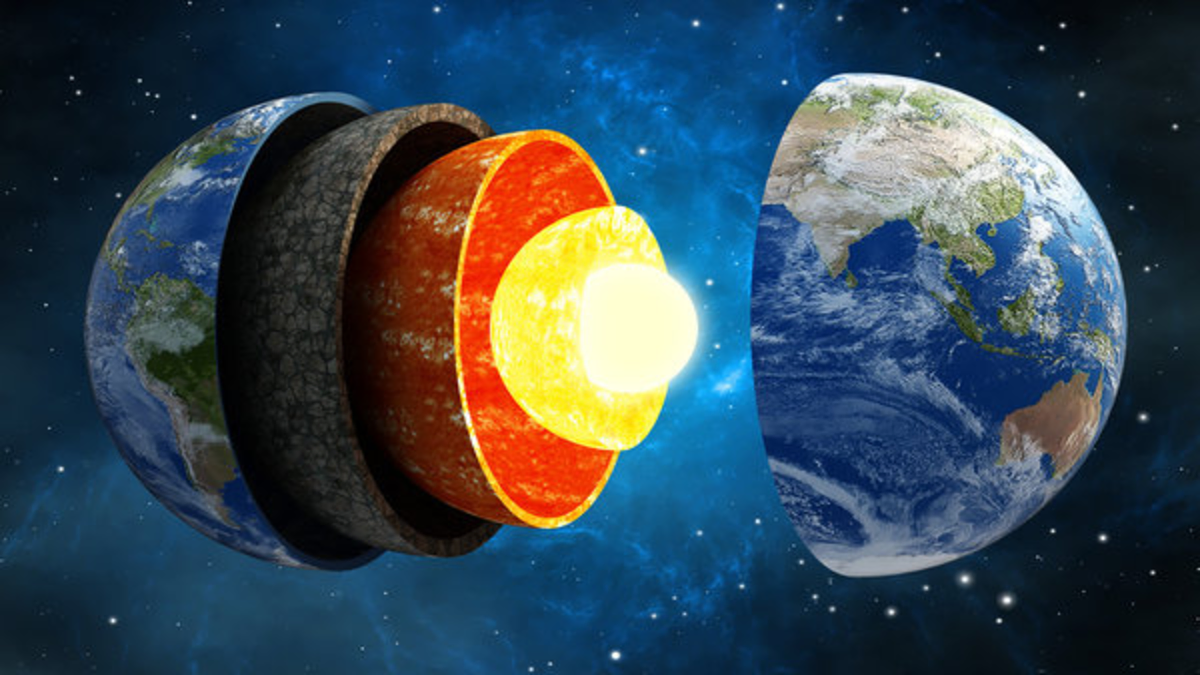
Image credit: Adobe Stock
At the base of the mantle lies a rugged interface known as the core–mantle boundary. It separates the solid silicate rock above from the molten iron and nickel outer core below.
For decades, seismologists imagined this boundary as a smooth sphere. New data reveal it as one of the most irregular places on Earth, sculpted by billions of years of sinking slabs and rising plumes.
The region is dominated by two vast structures called large low-shear-velocity provinces. These enormous hot masses rise more than 1 000 km (620 miles) above the boundary, one beneath Africa and another below the Pacific Ocean. Around their edges, smaller mountain-sized zones slow down seismic waves. Researchers believe these are the graveyards of ancient oceanic plates that sank through the mantle and came to rest on the core.
Each major earthquake sends shock waves through the planet. As these waves change speed and direction, they expose the composition and motion of deep rock layers. The signals that pass close to the core carry vital clues about the mantle’s internal circulation, but they are rare and difficult to measure because interference from the upper mantle distorts them.
By combining data from dozens of seismic networks around the world, researchers can trace how mineral crystals in the lowermost mantle align. When these crystals deform under immense pressure, they create seismic anisotropy—waves move faster in one direction than another. Detecting this pattern allows scientists to map the slow motion of solid rock nearly 3 000 km (1 860 miles) below ground.
Building the most complete map of the deep mantle
Jonathan Wolf and his colleagues at the University of California, Berkeley assembled seismic records from 5 300 major earthquakes dating back to 1995. Each event was strong enough to send waves across the globe. When stacked and compared, these signals produced a detailed image of how the lowermost mantle deforms and flows.
The map revealed zones where seismic waves change velocity, exposing regions of aligned minerals that trace mantle currents. In some places, the data contained 100 times more detail than earlier efforts. This unprecedented coverage now includes about three-quarters of the deep mantle, giving geophysicists their most complete view of the core–mantle boundary to date.
Wolf explained that many of the flow patterns occur near the edges of subducted slabs—ancient fragments of the ocean floor that once sank into the planet. These slabs appear to reach the core, flatten, and then move laterally, spreading cold material across the boundary. The study offers direct observational support for a mechanism long predicted by computer models but never clearly seen in global data.
Paul Tackley of ETH Zürich, who was not involved in the work, said the map finally provides a global test of geodynamic models. The detailed patterns of anisotropy confirm that the deepest mantle is not uniform but shaped by constant movement of solid rock, even at extreme depths where pressure exceeds 1.3 million atm (132 GPa).
Ancient plates feeding the planet’s interior engine
The accumulation of ancient slabs at the bottom of the mantle plays a vital role in Earth’s evolution. As these dense remnants cool the region around them, heat from the core escapes unevenly. The resulting temperature contrast drives slow convection: cold material spreads outward while nearby zones heat up and rise in towering plumes.
Some of these plumes reach the surface as persistent hot spots. Their origins are thought to lie deep at the core–mantle boundary, possibly anchored near the edges of the vast low-shear provinces. The lateral spreading of subducted slabs may reorganize these plumes over time, explaining why volcanic hot spots migrate across the surface.
This interaction links surface plate tectonics to processes occurring nearly halfway to the planet’s center. Each subducted plate carries surface material into the deep interior, where it mingles with ancient mantle and chemically distinct pockets. Over hundreds of millions of years, this cycle influences volcanism, continental growth, and the thermal evolution of the entire planet.
The new results strengthen the idea that the mantle operates as a connected system from crust to core. Far from being static, the boundary is alive with movement that redistributes heat and matter between Earth’s outer shell and its metallic heart.
Revealing hidden plumes beneath Asia and beyond
Among the regions highlighted in the new survey is the Perm Anomaly, a hot zone beneath Asia surrounded by upwelling rock. The pattern suggests it could be the root of an ancient mantle plume. Geological evidence links this deep structure to the colossal eruptions of the Siberian Traps about 252 million years ago, an event that triggered the Permian mass extinction.
The discovery supports the theory that many of Earth’s largest volcanic outpourings originate deep within the mantle rather than shallow crustal processes. If confirmed, it could explain how catastrophic eruptions recur in roughly the same regions over geologic time.
Elsewhere, the survey shows variations in flow near Africa and the Pacific, the two major low-velocity provinces. These zones may channel hot material upward toward the surface, feeding modern hot spots such as Hawaii and Yellowstone. The new data indicate that both rising and sinking motions coexist along the boundary, weaving a complex global circulation system.
Wolf and his colleagues plan to integrate additional seismic phases and more stations, especially in the southern hemisphere, to close remaining data gaps. Improved coverage could reveal whether these deep currents change through time or remain stable for hundreds of millions of years.
Why the discovery matters for Earth’s future
The core–mantle boundary regulates how heat escapes from the core, influencing mantle convection and possibly the magnetic field that shields the planet from solar radiation. Understanding its structure helps scientists predict how Earth’s internal engine will evolve as the core cools.
Anisotropy acts like a memory of motion: once the rocks are deformed, their aligned crystals preserve the direction of past flows. By reading these patterns, seismologists can reconstruct the hidden circulation of the mantle and test computer models of plate motion and plume generation. Each new layer of data brings us closer to a coherent picture of how deep processes shape surface geology.
Although the results rely on indirect measurements, their consistency across thousands of earthquakes makes the conclusions robust. For the first time, scientists can trace the pathways of ancient slabs from their descent at subduction zones to their slow drift along the core.
This work marks a major step toward connecting Earth’s surface activity with its deepest interior dynamics. It transforms our understanding of the mantle not as a passive layer, but as a restless medium linking the planet’s crust and core.
References:
1 Ancient tectonic plates are oozing along Earth’s core – Science – December 17, 2025

I’m a science journalist and researcher at The Watchers, contributing to the Epicenter edition, where I cover peer-reviewed scientific research and emerging discoveries across Earth and space sciences. With a background in astronomy and a passion for environmental science, I’ve worked in shark and coral conservation in Fiji, conducting reef and shark-behavior research, contributing to mangrove restoration, and earning PADI Open Water and Coral Reef Certifications. I bring a blend of scientific rigor and storytelling to illuminate the discoveries shaping our planet and beyond.

Commenting rules and guidelines
We value the thoughts and opinions of our readers and welcome healthy discussions on our website. In order to maintain a respectful and positive community, we ask that all commenters follow these rules.