
AI emulator reproduces global storm-resolving atmosphere with about 50 times greater energy efficiency
Researchers have developed an AI emulator that reproduced global storm-resolving atmospheric behavior at kilometer scale while using about 50 times less energy per simulated day than the physics-based model it was trained to emulate. STRATA produced stable 24-hour global simulations and reached 741 simulated days per wall-clock day on 512 NVIDIA H100 GPUs, although growing large-scale circulation errors still limit longer integrations.
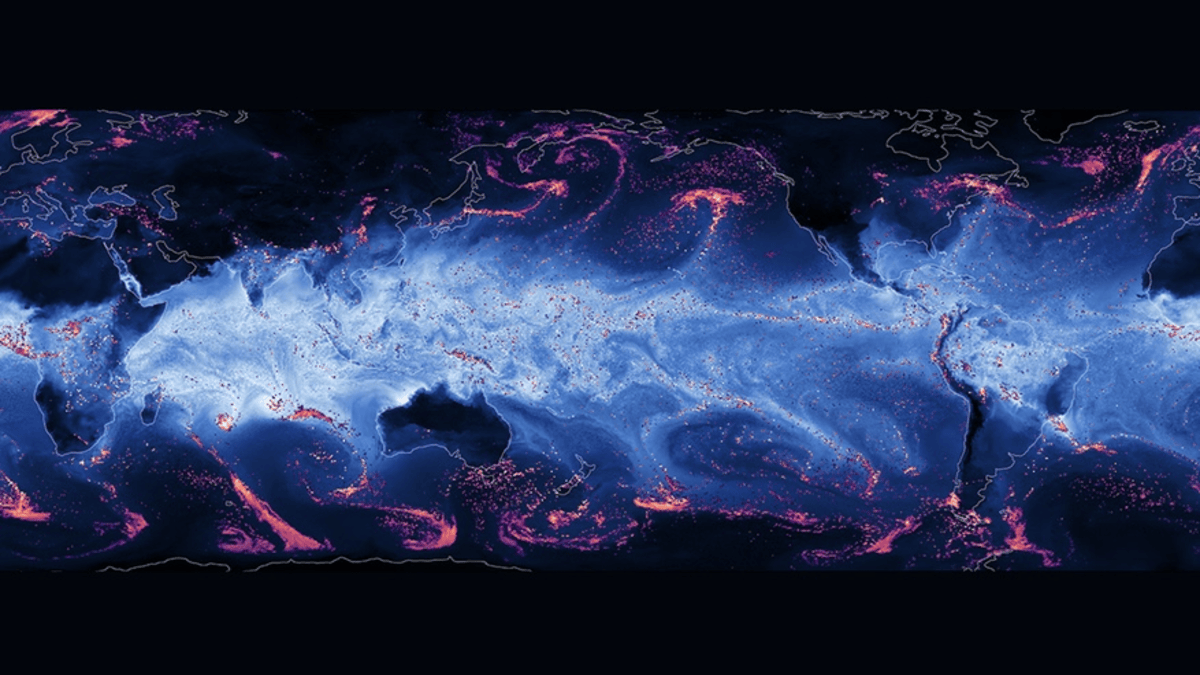
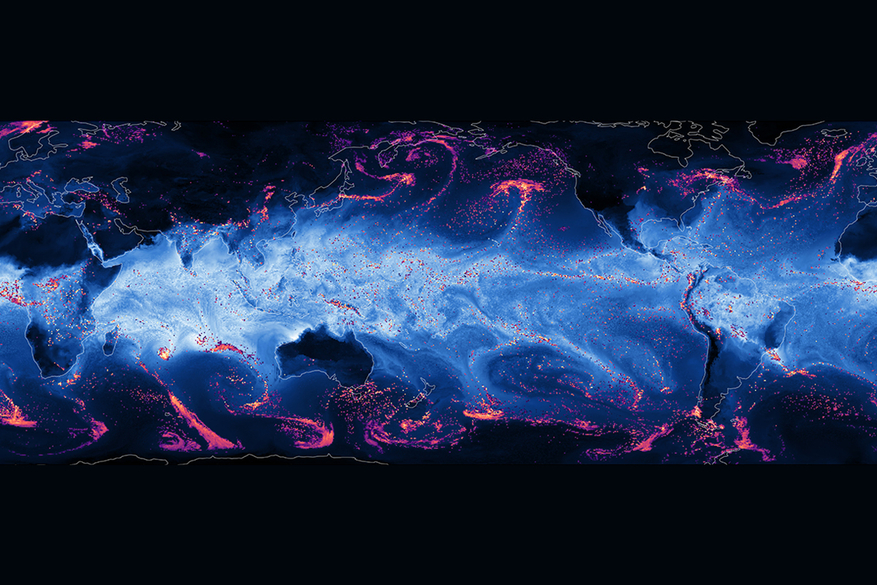
Global STRATA atmospheric simulation showing increased rain intensity in pink and yellow and higher humidity in lighter blue. Credit: Peter Caldwell / Lawrence Livermore National Laboratory
Global storm-resolving atmosphere models can represent convective systems, cloud structures, and precipitation patterns that coarser global models must approximate, but that detail comes at a high computational cost.
The Simple Cloud-Resolving E3SM Atmosphere Model (SCREAM) resolves atmospheric behavior at kilometer scale by repeatedly solving the physical equations governing the atmosphere, making high-resolution global simulation possible while limiting how many independent simulations researchers can afford to run.
STRATA approaches the same problem differently. Instead of solving the governing equations during every simulated time step, the machine-learning system learns how atmospheric states evolve in SCREAM output and uses one atmospheric state to calculate the next. Hu et al. (2026) report that the emulator produced stable 24-hour global simulations while retaining kilometer-scale atmospheric structure across several types of weather and cloud regimes.
The difference in computational cost was substantial. STRATA achieved about 48 simulated days per MWh, approximately 50 times the energy efficiency reported for SCREAM in the study. When distributed across 512 NVIDIA H100 GPUs, it reached 741 simulated days per wall-clock day. Faster execution makes it possible to run much larger ensembles of high-resolution simulations within the same computing budget, an important requirement when researchers need many model runs to examine a range of possible atmospheric outcomes.
The researchers trained STRATA on 17 days of SCREAM output stored on a 4.9 km (3.0 miles) global grid containing about 25 million horizontal cells, with atmospheric states recorded every 10 minutes. Many conventional global atmospheric models operate at roughly 25 to 100 km (16 to 62 miles) resolution, where convective processes occur below the grid scale and must be represented through parameterizations. Kilometer-scale simulations preserve much more of the spatial structure associated with convection, precipitation and clouds, but they also contain substantially more information for an emulator to learn.
STRATA makes the training problem manageable by dividing the atmosphere into smaller spatial tiles. Atmospheric evolution over a 10-minute interval is strongly controlled by nearby conditions, allowing the researchers to turn a relatively short global simulation into many local training examples. During a global simulation, overlapping tiles are calculated separately and then blended to reconstruct the atmospheric state.
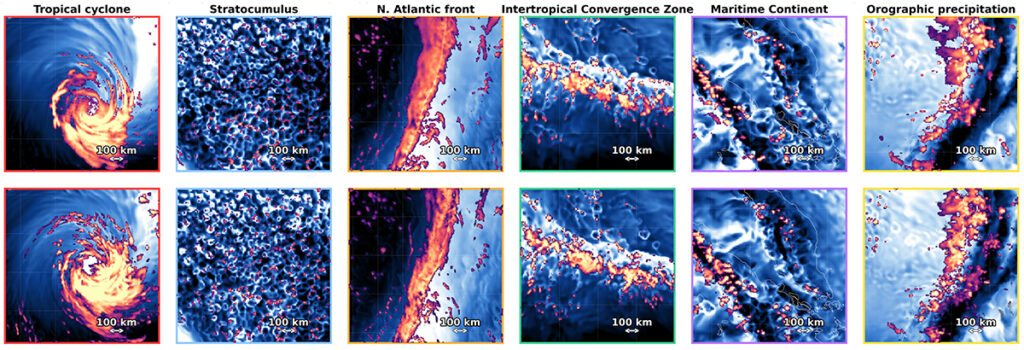
The researchers tested whether the emulator could preserve small-scale atmospheric behavior rather than only reproduce broad global patterns. The study examined a tropical cyclone, stratocumulus clouds, a North Atlantic front, the Intertropical Convergence Zone, Maritime Continent convection, and orographic precipitation. Comparisons between STRATA and SCREAM showed broad agreement across those regimes during the tested simulations.
Kilometer-scale emulation proved more computationally demanding per grid point than coarse-resolution AI weather modeling. An equal-compute scaling analysis found that successful kilometer-scale emulation required about 10 times more floating-point operations per grid point than a simple extrapolation from coarse-resolution autoregressive weather models would predict. The authors relate the difference to the greater information content of three-dimensional convective-scale atmospheric dynamics.
STRATA reproduced local and convective-scale behavior better than large-scale atmospheric circulation. Those large-scale biases increased as the simulation progressed. Hu et al. identified coupling the local tile-based emulator with a lower-resolution global emulator as one possible way to control large-scale drift while preserving kilometer-scale detail.
STRATA was evaluated mainly on how well it reproduced SCREAM rather than as an operational weather forecast system verified directly against observations.
While the study establishes rapid kilometer-scale atmospheric emulation over the tested 24-hour period, it does not establish that STRATA produces more accurate operational forecasts than existing numerical weather-prediction systems.
Lawrence Livermore National Laboratory (LLNL) said faster emulators are useful because atmospheric prediction often requires ensembles rather than single simulations.
LLNL scientist Peter Caldwell said researchers may need hundreds of simulations to build confidence in the range of possible outcomes. Running such ensembles with high-resolution physics models can sharply increase computing requirements.
LLNL is developing STRATA alongside other machine-learning efforts aimed at separate Earth-system modeling bottlenecks. The Marine Assimilation with Generative Graphs in E3SM (MAGGIE) project is intended to generate consistent initial conditions for predictive simulations, while the Scalable Twin for Intelligent Turbulence and Cloud Heuristics (STITCH) project focuses on cloud microphysics and small-scale turbulence.
The immediate research problem is extending the efficiency gain without losing control of the atmosphere’s larger-scale evolution. STRATA shows that local, kilometer-scale atmospheric behavior can be emulated globally for the tested 24-hour interval, but longer integrations will require a way to prevent circulation errors from accumulating.
Whether a coupled system can preserve storm-scale detail while maintaining the large-scale atmospheric state remains one of the main unanswered questions.
References:
1 Hu, Z., Subramaniam, A., Keen, N., Ge, T., Pathak, J., Abbas, M. S., Ravuri, S., Kashinath, K., Mahfouz, N., Caldwell, P., Pritchard, M., & Brenowitz, N. (2026). Scaling storm-resolving atmospheric AI simulation to the entire planet. Accepted at NeurIPS 2026 Main Track; manuscript available via arXiv. DOI: 10.48550/arXiv.2606.31248
2 LLNL researchers emulate the Earth’s atmosphere for faster and more accurate weather predictions – Lawrence Livermore National Laboratory – November 4, 2026

I’m a science journalist and researcher at The Watchers, contributing to the Epicenter edition, where I cover peer-reviewed scientific research and emerging discoveries across Earth and space sciences. With a background in astronomy and a passion for environmental science, I’ve worked in shark and coral conservation in Fiji, conducting reef and shark-behavior research, contributing to mangrove restoration, and earning PADI Open Water and Coral Reef Certifications. I bring a blend of scientific rigor and storytelling to illuminate the discoveries shaping our planet and beyond.
