
September 28 CME expected to deliver glancing blow to Earth on October 2, geomagnetic storm forecast
NOAA’s Space Weather Prediction Center (SWPC) issued a G1 – Minor geomagnetic storm watch for October 2, 2026, following a large filament eruption and associated coronal mass ejection (CME) on September 28. SWPC expects glancing effects from the CME, while NASA models place its arrival near the start of October 2 with an uncertainty of several hours.
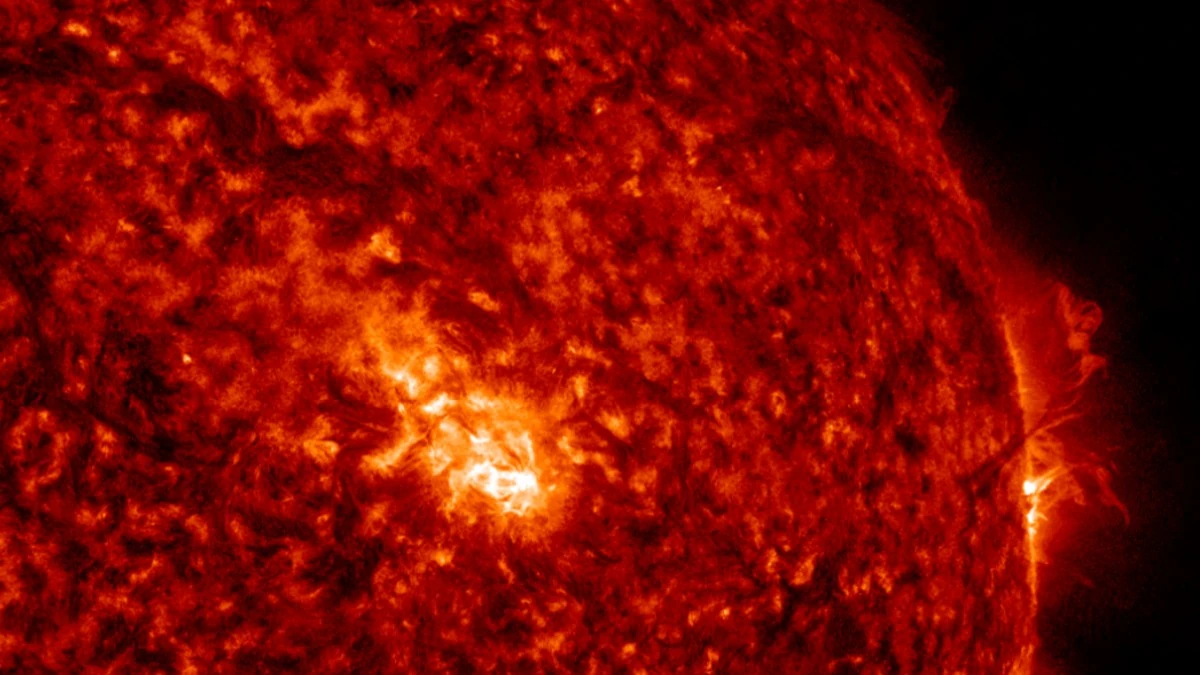
Filament eruption at 13:50 UTC on September 28, 2026. Credit: NASA SDO/AIA 304, Helioviewer, The Watchers
SWPC issued the watch at 13:01 UTC on September 29, forecasting no storm-level geomagnetic activity on September 30 or October 1 and G1 conditions on October 2.
In its three-day forecast issued at 00:30 UTC on September 30, SWPC said G1 – Minor storming was likely on October 2 due to glancing effects from the CME. It placed he highest forecast three-hour Kp at 4.67, equivalent to Kp 5− (G1 – Minor geomagnetic storm) during 15:00–18:00 UTC. The greatest observed three-hour Kp during the preceding 24 hours was 2, below NOAA Space Weather Scale levels.
NASA’s Community Coordinated Modeling Center (CCMC) said a large solar filament extending approximately from S10W50 to N45W50 began lifting off at about 13:51 UTC on September 28. The associated CME was first observed west of the Sun in imagery from the Solar and Heliospheric Observatory’s Large Angle and Spectrometric Coronagraph C2 at 14:36 UTC.
The Solar Influences Data Analysis Center at the Royal Observatory of Belgium independently described the event as a partial-halo CME with an angular width of about 200° and estimated speed near 500 km/s (311 miles/s). It said most of the material was directed westward, making a glancing encounter with Earth the expected scenario on October 2.
A deterministic NASA WSA-ENLIL+Cone model run predicted shock arrival near Earth at approximately 03:15 UTC on October 2, with an uncertainty of ±7 hours. That solution placed the possible maximum geomagnetic response between Kp 3 and Kp 5.
NASA’s 27-member ensemble produced an average modeled arrival of 00:05 UTC on October 2. The CME’s leading edge reached missions near Earth between 16:25 UTC on October 1 and 06:42 UTC on October 2 in 96% of the simulations, while the ensemble assigned a 95% chance that maximum Kp would remain between 2 and 4, below the G1 threshold.
G1 – Minor is the lowest category on NOAA’s five-level geomagnetic storm scale and corresponds to Kp 5. Weak power-grid fluctuations can occur, minor effects on satellite operations are possible, and aurora may become visible at high latitudes, including parts of the northern U.S. tier such as northern Michigan and Maine.
References:
1 Three-Day Forecast – NOAA/SWPC – September 30, 2026
2 Prediction for CME 2026-09-28T14:36:00-CME-001 – NASA/CCMC – September 28, 2026

Rishav Kothari is Editor-in-Chief of The Watchers, where he runs the newsroom and covers earthquakes, volcanoes, severe weather and space weather.
Published in the last 24 hours
- CPC posts a slight risk of heavy rain from the Gulf Coast to the Northeast urban corridor November 25-29, and a moderate risk of West Coast wind and Sierra snow on November 25
- Florida's east coast faces a moderate flash flood risk Wednesday through Friday, with 4 to 8 inches of rain forecast and the St. Johns River near Cocoa already in major flood at 17.13 feet
- Cyclone Akvan to make landfall between Nellore and Visakhapatnam around noon on November 20, IMD forecasts 120-130 km/h winds gusting to 145
- Radio pulses every 7.9 minutes reveal binary with white dwarf and Sun-like star Epicenter
