
Major to Extreme HeatRisk forecast across the South as dangerous heat expands into next week
Major to Extreme HeatRisk is forecast across large portions of the Southern Plains and Southeast on June 27–28, 2026, as hot and humid conditions expand across the southern United States. The dangerous heat is expected to persist into the week of June 29 across much of the Plains and Southeast while expanding into parts of the Mid-Atlantic.
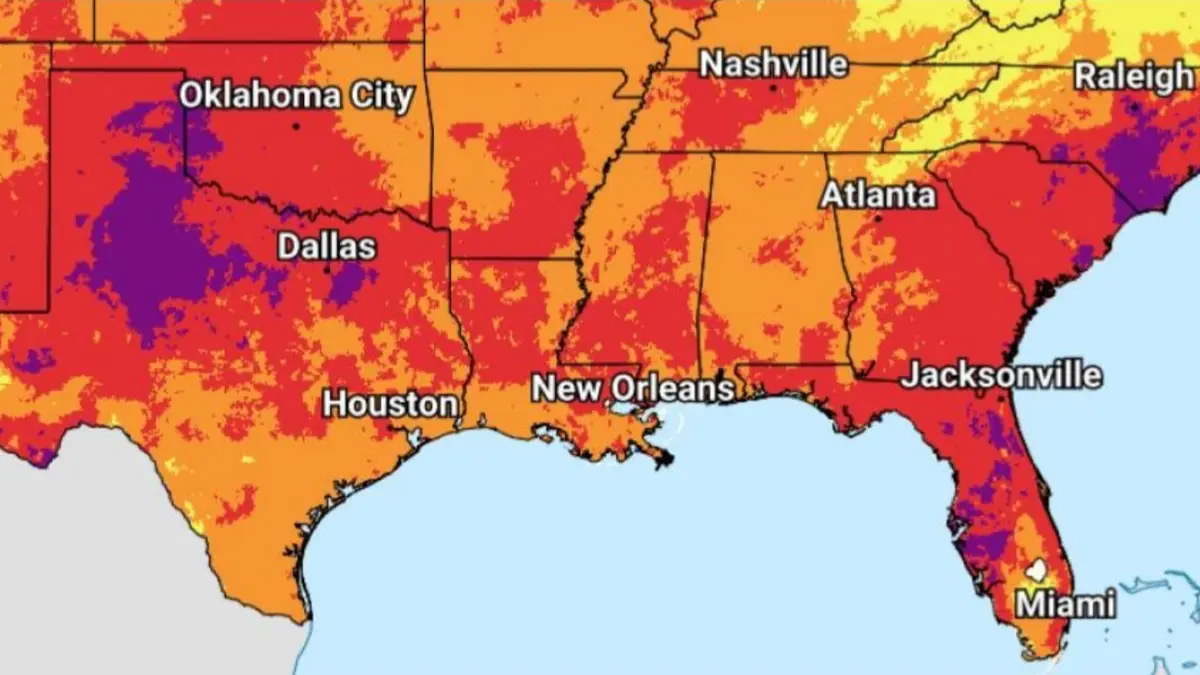
Hot and humid conditions are expected to expand across the southern U.S. beginning this weekend. Credit: NWS
Temperatures are forecast to climb into the mid-30s °C (90s °F) across much of the region this weekend, with temperatures exceeding 37.8°C (100°F) across northern Texas, particularly the Texas Panhandle. The highest HeatRisk levels are expected across northern Texas, including the Dallas area, where Extreme HeatRisk is forecast.
Extreme HeatRisk is also forecast from Tampa to Jacksonville in Florida and across portions of eastern North Carolina.
A broader area of Major HeatRisk is expected to stretch across much of the Southeast and Southern Plains, affecting major population centers including Oklahoma City, Houston, New Orleans, Nashville, Atlanta, Raleigh, Jacksonville, and Miami.
Much of the broader South is expected to see at least Minor to Moderate HeatRisk. The combination of heat and humidity will expand across a large portion of the southern United States, increasing heat exposure for millions of residents heading into the final weekend of June.
The Weather Prediction Center (WPC) said the risk of extreme heat will continue into next week across much of the Plains and Southeast while expanding farther northeast into parts of the Mid-Atlantic. The forecast highlights a prolonged period of elevated heat exposure rather than a short-lived weekend event.
NWS advises residents to stay hydrated, limit outdoor activities during the hottest part of the day, seek air-conditioned environments when possible, and monitor vulnerable individuals, including older adults, children, and those with chronic medical conditions.
Major (Level 3) HeatRisk indicates conditions that can affect anyone without effective cooling or hydration, while Extreme (Level 4) HeatRisk represents rare and prolonged dangerous heat capable of affecting even healthy individuals.

I’m a science journalist and researcher at The Watchers, contributing to the Epicenter edition, where I cover peer-reviewed scientific research and emerging discoveries across Earth and space sciences. With a background in astronomy and a passion for environmental science, I’ve worked in shark and coral conservation in Fiji, conducting reef and shark-behavior research, contributing to mangrove restoration, and earning PADI Open Water and Coral Reef Certifications. I bring a blend of scientific rigor and storytelling to illuminate the discoveries shaping our planet and beyond.

Commenting rules and guidelines
We value the thoughts and opinions of our readers and welcome healthy discussions on our website. In order to maintain a respectful and positive community, we ask that all commenters follow these rules.