
Seismic unrest and sulfur dioxide emissions increase eruption likelihood at Alaska’s Atka volcanic complex
A burst of seismic activity detected late March 14, 2026, local time at the Atka volcanic complex in Alaska’s central Aleutian Islands has increased the likelihood of explosive volcanic activity, most likely at Korovin volcano. The Volcano Alert Level was raised to Advisory and the Aviation Color Code to Yellow.
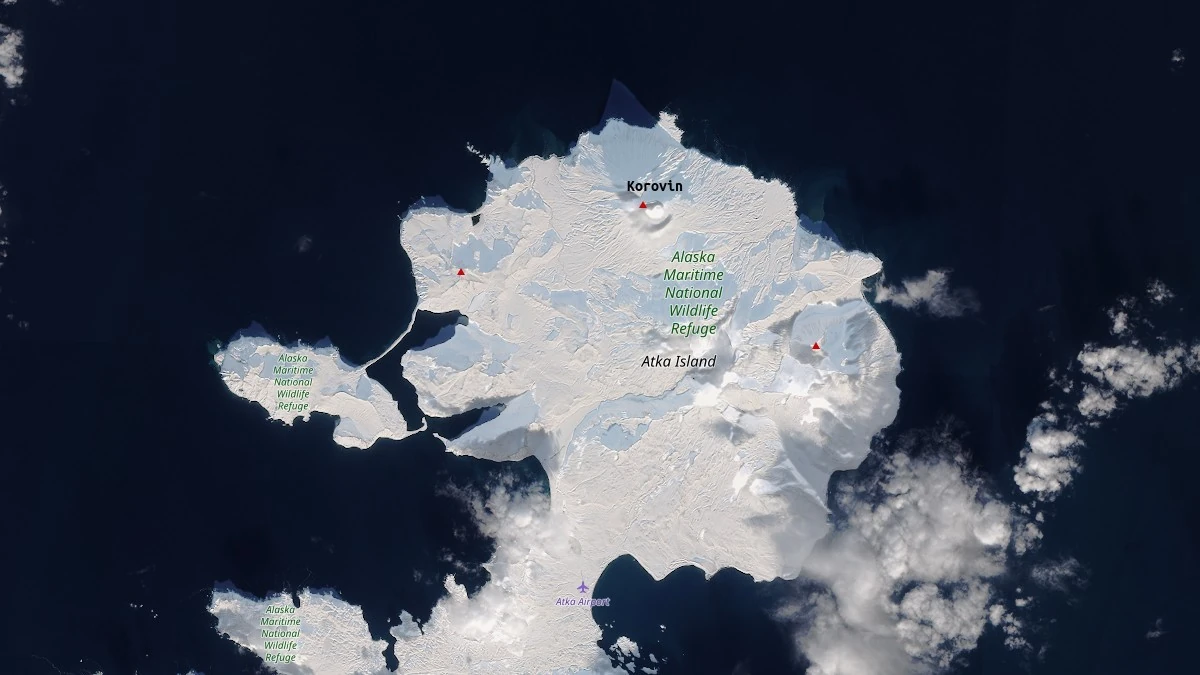
Satellite image of Korovin volcano, Atka Island, Alaska on January 17, 2026. Credit: CopernicusEU/Sentinel-2, The Watchers
A substantial increase in seismic activity was detected at the Atka volcanic complex in Alaska’s Aleutian Islands between 00:20 and 00:30 UTC on March 15, prompting the Alaska Volcano Observatory (AVO) to raise the Volcano Alert Level to Advisory and the Aviation Color Code to Yellow.
AVO reported an increase in small earthquakes accompanied by weak volcanic tremor during the brief period of intensified activity. Monitoring data collected over the previous week had already indicated elevated unrest, including small earthquakes and weak tremor beneath the volcanic complex.
Satellite observations also detected elevated levels of sulfur dioxide (SO2) gas above the volcanic complex. According to AVO, the detection of sulfur dioxide in satellite data is consistent with increased volcanic gas emissions associated with unrest.
Scientists at AVO assess that any near-term eruptive activity would most likely originate from the Korovin volcano, the historically most active vent within the Atka volcanic complex.
The Atka volcanic complex forms the northern portion of Atka Island in Alaska’s central Aleutian arc and lies about 16 km (10 miles) north of the community of Atka and approximately 1 761 km (1 094 miles) southwest of Anchorage. The volcanic system consists of several vents built within or near an older caldera structure, including Korovin volcano, Mount Kliuchef, and Sarichef volcano.
Korovin volcano rises to 1 533 m (5 030 feet) above sea level and has been responsible for most documented eruptions within the complex. Its summit crater contains a small, roiling crater lake that periodically produces energetic steam emissions.
Historical eruptions at Korovin occurred in 1973, 1987, and 1998. The 1998 eruption generated ash plumes reported as high as 10 600 m (35 000 feet) above sea level. Minor ash emissions are also thought to have occurred as recently as 2005.
Typical eruptions from Korovin involve short-lived explosive activity producing limited ash emissions and occasionally small lava flows. These eruptions can pose hazards primarily to aviation if ash clouds are injected into flight levels over the Aleutian region.
Mount Kliuchef, another volcano within the complex, consists of a series of vents aligned along a northeast–southwest trend. The easternmost vent may have been the source of an eruption in 1812 that is sometimes attributed to the Sarichef volcano.
AVO noted that a previous notice mistakenly raised the Aviation Color Code to Orange and the Volcano Alert Level to Watch. The current notice corrects that error and confirms that the appropriate status for the ongoing unrest is Yellow for aviation and Advisory for ground-based volcanic alert level.
AVO continues to monitor the Atka volcanic complex using seismic networks, satellite observations, and other remote sensing methods to detect further changes in volcanic activity.
References:
1 Volcano Activity Notice for Atka volcanic complex – USGS/AVO – Issued at 00:36 UTC on March 15, 2026

I'm a dedicated researcher, journalist, and editor at The Watchers. With over 20 years of experience in the media industry, I specialize in hard science news, focusing on extreme weather, seismic and volcanic activity, space weather, and astronomy, including near-Earth objects and planetary defense strategies. You can reach me at teo /at/ watchers.news.

Commenting rules and guidelines
We value the thoughts and opinions of our readers and welcome healthy discussions on our website. In order to maintain a respectful and positive community, we ask that all commenters follow these rules.